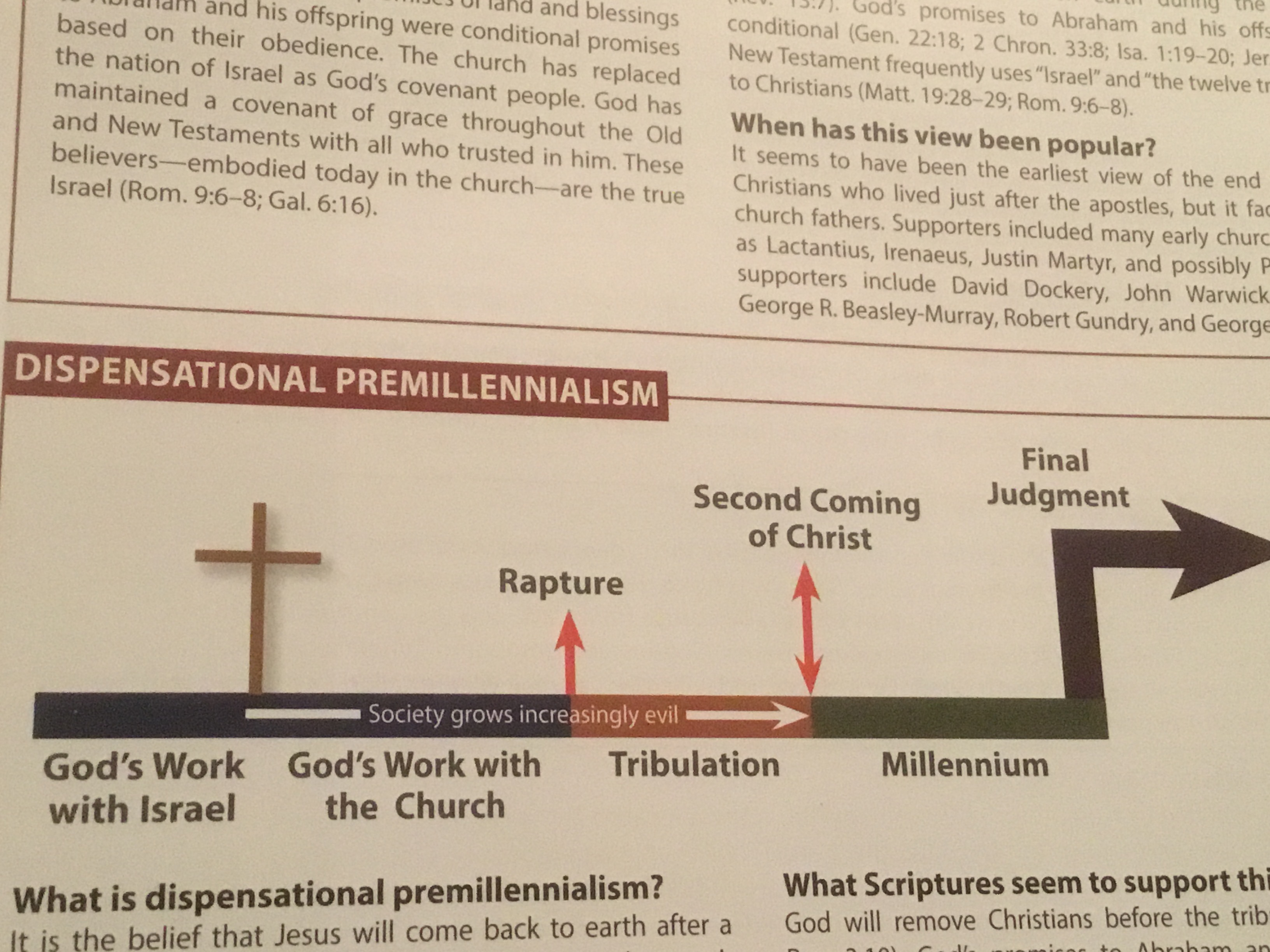
Most who hold to this view are pre-tribulationiats; believing Revelation 4:1-2 to describe the rapture of the church before the tribulation period begins. The rapture and the second coming of Christ are believed to be two separate events. As opposed to others who hold that the church will be raptured during the tribulation; known as “ mid-tribulationists.” It is believed that Jesus Christ will return to earth after the seven-year tribulation to rule and reign on earth for a thousand years( millennium) of peace. God will still honor his covenant with Israel; giving them the land promised to them in Genesis 15:8.
Does Scripture Support This View?
“God will remove Christians before the tribulation (1 Thess. 5:9; Rev. 3:10). God’s promises to Israel were unconditional (Gen. 15:7-21). The church is not specifically mentioned between Revelation 4 and 19.
when and by whom was this view popularized? This view emerged in the 1800s among the Plymouth Brethren. It increased in popularity in the 1800s and remains widespread today. Supporters include J. Nelson Darby, C.I. Scofield, Hary A. Ironside, Gleason Archer, Donald G. Barnhouse, Hal Lindsey, Chuck Smith, John MacArthur, Charles Ryrie, Charles Stanley, Norman L. Geisler, and Tim LaHaye.”(Rose Book of Bible Charts, Maps, & Timelines, p. 166)
God has not revealed the time of Christ’s return. Therefore, the setting of dates is fruitless and unbiblical speculation. Revelation speaks of “a thousand years” that Satan will be bound and some of God’s people will come to life and reign with him.
Christians have interpreted the millennium in different ways, but what is clear from scripture is that all humanity will acknowledge that Jesus is Lord over all creation. After this present age Christ will judge the whole world once and for all. At this time the righteous wrath of God will be unleashed on a rebellious world.
Unbelievers will be judged, and punished; those who refuse Gods grace and forgiveness in Christ will suffer eternal punishment in hell. However, in this age the church is called to warn people everywhere to repent and flee from the wrath to come when Christ returns as judge. Believers and unbelievers alike will be judged by Christ. God seeks to motivate his people to holiness by the rewards they will receive, and ultimately Christians can only stand before God because of Christ’s completed work on the cross. Our justification is only the perfect righteousness imputed to us who have faith in Jesus Christ. Believers are shielded from sins penalty because of his righteousness, and not our own false security of self-righteousness. Those who trust in Christ for their salvation have no fear of final judgment.
The New Heavens and New Earth
John’s revelation gives a powerful glimpse of the end of all things. Then I saw a new heaven and a new earth for the first heaven, and the first Earth had passed away. And the sea was no more and I saw the holy city, Jerusalem, coming down out of heaven from God, prepared as a bride adored for her husband. The entire world that was subject to futility and decay in the fall will be free from bondage when God makes everything new.”(ESV Study Bible, Crossway p. 2533)
”In 1 Thessalonians 4:16-17 Paul teaches that Christ’s coming will take the form of a descent from the sky, heralded by a trumpet fanfare, a shout, and the voice of the archangel. Those who died in Christ will already have been raised and will be with him, and all Christians on earth will be “raptured” (i.e., caught up among the clouds to meet Christ in the air) so that they may at once return to earth with him as part of his triumphant escort. The idea that the rapture takes them out of this world for a period before Christ appears a third time for a second “second coming” has been widely held but lacks scriptural support.”(Concise Theology: a guide to historic Christian beliefs, J.I. Packer)
while dispensational Premillinialism has increased in popularity today, I would like to propose a view of eschatology held by Martin Luther and John Calvin: Amillennialism. Saint Augustine was probably the first to teach this View. In his magnum opus, “the City of God”, he makes illusions to this view of end times.
Amillenialism is the belief that the millennium is the spiritual reign of Jesus in the hearts of his followers. The first resurrection in Revelation 20 is not physical, but spiritual; a spiritual resurrection (regeneration). Christ triumphs over Satan through his death and resurrection restrained the power of Satan on earth ( Rev. 20:1-3). The (tribulation) persecution of Christians will occur until Christ’s return, and the (millennium) expansion of God’s kingdom will both continue during the Church age. When Jesus returns, he will defeat the powers of evil, and resurrect the saved and unsaved for the general judgment and deliver them to their eternal destiny. Most references to “Israel” in Revelation are a symbolic reference to the people of God on earth.
”The Bible frequently uses the number 1,000 figuratively (Psalm 50:10; 90:4; 105:8, 2 Peter 3:8). The first resurrection could refer to the spiritual resurrection of those who trust Christ (Rev. 20:4; Romans 11:13-15; Eph. 2:1-4). The second coming of Christ and the resurrection of the saved and the unsaved will occur at the same time (Dan. 12:2-3; John 5:28-29). The Saints are on earth during the tribulation (Rev. 13:7).”(Rose Book of Bible Charts, Maps & Time Lines, p. 167)
The book of the Apocalypse is one of the most complex books in the Bible where numerous literary genres converge. The actual medium is visionary or apocalyptic writing. The most important thing to know about the literary form of the book of Revelation is that it uses the technique of symbolism throughout. There are four separate schools of interpretation: 1.) Historicism which understands the literary order of the visions(vs. 4:1-20:6) to symbolize the chronology of church history from apostolic times to the return of Christ and the new heaven and earth. 2.) Futurism, also treats the visions as a historic view of events. Chapters 4-22 are yet future, thus they believe in these coming events a literal 7 year period of great tribulation (ch. 6-9). This will be followed by a millennium (20:1-6)when Christ will rule on earth before the general resurrection and the new heaven and earth(20:7-22:5). 3.) Preterism, meaning “the thing that is past,”believes that most of Revelation’s visions were all ready fulfilled in the distant past, at the time of the early Christian church. The events of the destruction of Jerusalem or the fall of the Roman Empire are believed to be spoken of as to“soon take place “from the perspective of John and the early churches of Asia. The presence of a literary tool known as recapitulation is utilized in distinct, successive visions sometimes symbolize a repetition of the same historical events from complementary perspectives. However, full preterism—that posits that every prophecy and promise of the NT has already been fulfilled by 70 A.D.—is not an orthodox evangelical opinion because it denies Jesus’ future bodily return, and the physical resurrection of believers at the end of history as well as the renewal/ recreation of the present heaven and earth. Preterists that rightly insist these events are yet future are known as “Partial Preterists.” 4.) Idealism states, along with historicism, that the visions of Revelation symbolize the conflict between good and evil, between Christ and his church and Satan and his minions; spanning from the Apostolic age to Christ’s second coming. Even-though, Idealists believe in the presence of recapitulation means that the literary order need not reflect the temporal order of particular historical events. While agreeing with Preterists concerning Revelation’s vision cycles that manifest themselves in events that were to happen “soon”from the perspective of the first-century churches, however they also are expressed in the church’s struggle of preserving in faith while looking forward to future persecution and divine wrath leading to Christ’s second return and the new heaven and earth.
5.) Finally, some interpretations allow for multiple views, combining features of various positions; for example that both present and future fulfillments are possible. Like saying that many events have both past as well as future fulfillment. Such as past types of Antichrists but there be it still a future personal Antichrist.
Millennial Views of Revelation consist of three main categories: Premillennialism, Postmillennialism, and Amillenialism. These categories refer to when Christ will return with respect to the millennium (1,000 years). Premillennialism (Christ returns before), Postmillenialism(Christ returns after), and Amillenialism (no future millennium). The 1,000 year period is symbolic of the time between Christ’s first coming and His second coming; the millennium is Christ’s spiritual reign in the hearts of believers here and now until He comes bodily and gloriously to rescue his suffering church and destroy its enemies: the beast, the dragon, their deceived followers, and death itself through the general resurrection of the just and the unjust. (ESV Study Bible, J.I. Packer, Theological Editor, p.2460)
Is Fulfillment Theology the Same as Replacement Theology?
Fulfillment Theology is a new form of Replacement Theology that in effect replaces the Jewish people in God’s plan, not with the Christian church but with Jesus. This theology gives literal, ethnic Israel some recognition for God choosing them for His redemptive purposes but sees that calling as already “fulfilled” in Jesus’ first coming and the church’s birth (Acts 2). However, in his article “Israel and Fulfillment Theology,” ICEJ’s David Parsons writes that adherents to Fulfillment Theology “are generally uncomfortable with being identified with classical Replacement Theology, due to its malevolent fruit—namely the pogroms, inquisitions, expulsions, and the Holocaust.”[24]
So to scripturally back their “theology,” Parsons says they emphasize the “ever-expanding ‘inclusiveness’ of God’s salvation plan as it culminated in the gospel being preached to all nations.”[25] However, Fulfillment Theology ends up at the same place as Replacement Theology, concluding that “God is finished with Israel, albeit with less inherent hostility toward the Jews.”[26]
Ecclesia and Synagoga (“Church and Synagogue”) are two statues personifying the church replacing the Jewish synagogue. Ecclesia is adorned with a crown and looks confidently forward, while Synagoga is blindfolded and drooping, carrying a broken lance (which may allude to the Holy Lance that stabbed Jesus on the cross). The tablets of the Law are slipping from her hand.
No God-Given National Destiny
Hedding writes that like Replacement Theology, Fulfillment Theology ends up contending that since the time of Jesus, “the Jews no longer enjoy a God-given national destiny” in the land God promised them in Genesis 12:
This time around, it is not the church that replaces Israel and takes over all her promises in Scripture but, in fact, Jesus. He fulfills in His life and redemptive work all the promises that God ever made to the Jews—even the promise that Canaan would be the everlasting possession of the Jewish people. Jesus is the promised land. This allows the proponents of this theory to distance themselves from the awful evil (as in the apartheid state) and antisemitic consequences (as in the Christian pogroms of history) of Replacement Theology. However, they end up believing the same thing.[27]
Fulfillment Theology proponents argue, among other things, that when Jesus claimed to have fulfilled (correctly interpreted, not nullified) the Law and the Prophets in Matthew 5:17, He was referring to all of the law and the promises to natural Israel. In truth, Matthew 5–7 is a discussion about the Mosaic covenant. Hedding writes Jesus was “expounding the inward nature of the law and our failure to keep it. … When Jesus said that He came to fulfill the Law, He meant just that! That is, He would perfectly fulfill in His life the moral demands of the Law on behalf of a fallen world. He would thus prove to be a perfect man and would give His life on the cross so as to remove the curse of the Law from our lives” (Galatians 3:13).[28]
Did Paul contradict the idea of Replacement Theology?
The short answer is yes. Before arriving at Romans 11, Paul reviewed Israel’s sin and disbelief in the revelation of Jesus as Messiah. Then, in Romans 11, Paul responds to God’s stance with Israel considering this disbelief, stating in Romans 11:28–29 that God’s gifts and calling upon national Israel are “irrevocable”: they cannot be altered. The context of the surrounding Scripture affirms Paul is talking about corporate Israel: there remains a special, unique, and irreversible calling upon Israel as a nation. Adherents to Replacement Theology argue the opposite—that God has revoked that calling on Israel and transferred it to the church.
God Has Not Cast Away His People
However, consider more of Paul’s argument in Romans 11:
Has God cast away His people? Certainly not! For I also am an Israelite, of the seed of Abraham, of the tribe of Benjamin. God has not cast away His people whom He foreknew. (vv. 1–2)
I say then, have they [Israel] stumbled that they should fall? Certainly not! But through their fall, to provoke them to jealousy, salvation has come to the Gentiles. Now if their fall is riches for the world, and their failure riches for the Gentiles, how much more their fullness! (vv. 11–12).
For if their being cast away is the reconciling of the world, what will their acceptance be but life from the dead? (v. 15).
According to Paul—a Jewish man himself—God has not cast away Israel, and he was proof of it. Daniel Juster writes in his work on Replacement Theology:
Like all biological members of the nation, [Paul], too, was an Israelite—a biological descendent of Abraham and a biological member of one of Israel’s tribes. The fact that God accepted Paul into right relationship with Him through faith in the Messiah was evidence that God had not rejected Israel as a nation. Apparently, Paul’s point was as follows: If God had rejected Israel as a nation, then He would not have accepted me.[29]
Gentiles Brought Near
In fact, gentiles—whom Paul said in Ephesians 2:12 were “without God and without hope”—have been brought near to God because of Israel’s stumbling. But it doesn’t end there: if there was no future for Israel in God’s plan of redemption (as Replacement Theology adherents claim), what does Israel’s future “fullness” mean at the end of verse 12? And what did Paul mean by saying they would be resurrected and accepted by God?
The Preaching of Saint Paul at Ephesus, a 1649 portrait by Eustache Le Sueur (source: Wikipedia Commons)
Paul was referring to a future resurrection of literal, ethnic Israel, what the prophet Ezekiel envisioned in 37:1–4 when he described the “dry bones” of the whole house of Israel that will one day live. Zechariah alluded to this spiritual restoration, too, in 12:10: “And I will pour on the house of David and on the inhabitants of Jerusalem the Spirit of grace and supplication; then they will look on Me whom they pierced. Yes, they will mourn for Him as one mourns for his only son, and grieve for Him as one grieves for a firstborn.”
And of the nation of Israel, Isaiah says: “It is too small a thing for you [Israel] to be my servant to restore the tribes of Jacob and bring back those of Israel I have kept. I will also make you a light for the Gentiles, that my salvation may reach to the ends of the earth” (49:3).
Isaiah says about this coming time that it will be the nation of Israel “in whom I will be glorified” (49:3). Even Jesus says Israel will one day be restored (“you will not see me again”)—but not until His people repent (Matthew 23:39).
Restoration is coming for the children of Israel. On that day, they will pick up the mantle given to them in Genesis 12:3 to be God’s servant nation to bless all the families of the earth. They will fulfill their calling to be “a light to the gentiles” (Isaiah 42:6; 49:6) so that they might “be My salvation to the ends of the earth” (Isaiah 49:6).
Types of Replacement Theology
Replacement Theology (Supersessionism) has several forms, according to Michael J. Vlach, PhD, assistant professor of Theology at The Master’s Seminary and R. Kendall Soulen in his work The God of Israel and Christian Theology.
In his work “An Assessment of ‘Replacement Theology,’” Dr. Walter Kaiser sees five “fatal flaws” in the Replacement Theology thesis:
Flawed Belief #1: God made the “new covenant” with the church.
God’s word indicates God made the “new covenant” with the house of Israel and Judah, not the church, as seen clearly in Jeremiah 31:31:
Behold, the days are coming, says the Lord, when I will make a new covenant with the house of Israel and with the house of Judah.
Flawed Belief #2: Israel rejected Jesus as Savior, so God devised a new plan.
The Jewish people’s failure was always part of God’s calculated plan. As Hendrikus Berkof says, Israel was, is, and will be “the link between the Messiah and the nations,” even in her disobedience. Israel’s rejection of salvation actually had positive results:
For if their rejection brought reconciliation to the world, what will their acceptance be but life from the dead? (Romans 11:15 NIV)
Flawed Belief #3: God “cast off” disobedient Israel.
Scripture is clear that God has not cast Israel off—as Paul states clearly:
The gifts and the calling of God are irrevocable. (Romans 11:29)
I say then, has God cast away His people? Certainly not! For I also am an Israelite, of the seed of Abraham, of the tribe of Benjamin. … For I do not desire, brethren, that you should be ignorant of this mystery, lest you should be wise in your own opinion, that blindness in part has happened to Israel until the fullness of the Gentiles has come in. And so all Israel will be saved, as it is written: “The Deliverer will come out of Zion, and He will turn away ungodliness from Jacob.” (Romans 11:1, 25–26)
Paul used himself as an example: if he—a descendent of Abraham of the tribe of Benjamin, an Israelite once disobedient and in a state of unbelief—could be brought into God’s fold by faith, so could other Israelites.
Flawed Belief #4: God’s promise to Israel that the land was theirs as an “everlasting” possession was not speaking about linear time but rather “to the end of the age.”
This flaw misinterprets the term “everlasting” (or in some translations, “forever”) regarding the land promise in verses like Genesis 17:7–8:
I will establish my covenant as an everlasting covenant between me and you and your descendants after you for the generations to come, to be your God and the God of your descendants after you. The whole land of Canaan, where you now reside as a foreigner, I will give as an everlasting possession to you and your descendants after you; and I will be their God. (Genesis 17:8)
The eternal aspect of the land promise in 17:7–8 (as well as Genesis 12, et al) is not just an expression meaning “the end of the age.” Daniel Gruber writes:
The claim that the Hebrew word for “forever” or “everlasting” really means “to the end of the age” is only partially true. In some cases it does mean that, but that is not all it means. The English word “always” provides a helpful parallel. It means “every time,” but it also means “as long as” and “forever.”
Kaiser agrees:
The word “forever” is not limited in every instance of its usage, for there are numerous examples of its meaning that transcend such boundaries. When the additional phrases that are used in numerous contexts about the land being given in perpetuity to Israel and of the enduring nature of God’s promises to Israel as a nation are all added up, the impression of all the contexts is overwhelmingly in favor of an oath delivered by God that is as enduring as the shining of the sun and moon (see Jeremiah 33:17–22).
Flawed Belief #5: Paul’s allegory in Galatians 4:21–32 teaches that the church replaced national Israel in God’s plan.
Using this passage as evidence that God replaced Israel with the church misunderstands what Paul intended in Galatians 4 and the audience to whom he made these remarks, writes Gruber.[33] In its proper context, Paul was expositing the difference between justification by works versus justification by faith and grace.
Consider verses 21–23 and 30 and Paul’s example of Hagar (the slave woman) and Sarah (the free woman):
Tell me, you who want to be under the law, are you not aware of what the law says? For it is written that Abraham had two sons, one by the slave woman [Hagar] and the other by the free woman [Sarah]. His son by the slave woman was born according to the flesh, but his son by the free woman was born as the result of a divine promise. … Get rid of the slave woman and her son, for the slave woman’s son will never share in the inheritance with the free woman’s son. (21–23, 30)
Paul’s audience was primarily non-Jewish, and he wrote his letter to them to “explain the relation of the law to gentiles—which for Paul, is no relation at all.”[34] He was addressing whether gentiles should be circumcised to be righteous before God using the example of the two sons—not declaring that the Jews were cast out:
To say this would be to confuse the opposites that Paul is using: the opposite of the Jew is not the church, but the gentile. If one wants to learn what Paul’s opposite for the church is, it must be the “unbeliever,” not the Jew. For even Paul himself was once a persecutor of those who believed in the Messiah. In that action, he was much like Ishmael [son of the slave woman] born of the flesh and destined to be cast out.
But when he believed, he became like Isaac [son of the free woman] destined to be an heir and part of the persecuted seed of promise. … the same could be said for a gentile like Sosthenes, the leader of the synagogue, who at first persecuted Paul in Corinth (Acts 18:17). … when he, too, became a believer, he moved from one side of this allegory to the other side (1 Corinthians 1:1).[35]
Paul’s remarks were directed to legalistic gentiles who were making the wrong choice—to be circumcised in order to be justified by the law—which Paul declared would only take them “back into bondage and a disinherited state.”[36]The law couldn’t save them. Galatians 4:21–31teaches that “the quest for justification by works leads to bondage whereas justification by faith and grace leads to freedom and salvation.”[37]
If we miss this key point, writes Kaiser, “the meaning of Paul’s allegory will be lost, and wrong meanings will be found where they do not exist.”
Fundamentals of Catholic Dogma, by Dr. Ludwig Ott has some interesting ideas on predestination and the theological options of the Church fathers. In his book, Dr. Ott begins one of his headings as the mystery of predestination. The basic problem of predestination. The main difficulty of the doctrine of predestination lies in the question whether God‘s eternal resolve of predestination has been taken with, or without consideration of the merits of the man.
Attempts at resolution. The Thomists, the Augustines, the majority of Scotus, an individual older Molinas teach an absolute predestination therefore, according to them, God freely resolves from all eternity, without consideration of man’s merits grace to call certain men to beatification, and therefore to bestow on them graces, which will infallibly secure The execution of the divine decree. In time God first gives to the predestined effective graces, and then eternal bliss as a reward for the merits which flow from their free cooperation with grace.
It is defined by the holy Roman catholic church that God by his eternal resolve of Will has predestined certain men to eternal blessedness (de fide). Saint Augustine, at least in his later writings is more in favor of the Thomistic explanation. The Thomistic view emphasizes gods universal causality while the other view stresses the universality of the divine salvific will of man’s freedom and his cooperation in his salvation. The difficulties remain on both sides, prove that predestination, even for reason, enlighten by faith is an unfathomable mystery.
Another De fide statement by the Catholic Church says that God, by an eternal result of His will, predestines certain men on account of their foreseen sins to eternal rejection; this is called prescience. However, the reality of reprobation is not formally defined, but it is the general teaching of the Church. The Synod of Valence in 855 teaches it is declared in Matthew 25:41 “Depart from me, accursed, into everlasting fire, which was prepared for the devil and his angels,” and by Romans 9:22 “vessels of wrath fitted for destruction.” Saint Augustine teaches, “God is good. God is just. He can save a person without good works because He is good, but He cannot condemn anyone without evil works because He is just.”
According to the teaching of the church, there is a conditioned positive reprobation that is it occurs with consideration of foreseen future demerits this excludes gods, desiring in advance. The damnation of certain men, Saint Augustine teaches a similar view, but allows God to pass over those that are reprobate. The Thomist view favor not an absolute, but only a negative reprobation. This is conceived by most Thomas as non-election to eternal bliss. Together with the divine resolve to permit some rational creatures to fall into sin, and thus by their own guilt to lose eternal salvation, and the freedom of men’s will unconditioned negative probation of the Thomists involves the same result as the unconditional positive reprobation of the heretical predestinarians since outside heaven, and hell, there is no third final state.
According to Rome, the human will remains free under the influence of efficacious grace, which is not irresistible. (De fide) and there is a grace which is truly sufficient and yet remains inefficacious. (De fide). Saint Augustine, to whom the opponents of this doctrine appeal never denied the freedom of the will in relation to Grace. The defense of the freedom of the will he wrote in the year for 426 or 427 the work De gratia et libero arbitrio, in which he seeks to instruct, and to appease those who believe that free will is denied if Grace is defended, and who so defend free will that they deny grace and maintain that grace is given according to our merits. He says justification is not only a work of grace, but at the same time a work of the free will “he who created thee without thy help, does not justify thee without thy help.”(Fundamentals of Catholic Dogma, Dr. Ott, p.247)
Therefore, this all being said, the theological position of Rome is definitively semi-palagian; denying the hyper-Calvinism of the predestinarians and affirming at the same time the necessity of God’s grace. This is the mystery of predestination, that God’s sovereign election somehow works together with man’s free will.
“God, in a way of sovereignty, picks out some from this fallen apostatized race, to be vessels of grace and glory. He dispenses his gifts to whom he will, without giving us any reason: according to his own good pleasure he pitches upon some to be monuments of mercy and grace, preventing grace, effectual grace, while he passes by others.”(Matthew Henry Commentary, Romans 9)
God’s Sovereign Choice
9 I am speaking the truth in Christ—I am not lying; my conscience bears me witness in the Holy Spirit— 2 that I have great sorrow and unceasing anguish in my heart. 3 For I could wish that I myself were accursed and cut off from Christ for the sake of my brothers,[a] my kinsmen according to the flesh. 4 They are Israelites, and to them belong the adoption, the glory, the covenants, the giving of the law, the worship, and the promises. 5 To them belong the patriarchs, and from their race, according to the flesh, is the Christ, who is God over all, blessed forever. Amen.
6 But it is not as though the word of God has failed. For not all who are descended from Israel belong to Israel, 7 and not all are children of Abraham because they are his offspring, but “Through Isaac shall your offspring be named.” 8 This means that it is not the children of the flesh who are the children of God, but the children of the promise are counted as offspring. 9 For this is what the promise said: “About this time next year I will return, and Sarah shall have a son.” 10 And not only so, but also when Rebekah had conceived children by one man, our forefather Isaac, 11 though they were not yet born and had done nothing either good or bad—in order that God’s purpose of election might continue, not because of works but because of him who calls— 12 she was told, “The older will serve the younger.” 13 As it is written, “Jacob I loved, but Esau I hated.”
14 What shall we say then? Is there injustice on God’s part? By no means! 15 For he says to Moses, “I will have mercy on whom I have mercy, and I will have compassion on whom I have compassion.” 16 So then it depends not on human will or exertion,[b]but on God, who has mercy. 17 For the Scripture says to Pharaoh, “For this very purpose I have raised you up, that I might show my power in you, and that my name might be proclaimed in all the earth.” 18 So then he has mercy on whomever he wills, and he hardens whomever he wills.
19 You will say to me then, “Why does he still find fault? For who can resist his will?” 20 But who are you, O man, to answer back to God? Will what is molded say to its molder, “Why have you made me like this?” 21 Has the potter no right over the clay, to make out of the same lump one vessel for honorable use and another for dishonorable use? 22 What if God, desiring to show his wrath and to make known his power, has endured with much patience vessels of wrath prepared for destruction,23 in order to make known the riches of his glory for vessels of mercy, which he has prepared beforehand for glory— 24 even us whom he has called, not from the Jews only but also from the Gentiles? 25 As indeed he says in Hosea,
“Those who were not my people I will call ‘my people,’ and her who was not beloved I will call ‘beloved.’” 26 “And in the very place where it was said to them, ‘You are not my people,’ there they will be called ‘sons of the living God.’”
27 And Isaiah cries out concerning Israel: “Though the number of the sons of Israel[c] be as the sand of the sea, only a remnant of them will be saved, 28 for the Lord will carry out his sentence upon the earth fully and without delay.” 29 And as Isaiah predicted,
“If the Lord of hosts had not left us offspring, we would have been like Sodom and become like Gomorrah.”
Israel’s Unbelief
30 What shall we say, then? That Gentiles who did not pursue righteousness have attained it, that is, a righteousness that is by faith; 31 but that Israel who pursued a law that would lead to righteousness[d] did not succeed in reaching that law. 32 Why? Because they did not pursue it by faith, but as if it were based on works. They have stumbled over the stumbling stone, 33 as it is written,
“Behold, I am laying in Zion a stone of stumbling, and a rock of offense; and whoever believes in him will not be put to shame.”(ESV Bible)
James Montgomery Boice would entitle his posthumous book, after his death in June of 2000, The Doctrines of Grace. After his unfinished work would be completed by his colleague Philip Graham Ryken. This book was my introduction to reformed theology which we can find crystallized in Romans chapter 9.
The doctrines of grace—are short hand for the five distinct Bible teachings which were linked together in response to the theology that was developing in Holland in the late 1500’s.(p. 18). This line of theology was in response to the erroneous teachings of a man by the name of Jacob Arminius (1560-1609). Arminius and his followers taught free will and the self determination of man. I believe this goes against the clear teaching of scripture and that of John Calvin (1509-1564); this doctrine of predestination was actually the teaching of Jesus, and these teachings were later synthesized at the Synod of Dort (1618-1619) as well as the Westminster Confession of Faith (1643-1649). These doctrines from the Synod of Dort contained the classic summation of the five doctrines of Grace known to us today as TULIP or “The Five Points of Calvinism.”James Montgomery Boice, p. 18)
The Canons of Dort address five main theological points (heads of doctrine) in response to Arminianism, focusing on God’s sovereign grace:
Divine Election, Christ’s Death for Redemption, the Corruption of Man & Conversion, and the Perseverance of the Saints, presented in four main sections with positive and negative articles defining Reformed views on unconditional election, limited atonement, total depravity, irresistible grace, and eternal security (TULIP principles).
Here are the five heads of doctrine as outlined in the Canons:
Focuses on God’s eternal choice of some for salvation (election) and passing over others (reprobation), grounded in His good pleasure, not foreseen faith.
Second Head of Doctrine: The Death of Christ and the Redemption of Man Thereby
Affirms that Christ’s atonement was sufficient for all but efficient (intended to save) only for the elect, securing their salvation.
Third and Fourth Heads of Doctrine: The Corruption of Man, His Conversion to God, and the Manner Thereof
Details humanity’s total inability (total depravity) due to sin, requiring God’s irresistible grace for conversion, which is a work of the Holy Spirit, not human effort.
Fifth Head of Doctrine: The Perseverance of the Saints
Teaches that those truly converted by God’s grace will persevere in faith and cannot finally fall away from salvation (eternal security).
The Westminster Confession of Faith is a foundational Reformed Protestant statement of doctrine, created by the Westminster Assembly (1643-1649) in London to unify the Church of England, becoming a key subordinate standard for Presbyterianism and influencing many other traditions. Comprising 33 chapters, it systematically outlines Christian beliefs on Scripture’s authority, God’s sovereignty, salvation (including predestination), worship, sacraments, and church governance, serving as a summary of biblical teaching subordinate to the Bible itself.
Key Aspects:
Origin & Purpose: Convened by England’s Parliament during the English Civil War, the Assembly aimed to reform the Church of England and establish a unified Protestant doctrine.
Contents: Covers core doctrines like the Trinity, creation, fall, redemption, justification, sanctification, sacraments (Baptism, Lord’s Supper), and the last judgment, with extensive scripture citations.
Theological Stance: A classic expression of Calvinistic theology, emphasizing God’s absolute sovereignty, covenant theology (works and grace), and the doctrines of grace (election, predestination).
Authority: Acknowledges the Bible as the sole infallible rule of faith, with the Confession acting as a “subordinate standard”—a summary and guide, not a replacement.
Influence: Adopted by the Church of Scotland (1647) and widely influential in Presbyterian churches (like the PCA, OPC) and some Baptist/Congregational denominations, who use it alongside or adapted from it (e.g., the 1689 London Baptist Confession, the Savoy Declaration).
The 39 Articles are the historic doctrinal foundation of the Church of England (Anglican Communion), finalized in 1571, defining Anglican beliefs on faith, scripture, sacraments (Baptism, Eucharist), church authority, and practices, serving as a theological guide and unifying document during the English Reformation to balance Catholic tradition and Protestant theology. They address core Christian doctrines (Trinity, Christ) and distinctively Anglican stances (Church’s authority, marriage of clergy, role of the monarch).
Key aspects of the 39 Articles:
Purpose: To define the Church of England’s identity, unify doctrine, and set boundaries against Roman Catholicism and radical Protestantism during the Reformation.
Content: A summary of beliefs, including the sufficiency of Scripture, justification by faith, the two sacraments (Baptism, Lord’s Supper), rejection of Purgatory, and the authority of the monarch over the Church.
Articles 35-39: Anglican specifics (Book of Homilies, Ordination, Oaths).
Legacy: They remain foundational for Anglicans, forming part of the Book of Common Prayer, though their interpretation and binding nature vary across different Anglican churches globally, notes Wikipedia.
Examples of Articles:
Article 1: On the Trinity.
Article 9: On Original Sin.
Article 11: On Justification by Faith.
Article 28: On the Lord’s Supper (Eucharist).
Article 37: On the Authority of the Queen (Monarch).
[20] “No prophecy of scripture is made by private interpretation”: This shews plainly that the scriptures are not to be expounded by any one’s private judgment or private spirit, because every part of the holy scriptures were written by men inspired by the Holy Ghost, and declared as such by the Church; therefore they are not to be interpreted but by the Spirit of God, which he hath left, and promised to remain with his Church to guide her in all truth to the end of the world. Some may tell us, that many of our divines interpret the scriptures: they may do so, but they do it always with a submission to the judgment of the Church, and not otherwise.”(Douala-Reims)
we can also read in 2 Peter 3:15,16, “And account the longsuffering of our Lord, salvation; as also our most dear brother Paul, according to the wisdom given him, hath written to you: As also in all his epistles, speaking in them of these things; in which are certain things hard to be understood, which the unlearned and unstable wrest, as they do also the other scriptures, to their own destruction.”
As Catholics we must not fall into the trap of “private interpretation” that most Protestants espouse. Let us hold to the truth held by our One Holy Church, and interpret the Sacred Scriptures in the context of Church Tradition. The and only then are we safe from false teachers. “But if I tarry long, that thou mayest know how thou oughtest to behave thyself in the house of God, which is the church of the living God, the pillar and ground of the truth.”(1 Timothy 3:15)
“And we charge you, brethren, in the name of our Lord Jesus Christ, that you withdraw yourselves from every brother walking disorderly, and not according to the tradition which they have received of us. [2 Thessalonians 3:6]. And we know that we are not held to a standard of the scripture alone as the Protestants espouse, but to both Scripture as well as tradition: “Therefore, brethren, stand fast; and hold the traditions which you have learned, whether by word, or by our epistle.” (2 Thessalonians 2:14)
”For we wrestle not against flesh and blood, but against principalities, against powers, against the rulers of darkness of this world, against spiritual wickedness in high places.”(Ephesians 6:12)
This quote from the book of Ephesians is an example of early Christian’s description of spiritual warfare. As Christians today we should not suppose that we are exempt from these powerful forces. For even Christ warned us, “If the world hates you, keep in mind that it hated me first. 19 If you belonged to the world, it would love you as its own. As it is, you do not belong to the world, but I have chosen you out of the world. That is why the world hates you. 20 Remember what I told you: ‘A servant is not greater than his master.’[b] If they persecuted me, they will persecute you also.
The word of God is clear, Christ was hated by the world and we, as Christians, will be hated by the world. These last days in which we live are not easy for those who follow Jesus. Scripture tells us to “Be sober, be vigilant: because your adversary the devil, as a roaring lion, walketh about, seeking whom he may devour.”( II Peter 4:8)
We are told to resist the devil and he will flee. “Finally, be strong in the Lord and in his mighty power. 11 Put on the full armor of God, so that you can take your stand against the devil’s schemes. 12 For our struggle is not against flesh and blood, but against the rulers, against the authorities,against the powers of this dark world and against the spiritual forces of evil in the heavenly realms. 13 Therefore put on the full armor of God, so that when the day of evil comes, you may be able to stand your ground, and after you have done everything, to stand. 14 Stand firm then, with the belt of truth buckled around your waist, with the breastplate of righteousness in place, 15 and with your feet fitted with the readiness that comes from the gospel of peace. 16 In addition to all this, take up the shield of faith, with which you can extinguish all the flaming arrows of the evil one. 17 Take the helmet of salvation and the sword of the Spirit, which is the word of God.18 And pray in the Spirit on all occasions with all kinds of prayers and requests. With this in mind, be alert and always keep on praying for all the Lord’s people.”(Ephesians 6:10-18, NIV)
Christian’s are not powerless against their enemy, but have many weapons at our defense. Primarily the sword of the spirit, or the word of God, is an offensive weapon, but even more so the practice of prayer. We are to pray always; in perseverance and supplication. And in the Catholic world we have an even more powerful arsenal:
Scriptural Deliverance Prayer
The Word of God, our Lord Jesus Christ, has smashed Satan’s kingdom and liberated us from his grasp. His powerful Word in the Scriptures brings this liberation to us and confers a great grace in its hearing. The response is: “Deliver us O Lord from all evil.”
“Then the Lord God said to the snake; Because you have done this, Cursed are you among all the animals … On your belly you shall crawl, and dust you shall eat all the days of your life.” Gen 3:14
Deliver us O Lord from all evil.
“How you have fallen from the heavens, O Morning Star, son of the dawn! How you have been cut down to the earth, you who conquered nations! In your heart you said: ‘I will scale the heavens; Above the stars of God I will set up my throne…ascend above the tops of the clouds; I will be like the Most High!’ No! Down to Sheol you will be brought to the depths of the pit!” Is 14:12-15
Deliver us O Lord from all evil.
“Jesus said to him, ‘Get away, Satan! It is written: The Lord your God shall your worship and him alone shall you serve.’ Then the devil left him and, behold, angels came and ministered to him.” Mt 4:10-11
Deliver us O Lord from all evil.
“A demoniac who could not speak was brought to Jesus, and when the demon was driven out the mute man spoke. The crowds were amazed.” Mt 9:32-33
Deliver us O Lord from all evil.
“But if it by the Spirit of God that I drive out demons, then the kingdom of God has come upon you.” Mt 12:28
Deliver us O Lord from all evil.
“’What have you to do with us, Jesus of Nazareth? Have you come to destroy us?’… Jesus rebuked him and said, ‘Quiet! Come out of him!’ The unclean spirit convulsed him and with a loud cry came out of him.” Mk 1:24-26
Deliver us O Lord from all evil.
“No one can enter a strong man’s house to plunder his property, unless he first ties up the strong man. Then he can plunder his house.” Mk 3:27
Deliver us O Lord from all evil.
“They [Legion] pleaded with Jesus, “Send us into the swine…” The unclean spirits came out, and entered the swine … rushed down a steep bank into the sea, where they were drowned.” Mk 5:12-13
Deliver us O Lord from all evil.
“Jesus summoned the Twelve and began to send them out…and gave them authority over unclean spirits…They drove out many demons.” Mk 6:7,13
Deliver us O Lord from all evil.
“She [the Greek woman] begged Jesus to drive the demon out of her daughter. He said to her, ‘…For it is not right to take the food of the children and throw it to the dogs.’ ‘Lord, even the dogs under the table eat the children’s scraps.’ Then he said to her, ‘For this saying you may go; the demon has gone out of your daughter.’” Mk 7:26-29
Deliver us O Lord from all evil.
“Jesus rebuked the unclean spirit, and said to it, ‘Mute and deaf spirit, I command you: come out of him and never enter him again.’ Shouting and throwing the boy into convulsions, it came out.” Mk 9:25-26
Deliver us O Lord from all evil.
“And if your eye causes you to sin, pluck it out. Better for you to enter into the kingdom of God with one eye than with two eyes be thrown into Gehenna, where ‘their worm does not die, and the fire is not quenched.’” Mk 9:46-48
Deliver us O Lord from all evil.
“As Jesus was coming forward, the demon threw the boy to the ground in a convulsion; but Jesus rebuked the unclean spirit, healed the boy, and returned him to his father. And all were astonished.” Lk 9:42-43
Deliver us O Lord from all evil.
“The seventy[-two] returned rejoicing, and said, ‘Lord, even the demons are subject to us because of your name!’ Jesus said, ‘I have observed Satan fall like lightning from the sky. Behold, I have given you the power to tread … upon the full force of the enemy; and nothing will harm you. Nevertheless do not rejoice because the spirits are subject to you but rejoice because your names are written in heaven.” Lk 10:17-20
Deliver us O Lord from all evil.
“And a woman was there who for eighteen years had been crippled by a spirit; she was bent over…When Jesus saw her, he called to her and said, ‘Woman, you are set free of your infirmity.’ He laid his hands upon her and she at once stood straight up.” Lk 13:11-13
Deliver us O Lord from all evil.
The Son of Man will send his angels, and they will collect out of his kingdom all who cause others to sin and all evildoers. They will throw them into the fiery furnace, where there will be wailing and grinding of teeth. Then the righteous will shine like the sun in the kingdom of their Father.” Mt 13: 41-43
Deliver us O Lord from all evil.
“Whereas you are tormented. Moreover, between us and you a great chasm is established to prevent anyone from crossing … Lk 16:25-26
Deliver us O Lord from all evil.
“In the beginning was the Word, and the Word was with God, and the Word was God…The light shines in the darkness, and the darkness has not overcome it…And the Word became flesh and made his dwelling among us.” Jn 1: 1,5,14
Deliver us O Lord from all evil.
“Holy Father…I guarded them, and none of them was lost except the son of destruction, in order that the Scripture might be fulfilled….I do not ask that you take them out of the world, but that you keep them from the evil one.” Jn 17:12,15
Deliver us O Lord from all evil.
“Many signs and wonders were done among the people at the hands of the apostles…A large number of people from the towns in the vicinity of Jerusalem gathered, bringing the sick and those disturbed by unclean spirits, and they were all cured.” Acts 5:12,16
Deliver us O Lord from all evil.
“When Simon the Magician saw that the Spirit was conferred by the laying on of the apostles’ hands, he offered them money and said, ‘Give me this power too…’ But Peter said to him, ‘May your money perish with you…Repent of this wickedness of yours …For I see that you are filled with bitter gall and in the bonds of iniquity.’ Simon the Magician said in reply, ‘Pray for me to the Lord, that nothing of what you have said may come upon me.’” Acts 8:18-24
Deliver us O Lord from all evil.
“We met a slave girl with an oracular spirit, who used to bring a large profit to her owners through her fortune-telling. She began to follow Paul and us, shouting, ‘These people are slaves of the Most High God, who proclaim to you a way of salvation.’ … Paul said to the spirit, “I command you in the name of Jesus Christ to come out of her.’ Then it came out at that moment.” Acts 16:16-18
Deliver us O Lord from all evil.
“They were all amazed and said to one another, ‘What is there about his word? For with authority and power he commands the unclean spirits, and they come out.” Lk 4:36
Deliver us O Lord from all evil.
“War broke out in heaven; Michael and his angels battled against the dragon. The dragon and its angels fought back, but they did not prevail and there was no longer any place for them in heaven. The huge dragon, the ancient serpent…was thrown down to the earth…Then I heard a loud voice in heaven say: ‘Now have salvation and power come, and the kingdom of our God and the authority of his Anointed. For the accuser of our brothers is cast out… They conquered him by the blood of the lamb.”
Deliver us O Lord from all evil.
Let us pray. Heavenly Father, in the Word made flesh, we witness Your Divine power to bind the Evil One and to cast him out. We give great thanks that Your Divine Son has given this same power to the Apostles. As we read the Scriptures and invoke the Word made flesh, may Christ’s saving power once more be made manifest, the Spirit of God come upon us, the blood of the Lamb wash over us, and we be delivered from all evi
The Catholic doctrine of justification is the process by which a person is transformed from a state of unrighteousness to one of grace and sonship with God, beginning with baptism. It is not an instantaneous legal declaration but an infused grace, a real inner transformation by the Holy Spirit, that requires faith, the cooperation of free will, and good works. Justification is a lifelong, ongoing process that can be lost through mortal sin and regained through the sacrament of penance.
We have an authentic explanation of the Catholic doctrine in the famous “Decretum de justification” of the Sixth Session (January 13, 1547) of the Council of Trent, which in sixteen chapters (cf. Denzinger-Bannwart, “Enchir.”, nn. 793-810) and thirty-three canons (I. c., 811-43) gives in the clearest manner all necessary information about the process, causes, effects, and qualities of justification.
“(I) The Process of Justification (Processus justificationis).—Since justification as an application of the Redemption to the individual presupposes the fall of the entire human race, the Council of Trent quite logically begins with the fundamental statement that original sin has weakened and deflected, but not entirely destroyed or extinguished the freedom of the human will (Trent, sess. VI, cap. is “Liberum arbitrium minime extinctum, viribus licet attenuatum et inclinatum”). Nevertheless, as the children of Adam were really corrupted by original sin, they could not of themselves arise from their fall nor shake off the bonds of sin, death, and Satan. Neither the natural faculties left in man, nor the observance of the Jewish Law could achieve this. Since God alone was able to free us from this great misery, He sent in His infinite love His only begotten Son Jesus Christ, Who by His bitter passion and death on the cross redeemed fallen man and thus became the Mediator between God and man. But, if the grace of Redemption merited by Christ is to be appropriated by the individual, he must be “regenerated in God“, that is he must be justified. What then is meant by justification? Justification denotes that change or transformation in the soul by which man is transferred from the state of original sin, in which as a child of Adamhe was born, to that of grace and Divine sonship through Jesus Christ, the second Adam, our Redeemer (I. c., cap. iv: “Justificatio impii… translatio ab eo statu, in quo homo nascitur filius primi Adae, in statum gratiae et adoptionis filiorum Dei per secundum Adam, Jesum Christum, Salvatorem nostrum”). In the New Law this justification cannot, according to Christ’s precept, be effected except at the fountain of regeneration, that is, by the baptism of water. While in Baptism infants are forthwith cleansed of the stain of original sin without any preparation on their part, the adult must pass through a moral preparation, which consists essentially in turning from sin and towards God. This entire process receives its first impulse from the supernatural grace of vocation (absolutely independent of man’s merits), and requires an intrinsic union of the Divine and human action, of grace and moral freedom of election, in such a manner, however, that the will can resist, and with full liberty reject the influence of grace (Trent, 1. c., can. iv: “If any one should say that free will, moved and set in action by God, cannot cooperate by assenting to God‘s call, nor dissent if it wish… let him be anathema”). By this decree the Council not only condemned the Protestant view that the will in the reception of grace remains merely passive, but also forestalled the Jansenistic heresy regarding the impossibility of resisting actual grace. (See Cornelius Jansen.) With what little right heretics in defense of their doctrine appeal to St. Augustine, may be seen from the following brief extract from his writings: “He who made you without your doing does not without your action justify you. Without your knowing He made you, with your willing He justifies you; but it is He who justifies, that the justice be not your own” (Serm. clxix, c. xi, n. 13). Regarding St. Augustine’s doctrine cf. J. Mausbach, “Die Ethik des hl. Augustinus”, II, Freiburg, 1909, pp. 208-58.
We now come to the different stages in the process of justification. The Council of Trent assigns the first and most important place to faith, which is styled “the beginning, foundation and root of all justification” (Trent, 1. c., cap. viii). Cardinal Pallavicini (Hist. Conc. Trid., VIIL, iv, 18) tells us that all the bishops present at the council fully realized how important it was to explain St. Paul’s saying that man is justified through faith. Comparing Bible and Tradition they could not experience any serious difficulty in showing that fiduciary faith was an absolutely new invention and that the faith of justification was identical with a firm belief in the truths and promises of Divine revelation (I. c., cap. vi: “credentes vera esse, quae divinitus revelata et promissa sunt”). As its first effect this supernatural faith produces in the soul a fear of God‘s avenging justice, and then, through the consideration of God‘s mercy, it awakens the hope of forgiveness for Christ’s sake, which is soon followed by the first beginnings of charity (I. c.: “illumque [Deum] tanquam omnis justifiae fontem diligere incipiunt”).
The next step is a genuine sorrow for all sin with the resolution to begin a new life by receiving holy baptism and by observing the commandments of God. The process of justification is then brought to a close by the baptism of water, inasmuch as by the grace of this sacrament the catechumen is freed from sin (original and personal) and its punishments, and is made a child of God. The same process of justification is repeated in those who by mortal sin have lost their baptismal innocence; with this modification, however, that the Sacrament of Penance replaces baptism. Considering merely the psychological analysis of the conversion of sinners, as given by the council, it is at once evident that faith alone, whether fiduciary or dogmatic, cannot justify man (Trent, 1. c., can. xii: “Si quis dixerit, fidem justificantem nihil aliud esse quam fiduciam divinae misericordisae, peccata remittentis propter Christum, vel earn fiduciam solam esse, qua justificamur, a. s.”). Since our Divine adoption and friendship with God is based on perfect love of God or charity (cf. Gal., v, 6; I Cor., xiii; James, ii, 17 sqq.), dead faith devoid of charity (fides informis) cannot possess any justifying power. Only such faith as is active in charity and good works (fides caritate formata) can justify man, and this even before the actual reception of baptism or penance, although not without a desire of the sacrament (cf. Trent, Sess. VI, cap. iv, xiv). But, not to close the gates of heaven against pagans and those non-Catholics, who without their fault do not know or do not recognize the Sacraments of Baptism and Penance, Catholic theologians unanimously hold that the desire to receive these sacraments is implicitly contained in the serious resolve to do all that God has commanded, even if His holy will should not become known in every detail.
(2) The Formal Cause of Justification.—The Council of Trent decreed that the essence of active justification comprises not only forgiveness of sin, but also “sanctification and renovation of the interior man by means of the voluntary acceptation of sanctifying grace and other supernatural gifts” (Trent, 1. c., cap. vii: “Non est sola peccatorum remissio, sed et sanctificatio et renovatio interioris hominis per voluntariam susceptionem gratiae et donorum”). In order to exclude the Protestant idea of a merely forensic absolution and exterior declaration of righteousness, special stress is laid on the fact that we are justified by God‘s justice, not that whereby He himself is just but that whereby He makes us just, in so far as He bestows on us the gift of His grace which renovates the soul interiorly and adheres to it as the soul’s own holiness (Trent, 1. c., cap. vii; “Unica formalis causa [justificationis] est justitia Dei, non qua ipse justus est, sed qua nos justos facit, qua videlicet ab eo donati, renovamur spiritu mentis nostrae: et non modo reputamur, sed vere justi nominamur et sumus, justitiam in nobis recipientes unusquisque suam”). This inner quality of righteousness and sanctity is universally termed “sanctifying (or habitual) grace”, and stands in marked contrast to an exterior, imputed sanctity, as well as to the idea of merely covering and concealing sin. By this, however, we do not assert that the “justitia Dei extra nos” is of no importance in the process of justification. For, even if it is not the formal cause of justification (causa formalis), it is nevertheless its true exemplar (causa exemplaris), inasmuch as the soul receives a sanctity in imitation of God‘s own holiness. The Council of Trent (I. c., cap. vii), moreover, did not neglect to enumerate in detail the other causes of justification: the glory of God and of Christ as the final cause (causa finalis), the mercy of God as the efficient cause (causa efficiens), the Passion of Christ as the meritorious cause (causa meritoria), the reception of the Sacraments as the instrumental cause (causa instrumentalis). Thus each and every factor receives its full share and is assigned its proper place. Hence the Catholic doctrine on justification, in welcome contrast to the Protestant teaching, stands out as a reasonable, consistent, harmonious system. For further explanation of the nature of sanctifying grace, see Grace. Regarding the false doctrine of the Catholic theologian Hermes, cf. Kleutgen, “Theologie der Vorzeit”, II (2nd ed., Münster. 1872), 254-343.
According to the Council of Trent sanctifying grace is not merely a formal cause, but “the only formal cause” (unica causa formalis) of our justification. By this important decision the Council excluded the error of Butzer and some Catholic theologians (Gropper, Seripando, and Albert Pighius) who maintained that an additional “external favor of God” (favor Dei externus) belonged to the essence of justification. The same decree also effectually set aside the opinion of Peter Lombard, that the formal cause of justification (i.e. sanctifying grace) is nothing less than the Person of the Holy Ghost, Who is the hypostatic holiness and charity, or the uncreated grace (gratia increata). Since justification consists in an interior sanctity and renovation of spirit, its formal cause evidently must be a created grace (gratia creata), a permanent quality, a supernatural modification or accident (accidens) of the soul. Quite distinct from this is the question whether the personal indwelling of the Holy Ghost, although not required for justification (inasmuch as sanctifying grace alone suffices), be necessary as a prerequisite for Divine adoption. Several great theologians have answered in the affirmative, as for instance Lessius (“De summo bono”, II, i; “De perfect. moribusque divin.”, XII, ii); Petavius (“De Trinit.”, viii, 4 sqq.); Thomassin (“De Trinit.”, viii, 9 sqq.), and Hurter (“Compend. theol. dogmat.’ III, 6th ed., pp. 162 sqq.). The solution of the lively controversy on this point between Fr. Granderat.h (“Zeitschrift für katholische Theologie”, 1881, pp. 283 sqq.; 1883, 491 sqq., 593 sqq.; 1884, 545 sqq.) and Professor Scheeben (“Dogmatik”, II, § 169; “Katholik”, 1883, I, 142 sqq.; II, 561 sqq.; 1884, I, 18 sqq.; II, 465 sqq., 610 sqq.) seems to lie in the following distinction: the Divine adoption, inseparably connected with sanctifying grace, is not constituted by the personal indwelling of the Holy Ghost, but receives therefrom its full development and perfection.
(3) The Effects of Justification.—The two elements of active justification, forgiveness of sin and sanctification, furnish at the same time the elements of habitual justification, freedom from sin and holiness. According to the Catholic doctrine, however, this freedom from sin and this sanctity are effected, not by two distinct and successive Divine acts, but by a single act of God. For, just as light dispels darkness, so the infusion of sanctifying grace eo ipso dispels from the soul original and mortal sin. (Cf. Trent, sess. VI, can. xi: “Si quis dixerit, homines justificari vel sola imputatione justitiae Christi, vel sola peccatorum remissione, exclusa gratia et caritate, quae in cordibus eorum per Spiritum Sanctum diffundatur atque illis inhaereat…, a. s.”) In considering the effects of justification it will be useful to compare the Catholic doctrine of real forgiveness of sin with the Protestant theory that sin is merely “covered” and not imputed. By declaring the grace of justification, or sanctifying grace, to be the only formal cause of justification, the Council of Trent intended to emphasize the fact that in possessing sanctifying grace we possess the whole essence of the state of justification with all its formal effects; that is, we possess freedom from sin and sanctity, and indeed freedom from sin by means of sanctity. Such a remission of sin could not consist in a mere covering or non-imputation of sins, which continue their existence out of view; it must necessarily consist in the real obliteration and annihilation of the guilt. This genuinely Biblical concept of justification forms such an essential element of Catholicism, that even Antonio Rosmini’s theory, standing half way between Protestantism and Catholicism, is quite irreconcilable with it. According to Rosmini, there are two categories of sin: (I) such as God merely covers and does not impute (cf. Ps., xxxi, 1); (2) such as God really forgives and blots out. By the latter Rosmini understood deliberate sins of commission (cutpoe actuales et liberoe), by the former indeliberate sins (peccata non libera), which “do no harm to those who are of the people of God“. This opinion was censured by the Holy Office (December 14, 1887), not only because without any reason it defended a twofold remission of sin, but also because it stamped indeliberate acts as sins (cf. Denzinger-Bannwart, “Enchir.”, n. 1925).
Although it is a Catholic dogma that sanctifying grace and sin (original and mortal) do never exist simultaneously in the soul, there may be, nevertheless a diversity of opinion regarding the extent of this incompatibility, according as it is considered as either moral, physical, or metaphysical in character. According to the now universally rejected opinion of the Nominalists (Occam, Gabriel Biel) and the Scotists (Mastrius, Henno) the contrast between grace and sin is based on a free decree and acceptation of God, or in other words, the contrast is merely moral. This would logically imply in contradiction to the “unica causa formalis” of the Council of Trent, a twofold formal cause of justification (cf. Pohle, “Dogmatik”, II, 4th ed., Paderborn, 1909, p. 512). Suarez (De gratia, VII, 20) and some of his followers in defending a physical contrast come nearer the truth. In their explanation grace and sin exclude each other with the same necessity as do fire and water, although in both cases God, by a miracle of his omnipotence, could suspend the general law and force the two hostile elements to exist peacefully side by side. This opinion might be safely accepted were sanctifying grace only a physical ornament of the soul. But since in reality it is an ethical form of sanctification by which even an infant in receiving baptism is necessarily made just and pleasing to God, there must be between the concepts of grace and of sin a metaphysical and absolute contradiction, which not even Divine omnipotence can alter and destroy. For this last opinion, defended by the Thomists and the majority of theologians, there is also a solid foundation in Holy Writ. For the contrast between grace and sin is as great as between light and darkness (II Cor., vi, 14; Eph., v, 8), between life and death (Rom., v, 21; Col., ii, 13; I John, iii, 14), between God and idols, Christ and Belial (II Cor., vi, 15 sqq.), etc. Thus it follows from Holy Writ that by the infusion of sanctifying grace sin is destroyed and blotted out of absolute necessity, and that the Protestant theory of “covering and not imputing sin” is both a philosophical and a theological impossibility. Besides the principal effect of justification, i.e. real obliteration of sin by means of sanctification, there is a whole series of other effects: beauty of the soul, friendship with God, and Divine adoption. In the article on Grace these are described as formal effects of sanctifying grace. In the same article is given an explanation of the supernatural accompaniments—the three theological virtues, the moral virtues, the seven gifts, and the personal indwelling of the Holy Ghost. These, as freely bestowed gifts of God, cannot be regarded as formal effects of justification.
(4) The Qualities of Justification.—We have seen that Protestants claim the following three qualities for justification: certainty, equality, the impossibility of ever losing it. Diametrically opposed to these qualities are those defended by the Council of Trent (sess. VI, cap. 9-11): uncertainty (incertitudo), inequality (inoequalitas), amissibility (amissibilitas). Since these qualities of justification are also qualities of sanctifying grace, see Grace.”(https://www.catholic.com/encyclopedia/justification#)
In the beginning God created the heavens and the Earth. The Earth was without form and void, and darkness was over the face of the deep, and the spirit of God was hovering over the face of the Waters. (Genesis 1:1-2). This is where the story begins with God, creating the world, but his plan was bigger than anyone knew 40 find in the gospel of John a parallel to this story.
In the world and the Word was with God and the Word was God he was in the beginning with God all things were made through him, and without him it’s not anything made that was me, and him was life in the life was the light of men the light shines in the darkness, and the darkness has not overcome it.(John 1:1-5)
In the beginning of John’s gospel, he is setting the stage for his story, the story of Jesus Christ, the son of God. Jesus came into the world as a child, born of a virgin, in poor circumstances at the small town in Judea called Bethlehem.
From his birth he grew into a man, and came to give a message of salvation for the world. If we believe with all our heart in Jesus and his sacrificial death, then we will be saved from God’s wrath and live forever with him in heaven.
Jesus chose to go to a Roman cross to fulfill a prophecy of a suffering serpent, but soon he will return and rule with a Rod of iron as the King of kings. We must first put our faith in him.
“And without faith it is impossible to please him, for whoever would draw near to God must believe that he exists and that he rewards those who seek him.”(Hebrews 11:6, ESV)
And also we read in John’s Gospel:
(John 3:16 ESV)
“For God so loved the world, that he gave his only Son, that whoever believes in him should not perish but have eternal life.”
This was God’s plan from the beginning. To defeat Satan, a fallen angel, who controls this world for evil by lies and minions of fallen angels that roam through the world seeking whom they may destroy.
Jesus is returning soon for his Church; those who believe in him as savior. When he returns, those who believe will be taken and caught up into heaven. (1 Thessalonians 4:16-17 ESV)
“For the Lord himself will descend from heaven with a cry of command, with the voice of an archangel, and with the sound of the trumpet of God. And the dead in Christ will rise first. [17] Then we who are alive, who are left, will be caught up together with them in the clouds to meet the Lord in the air, and so we will always be with the Lord.” The man of lawlessness must come first; the Antichrist. Concerning the second coming;
(2 Thessalonians 2:3-4 ESV)
“Let no one deceive you in any way. For that day will not come, unless the rebellion comes first, and the man of lawlessness is revealed, the son of destruction, [4] who opposes and exalts himself against every so-called god or object of worship, so that he takes his seat in the temple of God, proclaiming himself to be God.”
“For God has not destined us for wrath, but to obtain salvation through our Lord Jesus Christ, [10] who died for us so that whether we are awake or asleep we might live with him. [11] Therefore encourage one another and build one another up, just as you are doing.”( 1 Thessalonians 5:9-11 ESV)
The tribulation is God’s wrath against an unbelieving world, which his Church is not destined to experience. So the Lord will rescue his Church from the earth before the tribulation in an event called the rapture.
In the book of Revelation Jesus said to the Church of Philadelphia, (Revelation 3:10 ESV)
“Because you have kept my word about patient endurance, I will keep you from the hour of trial that is coming on the whole world, to try those who dwell on the earth.”
If you are left in the tribulation, you will need a Bible. I have many copies of the scriptures in my library. Read the book of Revelation. It will tell you the judgements that are coming. Trust in Christ. Read his story in Matthew, Mark, Luke, and John. He will return at the end to defeat the Antichrist and his false prophet. Keep your faith in the blood of Jesus that covers all our sins.
Regards,
Servant of the Lord
P.S. the Gospel:( 1 Corinthians 15:3-4 ESV)
“For I delivered to you as of first importance what I also received: that Christ died for our sins in accordance with the Scriptures, [4] that he was buried, that he was raised on the third day in accordance with the Scriptures,”
“Freedom from the Law.[a]1 Are you unaware, brothers (for I am speaking to people who know the law), that the law has jurisdiction over one as long as one lives? 2 Thus a married woman is bound by law to her living husband; but if her husband dies, she is released from the law in respect to her husband. 3 Consequently, while her husband is alive she will be called an adulteress if she consorts with another man. But if her husband dies she is free from that law, and she is not an adulteress if she consorts with another man.
4 In the same way, my brothers, you also were put to death to the law through the body of Christ, so that you might belong to another, to the one who was raised from the dead in order that we might bear fruit for God. 5 For when we were in the flesh, our sinful passions, awakened by the law, worked in our members to bear fruit for death. 6 But now we are released from the law, dead to what held us captive, so that we may serve in the newness of the spirit and not under the obsolete letter.
Acquaintance with Sin Through the Law.7 [b]What then can we say? That the law is sin? Of course not![c] Yet I did not know sin except through the law, and I did not know what it is to covet except that the law said, “You shall not covet.” 8 But sin, finding an opportunity in the commandment, produced in me every kind of covetousness. Apart from the law sin is dead. 9 I once lived outside the law, but when the commandment came, sin became alive; 10 then I died, and the commandment that was for life turned out to be death for me. 11 For sin, seizing an opportunity in the commandment, deceived me and through it put me to death. 12 So then the law is holy, and the commandment is holy and righteous and good.
Sin and Death.[d]13 Did the good, then, become death for me? Of course not! Sin, in order that it might be shown to be sin, worked death in me through the good, so that sin might become sinful beyond measure through the commandment. 14 We know that the law is spiritual; but I am carnal, sold into slavery to sin. 15 What I do, I do not understand. For I do not do what I want, but I do what I hate. 16 Now if I do what I do not want, I concur that the law is good. 17 So now it is no longer I who do it, but sin that dwells in me. 18 For I know that good does not dwell in me, that is, in my flesh. The willing is ready at hand, but doing the good is not. 19 For I do not do the good I want, but I do the evil I do not want. 20 Now if [I] do what I do not want, it is no longer I who do it, but sin that dwells in me. 21 So, then, I discover the principle that when I want to do right, evil is at hand. 22 For I take delight in the law of God, in my inner self, 23 but I see in my members another principle at war with the law of my mind, taking me captive to the law of sin that dwells in my members.[e]24 Miserable one that I am! Who will deliver me from this mortal body? 25 Thanks be to God through Jesus Christ our Lord. Therefore, I myself, with my mind, serve the law of God but, with my flesh, the law of sin.
Footnotes
7:1–6 Paul reflects on the fact that Christians have a different understanding of the law because of their faith in Christ. Law binds the living, not the dead, as exemplified in marriage, which binds in life but is dissolved through death. Similarly, Christians who through baptism have died with Christ to sin (cf. Rom 6:2–4) are freed from the law that occasioned transgressions, which in turn were productive of death. Now that Christians are joined to Christ, the power of Christ’s resurrection makes it possible for them to bear the fruit of newness of life for God.
7:7–25 In this passage Paul uses the first person singular in the style of diatribe for the sake of argument. He aims to depict the disastrous consequences when a Christian reintroduces the law as a means to attain the objective of holiness pronounced in Rom 6:22.
7:7–12 The apostle defends himself against the charge of identifying the law with sin. Sin does not exist in law but in human beings, whose sinful inclinations are not overcome by the proclamation of law.
7:13–25 Far from improving the sinner, law encourages sin to expose itself in transgressions or violations of specific commandments (see Rom 1:24; 5:20). Thus persons who do not experience the justifying grace of God, and Christians who revert to dependence on law as the criterion for their relationship with God, will recognize a rift between their reasoned desire for the goodness of the law and their actual performance that is contrary to the law. Unable to free themselves from the slavery of sin and the power of death, they can only be rescued from defeat in the conflict by the power of God’s grace working through Jesus Christ.




 Christian Universal Truth