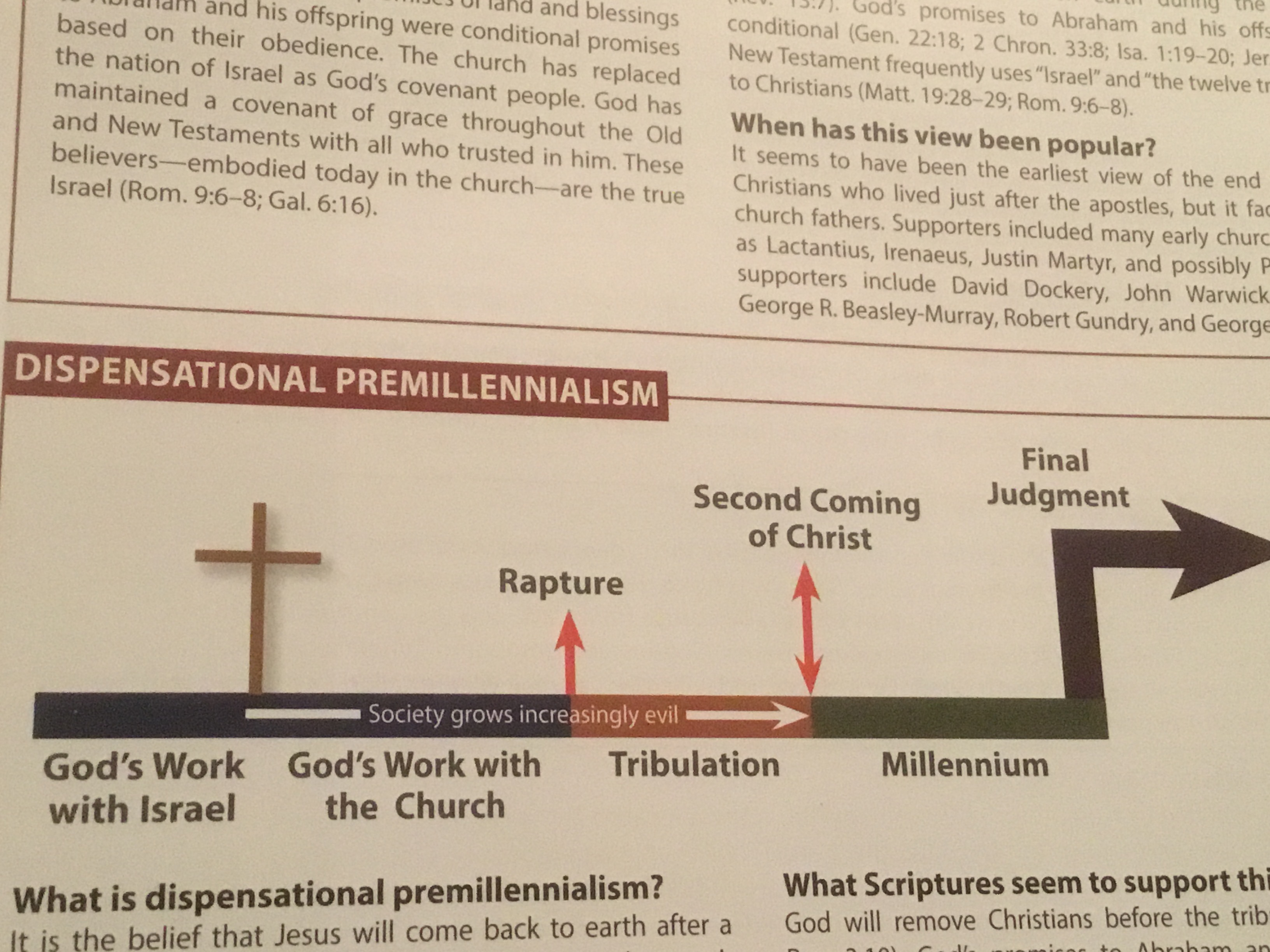
Most who hold to this view are pre-tribulationiats; believing Revelation 4:1-2 to describe the rapture of the church before the tribulation period begins. The rapture and the second coming of Christ are believed to be two separate events. As opposed to others who hold that the church will be raptured during the tribulation; known as “ mid-tribulationists.” It is believed that Jesus Christ will return to earth after the seven-year tribulation to rule and reign on earth for a thousand years( millennium) of peace. God will still honor his covenant with Israel; giving them the land promised to them in Genesis 15:8.
Does Scripture Support This View?
“God will remove Christians before the tribulation (1 Thess. 5:9; Rev. 3:10). God’s promises to Israel were unconditional (Gen. 15:7-21). The church is not specifically mentioned between Revelation 4 and 19.
when and by whom was this view popularized? This view emerged in the 1800s among the Plymouth Brethren. It increased in popularity in the 1800s and remains widespread today. Supporters include J. Nelson Darby, C.I. Scofield, Hary A. Ironside, Gleason Archer, Donald G. Barnhouse, Hal Lindsey, Chuck Smith, John MacArthur, Charles Ryrie, Charles Stanley, Norman L. Geisler, and Tim LaHaye.”(Rose Book of Bible Charts, Maps, & Timelines, p. 166)
God has not revealed the time of Christ’s return. Therefore, the setting of dates is fruitless and unbiblical speculation. Revelation speaks of “a thousand years” that Satan will be bound and some of God’s people will come to life and reign with him.
Christians have interpreted the millennium in different ways, but what is clear from scripture is that all humanity will acknowledge that Jesus is Lord over all creation. After this present age Christ will judge the whole world once and for all. At this time the righteous wrath of God will be unleashed on a rebellious world.
Unbelievers will be judged, and punished; those who refuse Gods grace and forgiveness in Christ will suffer eternal punishment in hell. However, in this age the church is called to warn people everywhere to repent and flee from the wrath to come when Christ returns as judge. Believers and unbelievers alike will be judged by Christ. God seeks to motivate his people to holiness by the rewards they will receive, and ultimately Christians can only stand before God because of Christ’s completed work on the cross. Our justification is only the perfect righteousness imputed to us who have faith in Jesus Christ. Believers are shielded from sins penalty because of his righteousness, and not our own false security of self-righteousness. Those who trust in Christ for their salvation have no fear of final judgment.
The New Heavens and New Earth
John’s revelation gives a powerful glimpse of the end of all things. Then I saw a new heaven and a new earth for the first heaven, and the first Earth had passed away. And the sea was no more and I saw the holy city, Jerusalem, coming down out of heaven from God, prepared as a bride adored for her husband. The entire world that was subject to futility and decay in the fall will be free from bondage when God makes everything new.”(ESV Study Bible, Crossway p. 2533)
”In 1 Thessalonians 4:16-17 Paul teaches that Christ’s coming will take the form of a descent from the sky, heralded by a trumpet fanfare, a shout, and the voice of the archangel. Those who died in Christ will already have been raised and will be with him, and all Christians on earth will be “raptured” (i.e., caught up among the clouds to meet Christ in the air) so that they may at once return to earth with him as part of his triumphant escort. The idea that the rapture takes them out of this world for a period before Christ appears a third time for a second “second coming” has been widely held but lacks scriptural support.”(Concise Theology: a guide to historic Christian beliefs, J.I. Packer)
while dispensational Premillinialism has increased in popularity today, I would like to propose a view of eschatology held by Martin Luther and John Calvin: Amillennialism. Saint Augustine was probably the first to teach this View. In his magnum opus, “the City of God”, he makes illusions to this view of end times.
Amillenialism is the belief that the millennium is the spiritual reign of Jesus in the hearts of his followers. The first resurrection in Revelation 20 is not physical, but spiritual; a spiritual resurrection (regeneration). Christ triumphs over Satan through his death and resurrection restrained the power of Satan on earth ( Rev. 20:1-3). The (tribulation) persecution of Christians will occur until Christ’s return, and the (millennium) expansion of God’s kingdom will both continue during the Church age. When Jesus returns, he will defeat the powers of evil, and resurrect the saved and unsaved for the general judgment and deliver them to their eternal destiny. Most references to “Israel” in Revelation are a symbolic reference to the people of God on earth.
”The Bible frequently uses the number 1,000 figuratively (Psalm 50:10; 90:4; 105:8, 2 Peter 3:8). The first resurrection could refer to the spiritual resurrection of those who trust Christ (Rev. 20:4; Romans 11:13-15; Eph. 2:1-4). The second coming of Christ and the resurrection of the saved and the unsaved will occur at the same time (Dan. 12:2-3; John 5:28-29). The Saints are on earth during the tribulation (Rev. 13:7).”(Rose Book of Bible Charts, Maps & Time Lines, p. 167)
The book of the Apocalypse is one of the most complex books in the Bible where numerous literary genres converge. The actual medium is visionary or apocalyptic writing. The most important thing to know about the literary form of the book of Revelation is that it uses the technique of symbolism throughout. There are four separate schools of interpretation: 1.) Historicism which understands the literary order of the visions(vs. 4:1-20:6) to symbolize the chronology of church history from apostolic times to the return of Christ and the new heaven and earth. 2.) Futurism, also treats the visions as a historic view of events. Chapters 4-22 are yet future, thus they believe in these coming events a literal 7 year period of great tribulation (ch. 6-9). This will be followed by a millennium (20:1-6)when Christ will rule on earth before the general resurrection and the new heaven and earth(20:7-22:5). 3.) Preterism, meaning “the thing that is past,”believes that most of Revelation’s visions were all ready fulfilled in the distant past, at the time of the early Christian church. The events of the destruction of Jerusalem or the fall of the Roman Empire are believed to be spoken of as to“soon take place “from the perspective of John and the early churches of Asia. The presence of a literary tool known as recapitulation is utilized in distinct, successive visions sometimes symbolize a repetition of the same historical events from complementary perspectives. However, full preterism—that posits that every prophecy and promise of the NT has already been fulfilled by 70 A.D.—is not an orthodox evangelical opinion because it denies Jesus’ future bodily return, and the physical resurrection of believers at the end of history as well as the renewal/ recreation of the present heaven and earth. Preterists that rightly insist these events are yet future are known as “Partial Preterists.” 4.) Idealism states, along with historicism, that the visions of Revelation symbolize the conflict between good and evil, between Christ and his church and Satan and his minions; spanning from the Apostolic age to Christ’s second coming. Even-though, Idealists believe in the presence of recapitulation means that the literary order need not reflect the temporal order of particular historical events. While agreeing with Preterists concerning Revelation’s vision cycles that manifest themselves in events that were to happen “soon”from the perspective of the first-century churches, however they also are expressed in the church’s struggle of preserving in faith while looking forward to future persecution and divine wrath leading to Christ’s second return and the new heaven and earth.
5.) Finally, some interpretations allow for multiple views, combining features of various positions; for example that both present and future fulfillments are possible. Like saying that many events have both past as well as future fulfillment. Such as past types of Antichrists but there be it still a future personal Antichrist.
Millennial Views of Revelation consist of three main categories: Premillennialism, Postmillennialism, and Amillenialism. These categories refer to when Christ will return with respect to the millennium (1,000 years). Premillennialism (Christ returns before), Postmillenialism(Christ returns after), and Amillenialism (no future millennium). The 1,000 year period is symbolic of the time between Christ’s first coming and His second coming; the millennium is Christ’s spiritual reign in the hearts of believers here and now until He comes bodily and gloriously to rescue his suffering church and destroy its enemies: the beast, the dragon, their deceived followers, and death itself through the general resurrection of the just and the unjust. (ESV Study Bible, J.I. Packer, Theological Editor, p.2460)
Is Fulfillment Theology the Same as Replacement Theology?
Fulfillment Theology is a new form of Replacement Theology that in effect replaces the Jewish people in God’s plan, not with the Christian church but with Jesus. This theology gives literal, ethnic Israel some recognition for God choosing them for His redemptive purposes but sees that calling as already “fulfilled” in Jesus’ first coming and the church’s birth (Acts 2). However, in his article “Israel and Fulfillment Theology,” ICEJ’s David Parsons writes that adherents to Fulfillment Theology “are generally uncomfortable with being identified with classical Replacement Theology, due to its malevolent fruit—namely the pogroms, inquisitions, expulsions, and the Holocaust.”[24]
So to scripturally back their “theology,” Parsons says they emphasize the “ever-expanding ‘inclusiveness’ of God’s salvation plan as it culminated in the gospel being preached to all nations.”[25] However, Fulfillment Theology ends up at the same place as Replacement Theology, concluding that “God is finished with Israel, albeit with less inherent hostility toward the Jews.”[26]
Ecclesia and Synagoga (“Church and Synagogue”) are two statues personifying the church replacing the Jewish synagogue. Ecclesia is adorned with a crown and looks confidently forward, while Synagoga is blindfolded and drooping, carrying a broken lance (which may allude to the Holy Lance that stabbed Jesus on the cross). The tablets of the Law are slipping from her hand.
No God-Given National Destiny
Hedding writes that like Replacement Theology, Fulfillment Theology ends up contending that since the time of Jesus, “the Jews no longer enjoy a God-given national destiny” in the land God promised them in Genesis 12:
This time around, it is not the church that replaces Israel and takes over all her promises in Scripture but, in fact, Jesus. He fulfills in His life and redemptive work all the promises that God ever made to the Jews—even the promise that Canaan would be the everlasting possession of the Jewish people. Jesus is the promised land. This allows the proponents of this theory to distance themselves from the awful evil (as in the apartheid state) and antisemitic consequences (as in the Christian pogroms of history) of Replacement Theology. However, they end up believing the same thing.[27]
Fulfillment Theology proponents argue, among other things, that when Jesus claimed to have fulfilled (correctly interpreted, not nullified) the Law and the Prophets in Matthew 5:17, He was referring to all of the law and the promises to natural Israel. In truth, Matthew 5–7 is a discussion about the Mosaic covenant. Hedding writes Jesus was “expounding the inward nature of the law and our failure to keep it. … When Jesus said that He came to fulfill the Law, He meant just that! That is, He would perfectly fulfill in His life the moral demands of the Law on behalf of a fallen world. He would thus prove to be a perfect man and would give His life on the cross so as to remove the curse of the Law from our lives” (Galatians 3:13).[28]
Did Paul contradict the idea of Replacement Theology?
The short answer is yes. Before arriving at Romans 11, Paul reviewed Israel’s sin and disbelief in the revelation of Jesus as Messiah. Then, in Romans 11, Paul responds to God’s stance with Israel considering this disbelief, stating in Romans 11:28–29 that God’s gifts and calling upon national Israel are “irrevocable”: they cannot be altered. The context of the surrounding Scripture affirms Paul is talking about corporate Israel: there remains a special, unique, and irreversible calling upon Israel as a nation. Adherents to Replacement Theology argue the opposite—that God has revoked that calling on Israel and transferred it to the church.
God Has Not Cast Away His People
However, consider more of Paul’s argument in Romans 11:
Has God cast away His people? Certainly not! For I also am an Israelite, of the seed of Abraham, of the tribe of Benjamin. God has not cast away His people whom He foreknew. (vv. 1–2)
I say then, have they [Israel] stumbled that they should fall? Certainly not! But through their fall, to provoke them to jealousy, salvation has come to the Gentiles. Now if their fall is riches for the world, and their failure riches for the Gentiles, how much more their fullness! (vv. 11–12).
For if their being cast away is the reconciling of the world, what will their acceptance be but life from the dead? (v. 15).
According to Paul—a Jewish man himself—God has not cast away Israel, and he was proof of it. Daniel Juster writes in his work on Replacement Theology:
Like all biological members of the nation, [Paul], too, was an Israelite—a biological descendent of Abraham and a biological member of one of Israel’s tribes. The fact that God accepted Paul into right relationship with Him through faith in the Messiah was evidence that God had not rejected Israel as a nation. Apparently, Paul’s point was as follows: If God had rejected Israel as a nation, then He would not have accepted me.[29]
Gentiles Brought Near
In fact, gentiles—whom Paul said in Ephesians 2:12 were “without God and without hope”—have been brought near to God because of Israel’s stumbling. But it doesn’t end there: if there was no future for Israel in God’s plan of redemption (as Replacement Theology adherents claim), what does Israel’s future “fullness” mean at the end of verse 12? And what did Paul mean by saying they would be resurrected and accepted by God?
The Preaching of Saint Paul at Ephesus, a 1649 portrait by Eustache Le Sueur (source: Wikipedia Commons)
Paul was referring to a future resurrection of literal, ethnic Israel, what the prophet Ezekiel envisioned in 37:1–4 when he described the “dry bones” of the whole house of Israel that will one day live. Zechariah alluded to this spiritual restoration, too, in 12:10: “And I will pour on the house of David and on the inhabitants of Jerusalem the Spirit of grace and supplication; then they will look on Me whom they pierced. Yes, they will mourn for Him as one mourns for his only son, and grieve for Him as one grieves for a firstborn.”
And of the nation of Israel, Isaiah says: “It is too small a thing for you [Israel] to be my servant to restore the tribes of Jacob and bring back those of Israel I have kept. I will also make you a light for the Gentiles, that my salvation may reach to the ends of the earth” (49:3).
Isaiah says about this coming time that it will be the nation of Israel “in whom I will be glorified” (49:3). Even Jesus says Israel will one day be restored (“you will not see me again”)—but not until His people repent (Matthew 23:39).
Restoration is coming for the children of Israel. On that day, they will pick up the mantle given to them in Genesis 12:3 to be God’s servant nation to bless all the families of the earth. They will fulfill their calling to be “a light to the gentiles” (Isaiah 42:6; 49:6) so that they might “be My salvation to the ends of the earth” (Isaiah 49:6).
Types of Replacement Theology
Replacement Theology (Supersessionism) has several forms, according to Michael J. Vlach, PhD, assistant professor of Theology at The Master’s Seminary and R. Kendall Soulen in his work The God of Israel and Christian Theology.
In his work “An Assessment of ‘Replacement Theology,’” Dr. Walter Kaiser sees five “fatal flaws” in the Replacement Theology thesis:
Flawed Belief #1: God made the “new covenant” with the church.
God’s word indicates God made the “new covenant” with the house of Israel and Judah, not the church, as seen clearly in Jeremiah 31:31:
Behold, the days are coming, says the Lord, when I will make a new covenant with the house of Israel and with the house of Judah.
Flawed Belief #2: Israel rejected Jesus as Savior, so God devised a new plan.
The Jewish people’s failure was always part of God’s calculated plan. As Hendrikus Berkof says, Israel was, is, and will be “the link between the Messiah and the nations,” even in her disobedience. Israel’s rejection of salvation actually had positive results:
For if their rejection brought reconciliation to the world, what will their acceptance be but life from the dead? (Romans 11:15 NIV)
Flawed Belief #3: God “cast off” disobedient Israel.
Scripture is clear that God has not cast Israel off—as Paul states clearly:
The gifts and the calling of God are irrevocable. (Romans 11:29)
I say then, has God cast away His people? Certainly not! For I also am an Israelite, of the seed of Abraham, of the tribe of Benjamin. … For I do not desire, brethren, that you should be ignorant of this mystery, lest you should be wise in your own opinion, that blindness in part has happened to Israel until the fullness of the Gentiles has come in. And so all Israel will be saved, as it is written: “The Deliverer will come out of Zion, and He will turn away ungodliness from Jacob.” (Romans 11:1, 25–26)
Paul used himself as an example: if he—a descendent of Abraham of the tribe of Benjamin, an Israelite once disobedient and in a state of unbelief—could be brought into God’s fold by faith, so could other Israelites.
Flawed Belief #4: God’s promise to Israel that the land was theirs as an “everlasting” possession was not speaking about linear time but rather “to the end of the age.”
This flaw misinterprets the term “everlasting” (or in some translations, “forever”) regarding the land promise in verses like Genesis 17:7–8:
I will establish my covenant as an everlasting covenant between me and you and your descendants after you for the generations to come, to be your God and the God of your descendants after you. The whole land of Canaan, where you now reside as a foreigner, I will give as an everlasting possession to you and your descendants after you; and I will be their God. (Genesis 17:8)
The eternal aspect of the land promise in 17:7–8 (as well as Genesis 12, et al) is not just an expression meaning “the end of the age.” Daniel Gruber writes:
The claim that the Hebrew word for “forever” or “everlasting” really means “to the end of the age” is only partially true. In some cases it does mean that, but that is not all it means. The English word “always” provides a helpful parallel. It means “every time,” but it also means “as long as” and “forever.”
Kaiser agrees:
The word “forever” is not limited in every instance of its usage, for there are numerous examples of its meaning that transcend such boundaries. When the additional phrases that are used in numerous contexts about the land being given in perpetuity to Israel and of the enduring nature of God’s promises to Israel as a nation are all added up, the impression of all the contexts is overwhelmingly in favor of an oath delivered by God that is as enduring as the shining of the sun and moon (see Jeremiah 33:17–22).
Flawed Belief #5: Paul’s allegory in Galatians 4:21–32 teaches that the church replaced national Israel in God’s plan.
Using this passage as evidence that God replaced Israel with the church misunderstands what Paul intended in Galatians 4 and the audience to whom he made these remarks, writes Gruber.[33] In its proper context, Paul was expositing the difference between justification by works versus justification by faith and grace.
Consider verses 21–23 and 30 and Paul’s example of Hagar (the slave woman) and Sarah (the free woman):
Tell me, you who want to be under the law, are you not aware of what the law says? For it is written that Abraham had two sons, one by the slave woman [Hagar] and the other by the free woman [Sarah]. His son by the slave woman was born according to the flesh, but his son by the free woman was born as the result of a divine promise. … Get rid of the slave woman and her son, for the slave woman’s son will never share in the inheritance with the free woman’s son. (21–23, 30)
Paul’s audience was primarily non-Jewish, and he wrote his letter to them to “explain the relation of the law to gentiles—which for Paul, is no relation at all.”[34] He was addressing whether gentiles should be circumcised to be righteous before God using the example of the two sons—not declaring that the Jews were cast out:
To say this would be to confuse the opposites that Paul is using: the opposite of the Jew is not the church, but the gentile. If one wants to learn what Paul’s opposite for the church is, it must be the “unbeliever,” not the Jew. For even Paul himself was once a persecutor of those who believed in the Messiah. In that action, he was much like Ishmael [son of the slave woman] born of the flesh and destined to be cast out.
But when he believed, he became like Isaac [son of the free woman] destined to be an heir and part of the persecuted seed of promise. … the same could be said for a gentile like Sosthenes, the leader of the synagogue, who at first persecuted Paul in Corinth (Acts 18:17). … when he, too, became a believer, he moved from one side of this allegory to the other side (1 Corinthians 1:1).[35]
Paul’s remarks were directed to legalistic gentiles who were making the wrong choice—to be circumcised in order to be justified by the law—which Paul declared would only take them “back into bondage and a disinherited state.”[36]The law couldn’t save them. Galatians 4:21–31teaches that “the quest for justification by works leads to bondage whereas justification by faith and grace leads to freedom and salvation.”[37]
If we miss this key point, writes Kaiser, “the meaning of Paul’s allegory will be lost, and wrong meanings will be found where they do not exist.”
Quo Primum (meaning “From the beginning“) is the Apostolic Constitution issued by Pope St. Pius V in 1570, promulgating the Roman Missal (the Tridentine Mass) for perpetual use, mandating its strict uniformity across the Latin Rite except for ancient, non-Roman rites, and forbidding alterations, aiming to standardize Catholic liturgy after the Council of Trent. It’s a significant document in Catholic liturgical history, establishing the “Traditional Latin Mass” and its universal application, though its binding nature on future popes regarding disciplinary matters remains debated.
Key Aspects of Quo Primum
Issuance: By Pope St. Pius V on July 14, 1570, as part of liturgical reforms following the Council of Trent.
Purpose: To unify the liturgy, standardize the Mass, and provide a pure, consistent form for the entire Latin Church.
Mandate: Declared the new Roman Missal obligatory for all churches, forbidding any additions, omissions, or alterations, under penalty of divine wrath.
Exceptions: Allowed the use of ancient rites (at least 200 years old) that differed from the Roman Rite, such as the Mozarabic Rite or Ambrosian Rite.
Binding Nature: While intended to be “in perpetuity,” it’s generally understood as a disciplinary decree, not infallible dogma, meaning future authorities can change it, though it carries great weight.
Impact Quo Primum fixed the Roman Rite for centuries, establishing the Tridentine Mass as the standard Catholic liturgy until the liturgical reforms after the Second Vatican Council introduced the Mass of Paul VI (the Ordinary Form). Quo primum of Pius V codified the TLM in perpetuity. Canon law also provides facilities in times of emergency “supplied jurisdiction.”
The phrase “New Mass is Illicit”
refers to a traditionalist Catholic view, primarily held by groups like the {!SSPX, Society of St. Pius X}, that the post-Vatican II {!Novus Ordo} Mass, while possibly valid (meaning Christ is truly present), is illicit (forbidden by Church law or deemed harmful to faith) due to its perceived Protestantizing elements, obscuring of the sacrificial nature of the Mass, and departure from traditional Catholic liturgy, making it a danger to souls despite appearances of legality.
Key Arguments of the Traditionalist View:
Obscures Sacrifice & Real Presence: Critics argue the Novus Ordo was designed to downplay the Mass as a sacrifice and diminish belief in the Real Presence, making it less Catholic and more like Protestant services.
Protestant Influence: Changes to rites, prayers (like removing “mystery of faith”), and practices (communion in hand, lay ministers, music, facing the people) are seen as yielding to Protestant theology.
Harm to Faith: The inherent flaws in the new liturgy are considered harmful to the faith, potentially leading to its loss, even if the priest says the correct words.
Illicit, Not Necessarily Invalid: The core claim is that the Mass is valid (consecration happens) but illicit (not pleasing to God, goes against proper worship), like a valid but sinful act.
Counterarguments (Official Church & Other Catholics):
Valid & Licit: The {!Catholic Church’s} Magisterium affirms the validity and licity (lawful use) of the Novus Ordo Mass.
Juridical Misunderstanding: Claims that Quo Primum forbids changes are seen as misinterpreting a juridical document, as popes can change liturgical law.
Liturgical Preference vs. Doctrine: Disagreements over facing east or other practices are seen as preferences, not grounds to declare a Mass illicit or reject valid Church law.
In essence: The debate hinges on whether the Novus Ordo’s structure and spirit truly offer proper Catholic worship or if they introduce novelties that undermine the faith, making them illicit despite their official recognition.
My opinion on the validity of the new Mass is doubtful at best. If it is at least valid, it is found to be illicit; and thus, in light of Quo Primum, a schismatic Mass invented by Freemasons, communists, and modernists to bring novelty and irreverence into God’s sacred Tradition. The new Mass, the new priesthood, and the new Magisterium are all in schism with God’s eternal Church. True Catholicism resides only in the hearts of men now. Such a crisis resides in our Catholic Church, that no one is able to admit to the extent of Satan’s infiltration of our once Holy Catholic Church: God help us.
“The courage of one’s convictions” means to have bravery and confidence; to act on your deeply held beliefs, even in difficulty, or when it is unpopular and brings opposition.
Core Aspects
Belief in self, action despite opposition, steadfastness, and building of character.
Examples of Action
When leaders stay the course in a necessary but unpopular policy.
An individual speaking out against injustice despite potential backlash.
Refusing to compromise core values, even under pressure.
It is the inner strength, in essence, to be true to yourself and your moral compass, making it a vital quality for leadership and personal integrity.
Saint Francis of Assisi
Saint Francis of Assisi (c. 1181-1226) was an Italian mystic, friar, and poet, famous for founding the Franciscan Order (Order of Friars Minor) and embracing a life of radical poverty, humility, and love for God’s creation, becoming the patron saint of animals and ecology. Born to a wealthy merchant, his life transformed after hearing God’s call to “rebuild my church,” leading him to renounce his wealth and live as a beggar, inspiring followers and establishing the Franciscans and the Poor Clares (with Clare of Assisi), and creating the first living Nativity scene. He is also known for receiving the stigmata (Christ’s wounds) and writing the Canticle of Brother Sun.
Key Aspects of His Life & Legacy:
Early Life & Conversion: Born Giovanni di Bernardone, he lived a carefree, luxurious youth before a war and illness led to a profound spiritual conversion, prompting him to give up his possessions.
Founding Orders: He established the Franciscans, dedicated to poverty, and inspired the Poor Clares (for women) and the Secular Franciscan Order (for laypeople).
Love for Creation: He saw all creatures as brothers and sisters, a deep respect that led to his patronage of animals and ecology.
Spiritual Experiences: Received the stigmata in 1224 and composed the Canticle of Brother Sun, a beautiful hymn to creation, marking him as a literary figure.
Patronage: Patron saint of Italy, animals, ecology, merchants, and peace, among others.
Feast Day: Celebrated annually on October 4th.
Famous For:
Poverty & Humility: Living the Gospel literally, without limit.
First Nativity Scene: Created the first live Nativity in Greccio, Italy.
Connection to Animals: Miracles and stories, like taming a wolf, highlight his bond with nature.
+7St. Francis of Assisi – My Catholic Life!Saint Francis of Assisi (c. 1181-1226) was an Italian mystic, friar, and poet, famous for founding the Franciscan Order (Order of Friars Minor) and embracing a life of radical poverty, humility, and love for God’s creation, becoming the patron saint of animals and ecology. Born to a wealthy merchant, his life transformed after hearing God’s call to “rebuild my church,” leading him to renounce his wealth and live as a beggar, inspiring followers and establishing the Franciscans and the Poor Clares (with Clare of Assisi), and creating the first living Nativity scene. He is also known for receiving the stigmata (Christ’s wounds) and writing the Canticle of Brother Sun. Key Aspects of His Life & Legacy:Early Life & Conversion: Born Giovanni di Bernardone, he lived a carefree, luxurious youth before a war and illness led to a profound spiritual conversion, prompting him to give up his possessions.Founding Orders: He established the Franciscans, dedicated to poverty, and inspired the Poor Clares (for women) and the Secular Franciscan Order (for laypeople).Love for Creation: He saw all creatures as brothers and sisters, a deep respect that led to his patronage of animals and ecology.Spiritual Experiences: Received the stigmata in 1224 and composed the Canticle of Brother Sun, a beautiful hymn to creation, marking him as a literary figure.Patronage: Patron saint of Italy, animals, ecology, merchants, and peace, among others.Feast Day: Celebrated annually on October 4th. Famous For:Poverty & Humility: Living the Gospel literally, without limit.First Nativity Scene: Created the first live Nativity in Greccio, Italy.Connection to Animals: Miracles and stories, like taming a wolf, highlight his bond with nature.
A “prophecy” sometimes attributed to Saint Francis speaks of a future tribulation, stating that during this time, “a man, not canonically elected, will be raised to the Pontificate, who, by his cunning, will endeavor to draw many into error and death!” In scripture we are warned of a great Apostasy that will come upon us in the Last Days. 2 Thessalonians 2:3-4 LSB – “Let no one in any way deceive you, for it has not come unless the apostasy comes first, and the man of lawlessness is revealed, the son of destruction, 4 who opposes and exalts himself above every so-called god or object of worship, so that he takes his seat in the sanctuary of God, exhibiting himself as being God.”(LSB)
The message of Our Lady of La Salette, delivered on September 19, 1846, to two shepherd children—Mélanie Calvat (14) and Maximin Giraud (11)—in the French Alps, is primarily
a call to reconciliation and conversion.
Core Themes of the Public Message
The apparition is known for its “weeping Lady” who lamented the lack of religious devotion. Her primary grievances included:
Desecration of Sundays: She expressed deep sorrow that few people attended Mass, and many continued to work on the “Lord’s Day”.
Blasphemy: She warned against the frequent use of her Son’s name as a curse word or in vain.
Neglect of Prayer: She urged the children to pray at least an “Our Father” and a “Hail Mary” morning and evening when they could do no more.
Warnings of Famine: She foretold a great famine, specifically mentioning that the potato harvest would continue to rot as a consequence of these sins. This was later linked to the Great Famine in Europe.
The “Secret” Messages
Beyond the public message, Our Lady entrusted each child with a private secret. These were controversial and were published in full later (notably in 1879). Key elements include:
Apostasy and Clergy: Warnings of a decline in faith among the clergy and religious orders.
Apocalyptic Prophecies: Predictions of social upheaval, wars, and natural disasters.
“Rome will lose the faith”: A widely cited line claiming that Rome would become the seat of the Antichrist and the Church would be “in eclipse”.
Even the Catechism of the Catholic Church has stated: “675 Before Christ’s second coming the Church must pass through a final trial that will shake the faith of many believers.574 The persecution that accompanies her pilgrimage on earth575 will unveil the “mystery of iniquity” in the form of a religious deception offering men an apparent solution to their problems at the price of apostasy from the truth. The supreme religious deception is that of the Antichrist, a pseudo-messianism by which man glorifies himself in place of God and of his Messiah come in the flesh.576 (769) 676 The Antichrist’s deception already begins to take shape in the world every time the claim is made to realize within history that messianic hope which can only be realized beyond history through the eschatalogical judgment. The Church has rejected even modified forms of this falsification of the kingdom to come under the name of millenarianism,577 especially the “intrinsically perverse” political form of a secular messianism.578 (2425) 677 The Church will enter the glory of the kingdom only through this final Passover, when she will follow her Lord in his death and Resurrection.579 The kingdom will be fulfilled, then, not by a historic triumph of the Church through a progressive ascendancy, but only by God’s victory over the final unleashing of evil, which will cause his Bride to come down from heaven.580 God’s triumph over the revolt of evil will take the form of the Last Judgment after the final cosmic upheaval of this passing world.581 (1340, 2853) II. To Judge the Living and the Dead 1038-1041 678 Following in the steps of the prophets and John the Baptist, Jesus announced the judgment of the Last Day in his preaching.582 Then will the conduct of each one and the secrets of hearts be brought to light.583 Then will the culpable unbelief that counted the offer of God’s grace as nothing be condemned.584 Our attitude about our neighbor will disclose acceptance or refusal of grace and divine love.585 On the last day Jesus will say: “Truly I say to you, as you did it to one of the least of these my brethren, you did it to me.”586 (1470) 679 Christ is Lord of eternal life. Full right to pass definitive judgment on the works and hearts of men belongs to him as redeemer of the world. He “acquired” this right by his cross. The Father has given “all judgment to the Son.”587 Yet the Son did not come to judge, but to save and to give the life he has in himself.588 By rejecting grace in this life, one already judges oneself, receives according to one’s works, and can even condemn oneself for all eternity by rejecting the Spirit of love.589 (1021)”
In conclusion, “680 Christ the Lord already reigns through the Church, but all the things of this world are not yet subjected to him. The triumph of Christ’s kingdom will not come about without one last assault by the powers of evil. 681 On Judgment Day at the end of the world, Christ will come in glory to achieve the definitive triumph of good over evil which, like the wheat and the tares, have grown up together in the course of history. 682 When he comes at the end of time to judge the living and the dead, the glorious Christ will reveal the secret disposition of hearts and will render to each man according to his works and according to his acceptance or refusal of grace.”(C.C.C. 675-682)
From the very first, upon Our elevation to the chief Apostleship, We gladly turned our mind and energies and directed all our thoughts to those matters which concerned the preservation of a pure liturgy, and We strove with God’s help, by every means in our power, to accomplish this purpose. For, besides other decrees of the sacred Council of Trent, there were stipulations for Us to revise and re-edit the sacred books: the Catechism, the Missal and the Breviary. With the Catechism published for the instruction of the faithful, by God’s help, and the Breviary thoroughly revised for the worthy praise of God, in order that the Missal and Breviary may be in perfect harmony, as fitting and proper – for its most becoming that there be in the Church only one appropriate manner of reciting the Psalms and only one rite for the celebration of Mass – We deemed it necessary to give our immediate attention to what still remained to be done, viz, the re-editing of the Missal as soon as possible.
Hence, We decided to entrust this work to learned men of our selection. They very carefully collated all their work with the ancient codices in Our Vatican Library and with reliable, preserved or emended codices from elsewhere. Besides this, these men consulted the works of ancient and approved authors concerning the same sacred rites; and thus they have restored the Missal itself to the original form and rite of the holy Fathers. When this work has been gone over numerous times and further emended, after serious study and reflection, We commanded that the finished product be printed and published as soon as possible, so that all might enjoy the fruits of this labor; and thus, priests would know which prayers to use and which rites and ceremonies they were required to observe from now on in the celebration of Masses.
Let all everywhere adopt and observe what has been handed down by the Holy Roman Church, the Mother and Teacher of the other churches, and let Masses not be sung or read according to any other formula than that of this Missal published by Us. This ordinance applies henceforth, now, and forever, throughout all the provinces of the Christian world, to all patriarchs, cathedral churches, collegiate and parish churches, be they secular or religious, both of men and of women – even of military orders – and of churches or chapels without a specific congregation in which conventual Masses are sung aloud in choir or read privately in accord with the rites and customs of the Roman Church. This Missal is to be used by all churches, even by those which in their authorization are made exempt, whether by Apostolic indult, custom, or privilege, or even if by oath or official confirmation of the Holy See, or have their rights and faculties guaranteed to them by any other manner whatsoever.
This new rite alone is to be used unless approval of the practice of saying Mass differently was given at the very time of the institution and confirmation of the church by Apostolic See at least 200 years ago, or unless there has prevailed a custom of a similar kind which has been continuously followed for a period of not less than 200 years, in which most cases We in no wise rescind their above-mentioned prerogative or custom. However, if this Missal, which we have seen fit to publish, be more agreeable to these latter, We grant them permission to celebrate Mass according to its rite, provided they have the consent of their bishop or prelate or of their whole Chapter, everything else to the contrary notwithstanding.
All other of the churches referred to above, however, are hereby denied the use of other missals, which are to be discontinued entirely and absolutely; whereas, by this present Constitution, which will be valid henceforth, now, and forever, We order and enjoin that nothing must be added to Our recently published Missal, nothing omitted from it, nor anything whatsoever be changed within it under the penalty of Our displeasure.
We specifically command each and every patriarch, administrator, and all other persons or whatever ecclesiastical dignity they may be, be they even cardinals of the Holy Roman Church, or possessed of any other rank or pre-eminence, and We order them in virtue of holy obedience to chant or to read the Mass according to the rite and manner and norm herewith laid down by Us and, hereafter, to discontinue and completely discard all other rubrics and rites of other missals, however ancient, which they have customarily followed; and they must not in celebrating Mass presume to introduce any ceremonies or recite any prayers other than those contained in this Missal.
Furthermore, by these presents [this law], in virtue of Our Apostolic authority, We grant and concede in perpetuity that, for the chanting or reading of the Mass in any church whatsoever, this Missal is hereafter to be followed absolutely, without any scruple of conscience or fear of incurring any penalty, judgment, or censure, and may freely and lawfully be used. Nor are superiors, administrators, canons, chaplains, and other secular priests, or religious, of whatever title designated, obliged to celebrate the Mass otherwise than as enjoined by Us. We likewise declare and ordain that no one whosoever is forced or coerced to alter this Missal, and that this present document cannot be revoked or modified, but remain always valid and retain its full force notwithstanding the previous constitutions and decrees of the Holy See, as well as any general or special constitutions or edicts of provincial or synodal councils, and notwithstanding the practice and custom of the aforesaid churches, established by long and immemorial prescription – except, however, if more than two hundred years’ standing.
It is Our will, therefore, and by the same authority, We decree that, after We publish this constitution and the edition of the Missal, the priests of the Roman Curia are, after thirty days, obliged to chant or read the Mass according to it; all others south of the Alps, after three months; and those beyond the Alps either within six months or whenever the Missal is available for sale. Wherefore, in order that the Missal be preserved incorrupt throughout the whole world and kept free of flaws and errors, the penalty for nonobservance for printers, whether mediately or immediately subject to Our dominion, and that of the Holy Roman Church, will be the forfeiting of their books and a fine of one hundred gold ducats, payable ipso facto to the Apostolic Treasury. Further, as for those located in other parts of the world, the penalty is excommunication latae sententiae, and such other penalties as may in Our judgment be imposed; and We decree by this law that they must not dare or presume either to print or to publish or to sell, or in any way to accept books of this nature without Our approval and consent, or without the express consent of the Apostolic Commissaries of those places, who will be appointed by Us. Said printer must receive a standard Missal and agree faithfully with it and in no wise vary from the Roman Missal of the large type (secundum magnum impressionem).
Accordingly, since it would be difficult for this present pronouncement to be sent to all parts of the Christian world and simultaneously come to light everywhere, We direct that it be, as usual, posted and published at the doors of the Basilica of the Prince of the Apostles, also at the Apostolic Chancery, and on the street at Campo Flora; furthermore, We direct that printed copies of this same edict signed by a notary public and made official by an ecclesiastical dignitary possess the same indubitable validity everywhere and in every nation, as if Our manuscript were shown there. Therefore, no one whosoever is permitted to alter this notice of Our permission, statute, ordinance, command, precept, grant, indult, declaration, will, decree, and prohibition. Would anyone, however, presume to commit such an act, he should know that he will incur the wrath of Almighty God and of the Blessed Apostles Peter and Paul.
Given at St. Peter’s in the year of the Lord’s Incarnation, 1570, on the 14th of July of the Fifth year of Our Pontificate.
Fundamentals of Catholic Dogma, by Dr. Ludwig Ott has some interesting ideas on predestination and the theological options of the Church fathers. In his book, Dr. Ott begins one of his headings as the mystery of predestination. The basic problem of predestination. The main difficulty of the doctrine of predestination lies in the question whether God‘s eternal resolve of predestination has been taken with, or without consideration of the merits of the man.
Attempts at resolution. The Thomists, the Augustines, the majority of Scotus, an individual older Molinas teach an absolute predestination therefore, according to them, God freely resolves from all eternity, without consideration of man’s merits grace to call certain men to beatification, and therefore to bestow on them graces, which will infallibly secure The execution of the divine decree. In time God first gives to the predestined effective graces, and then eternal bliss as a reward for the merits which flow from their free cooperation with grace.
It is defined by the holy Roman catholic church that God by his eternal resolve of Will has predestined certain men to eternal blessedness (de fide). Saint Augustine, at least in his later writings is more in favor of the Thomistic explanation. The Thomistic view emphasizes gods universal causality while the other view stresses the universality of the divine salvific will of man’s freedom and his cooperation in his salvation. The difficulties remain on both sides, prove that predestination, even for reason, enlighten by faith is an unfathomable mystery.
Another De fide statement by the Catholic Church says that God, by an eternal result of His will, predestines certain men on account of their foreseen sins to eternal rejection; this is called prescience. However, the reality of reprobation is not formally defined, but it is the general teaching of the Church. The Synod of Valence in 855 teaches it is declared in Matthew 25:41 “Depart from me, accursed, into everlasting fire, which was prepared for the devil and his angels,” and by Romans 9:22 “vessels of wrath fitted for destruction.” Saint Augustine teaches, “God is good. God is just. He can save a person without good works because He is good, but He cannot condemn anyone without evil works because He is just.”
According to the teaching of the church, there is a conditioned positive reprobation that is it occurs with consideration of foreseen future demerits this excludes gods, desiring in advance. The damnation of certain men, Saint Augustine teaches a similar view, but allows God to pass over those that are reprobate. The Thomist view favor not an absolute, but only a negative reprobation. This is conceived by most Thomas as non-election to eternal bliss. Together with the divine resolve to permit some rational creatures to fall into sin, and thus by their own guilt to lose eternal salvation, and the freedom of men’s will unconditioned negative probation of the Thomists involves the same result as the unconditional positive reprobation of the heretical predestinarians since outside heaven, and hell, there is no third final state.
According to Rome, the human will remains free under the influence of efficacious grace, which is not irresistible. (De fide) and there is a grace which is truly sufficient and yet remains inefficacious. (De fide). Saint Augustine, to whom the opponents of this doctrine appeal never denied the freedom of the will in relation to Grace. The defense of the freedom of the will he wrote in the year for 426 or 427 the work De gratia et libero arbitrio, in which he seeks to instruct, and to appease those who believe that free will is denied if Grace is defended, and who so defend free will that they deny grace and maintain that grace is given according to our merits. He says justification is not only a work of grace, but at the same time a work of the free will “he who created thee without thy help, does not justify thee without thy help.”(Fundamentals of Catholic Dogma, Dr. Ott, p.247)
Therefore, this all being said, the theological position of Rome is definitively semi-palagian; denying the hyper-Calvinism of the predestinarians and affirming at the same time the necessity of God’s grace. This is the mystery of predestination, that God’s sovereign election somehow works together with man’s free will.
“God, in a way of sovereignty, picks out some from this fallen apostatized race, to be vessels of grace and glory. He dispenses his gifts to whom he will, without giving us any reason: according to his own good pleasure he pitches upon some to be monuments of mercy and grace, preventing grace, effectual grace, while he passes by others.”(Matthew Henry Commentary, Romans 9)
God’s Sovereign Choice
9 I am speaking the truth in Christ—I am not lying; my conscience bears me witness in the Holy Spirit— 2 that I have great sorrow and unceasing anguish in my heart. 3 For I could wish that I myself were accursed and cut off from Christ for the sake of my brothers,[a] my kinsmen according to the flesh. 4 They are Israelites, and to them belong the adoption, the glory, the covenants, the giving of the law, the worship, and the promises. 5 To them belong the patriarchs, and from their race, according to the flesh, is the Christ, who is God over all, blessed forever. Amen.
6 But it is not as though the word of God has failed. For not all who are descended from Israel belong to Israel, 7 and not all are children of Abraham because they are his offspring, but “Through Isaac shall your offspring be named.” 8 This means that it is not the children of the flesh who are the children of God, but the children of the promise are counted as offspring. 9 For this is what the promise said: “About this time next year I will return, and Sarah shall have a son.” 10 And not only so, but also when Rebekah had conceived children by one man, our forefather Isaac, 11 though they were not yet born and had done nothing either good or bad—in order that God’s purpose of election might continue, not because of works but because of him who calls— 12 she was told, “The older will serve the younger.” 13 As it is written, “Jacob I loved, but Esau I hated.”
14 What shall we say then? Is there injustice on God’s part? By no means! 15 For he says to Moses, “I will have mercy on whom I have mercy, and I will have compassion on whom I have compassion.” 16 So then it depends not on human will or exertion,[b]but on God, who has mercy. 17 For the Scripture says to Pharaoh, “For this very purpose I have raised you up, that I might show my power in you, and that my name might be proclaimed in all the earth.” 18 So then he has mercy on whomever he wills, and he hardens whomever he wills.
19 You will say to me then, “Why does he still find fault? For who can resist his will?” 20 But who are you, O man, to answer back to God? Will what is molded say to its molder, “Why have you made me like this?” 21 Has the potter no right over the clay, to make out of the same lump one vessel for honorable use and another for dishonorable use? 22 What if God, desiring to show his wrath and to make known his power, has endured with much patience vessels of wrath prepared for destruction,23 in order to make known the riches of his glory for vessels of mercy, which he has prepared beforehand for glory— 24 even us whom he has called, not from the Jews only but also from the Gentiles? 25 As indeed he says in Hosea,
“Those who were not my people I will call ‘my people,’ and her who was not beloved I will call ‘beloved.’” 26 “And in the very place where it was said to them, ‘You are not my people,’ there they will be called ‘sons of the living God.’”
27 And Isaiah cries out concerning Israel: “Though the number of the sons of Israel[c] be as the sand of the sea, only a remnant of them will be saved, 28 for the Lord will carry out his sentence upon the earth fully and without delay.” 29 And as Isaiah predicted,
“If the Lord of hosts had not left us offspring, we would have been like Sodom and become like Gomorrah.”
Israel’s Unbelief
30 What shall we say, then? That Gentiles who did not pursue righteousness have attained it, that is, a righteousness that is by faith; 31 but that Israel who pursued a law that would lead to righteousness[d] did not succeed in reaching that law. 32 Why? Because they did not pursue it by faith, but as if it were based on works. They have stumbled over the stumbling stone, 33 as it is written,
“Behold, I am laying in Zion a stone of stumbling, and a rock of offense; and whoever believes in him will not be put to shame.”(ESV Bible)
James Montgomery Boice would entitle his posthumous book, after his death in June of 2000, The Doctrines of Grace. After his unfinished work would be completed by his colleague Philip Graham Ryken. This book was my introduction to reformed theology which we can find crystallized in Romans chapter 9.
The doctrines of grace—are short hand for the five distinct Bible teachings which were linked together in response to the theology that was developing in Holland in the late 1500’s.(p. 18). This line of theology was in response to the erroneous teachings of a man by the name of Jacob Arminius (1560-1609). Arminius and his followers taught free will and the self determination of man. I believe this goes against the clear teaching of scripture and that of John Calvin (1509-1564); this doctrine of predestination was actually the teaching of Jesus, and these teachings were later synthesized at the Synod of Dort (1618-1619) as well as the Westminster Confession of Faith (1643-1649). These doctrines from the Synod of Dort contained the classic summation of the five doctrines of Grace known to us today as TULIP or “The Five Points of Calvinism.”James Montgomery Boice, p. 18)
The Canons of Dort address five main theological points (heads of doctrine) in response to Arminianism, focusing on God’s sovereign grace:
Divine Election, Christ’s Death for Redemption, the Corruption of Man & Conversion, and the Perseverance of the Saints, presented in four main sections with positive and negative articles defining Reformed views on unconditional election, limited atonement, total depravity, irresistible grace, and eternal security (TULIP principles).
Here are the five heads of doctrine as outlined in the Canons:
Focuses on God’s eternal choice of some for salvation (election) and passing over others (reprobation), grounded in His good pleasure, not foreseen faith.
Second Head of Doctrine: The Death of Christ and the Redemption of Man Thereby
Affirms that Christ’s atonement was sufficient for all but efficient (intended to save) only for the elect, securing their salvation.
Third and Fourth Heads of Doctrine: The Corruption of Man, His Conversion to God, and the Manner Thereof
Details humanity’s total inability (total depravity) due to sin, requiring God’s irresistible grace for conversion, which is a work of the Holy Spirit, not human effort.
Fifth Head of Doctrine: The Perseverance of the Saints
Teaches that those truly converted by God’s grace will persevere in faith and cannot finally fall away from salvation (eternal security).
The Westminster Confession of Faith is a foundational Reformed Protestant statement of doctrine, created by the Westminster Assembly (1643-1649) in London to unify the Church of England, becoming a key subordinate standard for Presbyterianism and influencing many other traditions. Comprising 33 chapters, it systematically outlines Christian beliefs on Scripture’s authority, God’s sovereignty, salvation (including predestination), worship, sacraments, and church governance, serving as a summary of biblical teaching subordinate to the Bible itself.
Key Aspects:
Origin & Purpose: Convened by England’s Parliament during the English Civil War, the Assembly aimed to reform the Church of England and establish a unified Protestant doctrine.
Contents: Covers core doctrines like the Trinity, creation, fall, redemption, justification, sanctification, sacraments (Baptism, Lord’s Supper), and the last judgment, with extensive scripture citations.
Theological Stance: A classic expression of Calvinistic theology, emphasizing God’s absolute sovereignty, covenant theology (works and grace), and the doctrines of grace (election, predestination).
Authority: Acknowledges the Bible as the sole infallible rule of faith, with the Confession acting as a “subordinate standard”—a summary and guide, not a replacement.
Influence: Adopted by the Church of Scotland (1647) and widely influential in Presbyterian churches (like the PCA, OPC) and some Baptist/Congregational denominations, who use it alongside or adapted from it (e.g., the 1689 London Baptist Confession, the Savoy Declaration).
The 39 Articles are the historic doctrinal foundation of the Church of England (Anglican Communion), finalized in 1571, defining Anglican beliefs on faith, scripture, sacraments (Baptism, Eucharist), church authority, and practices, serving as a theological guide and unifying document during the English Reformation to balance Catholic tradition and Protestant theology. They address core Christian doctrines (Trinity, Christ) and distinctively Anglican stances (Church’s authority, marriage of clergy, role of the monarch).
Key aspects of the 39 Articles:
Purpose: To define the Church of England’s identity, unify doctrine, and set boundaries against Roman Catholicism and radical Protestantism during the Reformation.
Content: A summary of beliefs, including the sufficiency of Scripture, justification by faith, the two sacraments (Baptism, Lord’s Supper), rejection of Purgatory, and the authority of the monarch over the Church.
Articles 35-39: Anglican specifics (Book of Homilies, Ordination, Oaths).
Legacy: They remain foundational for Anglicans, forming part of the Book of Common Prayer, though their interpretation and binding nature vary across different Anglican churches globally, notes Wikipedia.
Examples of Articles:
Article 1: On the Trinity.
Article 9: On Original Sin.
Article 11: On Justification by Faith.
Article 28: On the Lord’s Supper (Eucharist).
Article 37: On the Authority of the Queen (Monarch).
[20] “No prophecy of scripture is made by private interpretation”: This shews plainly that the scriptures are not to be expounded by any one’s private judgment or private spirit, because every part of the holy scriptures were written by men inspired by the Holy Ghost, and declared as such by the Church; therefore they are not to be interpreted but by the Spirit of God, which he hath left, and promised to remain with his Church to guide her in all truth to the end of the world. Some may tell us, that many of our divines interpret the scriptures: they may do so, but they do it always with a submission to the judgment of the Church, and not otherwise.”(Douala-Reims)
we can also read in 2 Peter 3:15,16, “And account the longsuffering of our Lord, salvation; as also our most dear brother Paul, according to the wisdom given him, hath written to you: As also in all his epistles, speaking in them of these things; in which are certain things hard to be understood, which the unlearned and unstable wrest, as they do also the other scriptures, to their own destruction.”
As Catholics we must not fall into the trap of “private interpretation” that most Protestants espouse. Let us hold to the truth held by our One Holy Church, and interpret the Sacred Scriptures in the context of Church Tradition. The and only then are we safe from false teachers. “But if I tarry long, that thou mayest know how thou oughtest to behave thyself in the house of God, which is the church of the living God, the pillar and ground of the truth.”(1 Timothy 3:15)
“And we charge you, brethren, in the name of our Lord Jesus Christ, that you withdraw yourselves from every brother walking disorderly, and not according to the tradition which they have received of us. [2 Thessalonians 3:6]. And we know that we are not held to a standard of the scripture alone as the Protestants espouse, but to both Scripture as well as tradition: “Therefore, brethren, stand fast; and hold the traditions which you have learned, whether by word, or by our epistle.” (2 Thessalonians 2:14)
“It firmly believes, professes and preaches that all those who are outside the catholic church, not only pagans but also Jews or heretics and schismatics, cannot share in eternal life and will go into the everlasting fire which was prepared for the devil and his angels, unless they are joined to the catholic church before the end of their lives;”{Pope Eugene IV, Council of Florence, Cantate Domino, 1441, ex cathedra}
The term “Catholic” was first used by Saint Ignatius of Antioch in his Letter to the Smyrnaeans around 110 AD. The term “Catholic Church” literally means “universal church“. The letter reads, “Wheresoever the bishop shall appear, there let the people be, even as where Jesus may be, there is the universal [katholike] Church”.
The Archbishop [Vigano]defends his claim that there is a Deep Church in parallel to the Deep State. When asked to define these terms, he explains that these coordinated subversives are “a foreign body that is illegal, subversive and deprived of any sort of democratic legitimacy that uses the institution in which it is embedded to achieve goals that are diametrically opposed to the goals of the institution ….” I want to emphasize that the universal religion desired by the United Nations and Freemasonry has active collaborators at the highest levels of the Catholic Church who usurp authority and adulterate the Magisterium. They are opposing the Mystical Body of Christ, which is mankind’s only ark of salvation, with the mystical body of the Antichrist, according to the prophecy of the Venerable Archbishop Fulton Sheen, Ecumenism, Malthusian environmentalism, pan-sexualism, and immigrationism are the new dogmas of this universal religion, whose ministers are preparing the advent of the Antichrist prior to the final persecution and the definitive victory of Our Lord. But just as the glorious Resurrection of the Savior was preceded by His Passion and Death, so too is the Church journeying towards her own Calvary; and just as the Sanhedrin thought that it would eliminate the Messiah by crucifying Him, so the infamous sect believes that the eclipse of the Church is a prelude to its end. A “tiny remnant” remains, made up of fervent Catholics, just as the Mother of God, Saint John, and Mary Magdalene remained at the foot of the Cross.”(https://catholicfamilynews.com/blog/2020/10/01/in-new-interview-archbishop-vigano-elaborates-his-claim-that-we-face-an-epochal-conflict/)
“Enter ye in at the narrow gate: for wide is the gate, and broad is the way that leadeth to destruction, and many there are who go in thereat.14 How narrow is the gate, and strait is the way that leadeth to life: and few there are that find it!”(Matt. 7:13-14, DRA)
“It firmly believes, professes and preaches that all those who are outside the catholic church, not only pagans but also Jews or heretics and schismatics, cannot share in eternal life and will go into the everlasting fire which was prepared for the devil and his angels, unless they are joined to the catholic church before the end of their lives;”{Pope Eugene IV, Council of Florence, Cantate Domino, 1441, ex cathedra}
Scripture continues: “Jesus saith to him: Iamtheway, and the truth, and the life. No man cometh to theFather, but by me.”(John 14:6)
We cannot continue to call ourselves Christian and not follow the Lordship of our King. Christ made claims that were exclusive. Our One, Holy Church makes dogmatic pronouncements that are binding through Sacred Tradition. The true magisterium of the Church guides through it’s teaching. And it’s teaching should always be subordinate to Sacred Scripture.
The second Vatican council has no dogmatic pronouncements, other than citing previous magisterial documents, since it never proclaimed any dogmatic teaching but only those of a pastoral nature. This is subterfuge; deceit used in order to achieve one’s goal. The second Vatican council was used to weaken and subvert the Church of our Lord. The diabolical nature of this tries the souls of many faithful. Torn between obedience and truth, they vasalate in a state of lukewarm false obedience. Our Catholic faith is more than a sentimental humanitarianism. But a deep felt conviction to follow Christ’s teachings even when that means opposing the false teachers who would lead us to perdition.
This new false church under Vatican II has put all those who accept it in a bondage to a false system, a false truth, a false gospel. This false system (sect of Catholicism) teaches that all religions are equal (religious indifference) or that all roads lead to God.
The false ecumenism that has infected the Church, has also infiltrated even into the Protestant denominations. A diabolical blurring of the lines; leading one to believe in a god of mercy only. No judgment, no accountability, just mercy. A god of surprises—a god of accompaniment. False teachers have infiltrated the Church; those who remain are held hostage to a system of heresy and lukewarm teaching.




 Christian Universal Truth