Baptized in 1991. Confirmed Roman Catholic 2015. I am married and the father of two sons. My education includes a B.A. in Geography and Urban planning. My interests are in reading the Bible and good books like Will Durant's, The Story of Civilization.
“Sedevacantism is the theological position of those traditional Catholics who most certainly believe in the papacy, papal infallibility and the primacy of the Roman Pontiff, and yet do not recognize “Pope” Francis [Edit. note: at the time this article was written, it was Benedict XVI] as a legitimate successor of Peter in the primacy. In other words, they do not recognize him as a true pope. The word sedevacantism is a compound of two Latin words which together mean “the Chair is vacant.” Despite the various arguments raised against this position — that it is based on a false expectation that the pope can do no wrong, or that it is an emotional reaction to the problems in the Church — the sedevacantist position is founded on the Catholic doctrines of the infallibility and the indefectibility of the Church and on the theological opinion of the great Doctor of the Church, St. Robert Bellarmine.
As an introduction to this article, let the traditional Catholic first ask himself why he is a traditional Catholic. Why does he not attend the Novus Ordo Mass? Why does he reject the teachings of Vatican Council II on Religious Liberty and Ecumenism? Why does he reject the new code of Canon Law (1983) in which under certain circumstances schismatics and heretics may, without an abjuration of their errors and a profession of the Catholic Faith, be administered by a Catholic priest the Sacraments of Penance, Extreme Unction, and Holy Eucharist? If the traditional Catholic answers the first question correctly, he would state quite simply that the New Mass is without a doubt a danger to his faith and that due to the radical changes in the Offertory and Consecration, it is questionable whether transubstantiation even takes place. In answer to the second question, the traditional Catholic would properly state that the teachings found in Vatican II decrees of Religious Liberty and Ecumenism have been condemned by previous popes, in particular by Pope Pius IX in the Syllabus of Errors. Lastly, to the third question, the traditional Catholic would surely answer that such a law in the new code can never be considered as true and binding legislation since the sacraments would be sacrilegiously administered to heretics and schismatics.
How appropriately did the late Archbishop Marcel Lefebvre on the occasion of his Suspension a divinis by Paul VI write the following reflection on June 29, 1976:
“That the Conciliar Church is a schismatic Church, because it breaks with the Catholic Church that has always been. It has its new dogmas, its new priesthood, its new institutions, its new worship, all already condemned by the Church in many a document, official and definitive.
“This Conciliar Church is schismatic, because it has taken as a basis for its updating, principles opposed to those of the Catholic Church, such as the new concept of the Mass expressed in numbers 5 of the Preface to (the decree) Missale Romanum and 7 of its first chapter, which gives the assembly a priestly role that it cannot exercise; such likewise as the natural — which is to say divine — right of every person and of every group of persons to religious freedom.
“This right to religious freedom is blasphemous, for it attributes to God purposes that destroy His Majesty, His Glory, His Kingship. This right implies freedom of conscience, freedom of thought, and all the Masonic freedoms.
“The Church that affirms such errors is at once schismatic and heretical. This Conciliar Church is, therefore, not Catholic. To whatever extent Pope, bishops, priests or faithful adhere to this new Church, they separate themselves from the Catholic Church.”
Let the traditional Catholic, especially the members of the Society of St. Pius X, ask themselves to what extent have the Pope, bishops, priest and laity adhered to this new Church which would, as Archbishop Lefebvre reflected, separate themselves from the Catholic Church. Francis, as did Benedict XVI and John Paul II before him, completely adheres to the Conciliar Church. He enforces the Novus Ordo Mass and false teachings of Vatican II. He follows in the footsteps of John Paul II, who promulgated the New Code of Canon Law (1983), and who boldly practiced false ecumenism and heretical religious indifferentism in Assisi, Italy, on October 27, 1986, by the atrocious convocation of all the false religions of the world to pray to their false gods for world peace!
As unpleasant as this subject may be, traditional Catholics are confronted by the terrible and burning questions:
Is the Conciliar Church the Catholic Church?
Is Francis, as the head of the Conciliar Church, a true pope?
The sedevacantist would unhesitatingly and unequivocally say no.
To believe otherwise, to answer yes to the above questions, would be to imply that the Catholic Church has failed in its purpose, that the Church of Christ is not infallible and indefectible, that the Pope is not the rock upon which Christ founded His Church, that the promise of Christ to be with His Church “all days even to the consummation of the world” and that the special assistance of the Holy Ghost, have failed the Church — conclusions which no traditional Catholic could ever maintain. Consider the following quote from Vatican Council I (1870):
“For the fathers of the Fourth Council of Constantinople, following closely in the footsteps of their predecessors, made this solemn profession: ‘The first condition of salvation is to keep the norm of the true Faith. For it is impossible that the words of our Lord Jesus Christ Who said, “Thou art Peter, and upon this rock I will build my Church” (Matt. 16:18), should not be verified. And their truth has been proved by the course of history, for in the Apostolic See the Catholic religion has always been kept unsullied, and its teaching kept holy.’ …for they fully realized that this See of St. Peter always remains untainted by any error,according to the divine promise of our Lord and Savior made to the prince of his disciples, ‘I have prayed for thee, that thy faith may not fail; and do thou, when once thou has turned again, strengthen thy brethren’ (Luke 22:32).”
Pope Leo XIII, in his encyclical Satis Cognitum, taught that the Teaching Authority of the Church can never be in error:
“If (the living magisterium) could in any way be false, an evident contradiction follows; for then God Himself would be the author of error.”
How can a traditional Catholic on one hand reject the New Mass, the heretical teachings of Vatican Council II, and the New Code of Canon Law (1983), and on the other hand, continue to recognize as pope the very one who officially promulgates and enforces these errors?
To consider yet another question, is the faith and government of the traditional Catholic the same as Bergoglio and his Conciliar Church? Do traditional Catholics believe the same doctrines as Francis and his Conciliar Church on the New Mass, false ecumenism, and religious liberty?
Are traditional Catholics subject to the local hierarchy and ultimately to Rome?
Pope Pius XII, in his encyclical Mystical Body of Christ, taught:
“It follows that those who are divided in faith and government cannot be living in the one Body such as this, and cannot be living the life of its one Divine Spirit.”
Are traditional Catholics united or divided in faith and government with the Conciliar Church?
The sedevacantist honestly recognizes that his faith is actually not the same as Francis and his Conciliar Church. He recognizes that he is actually not subject and obedient to him. As a traditional Catholic, the sedevacantist believes and professes all the teachings of the Catholic Church, and this profession of the true Faith includes a rejection of the false teachings of Vatican II (“all already condemned by the Church in many a document, official and definitive” — Archbishop Marcel Lefebvre, June 29, 1976).
During the first prayer of the Canon of the traditional Mass which begins Te igitur, the priest in normal times would recite una cum papa nostro N. (one with our pope N.). What significance does this short phrase convey — una cum, one with? One in faith, one in government, one in the Mass and Sacraments — united— this is the significance! Can a traditional priest honestly recite in the Canon of the Mass that he is una cum Francis? In what is he una cum Francis? In the Conciliar teachings, in government, in the official New Mass and Sacraments — is he actually una cum?
One last consideration on this subject of sedevacantism is the manner in which all these things have come to pass. When did they take place? How did they take place? This is an area in which sedevacantists themselves differ. Some hold that the papal elections were invalid based on the Bull of Pope Paul IV in 1559, Cum ex apostolatus:
“If ever at any time it appears that… the Roman Pontiff has deviated from the Catholic Faith or fallen into some heresy before assuming the papacy, the assumption, done even with the unanimous consent of all the Cardinals, stands null, invalid and void; nor can it be said to become valid, or be held in any way legitimate, or be thought to give to such ones any power of administering either spiritual or temporal matters; but everything said, done and administered by them lacks all force and confers absolutely no authority or right on anyone; and let such ones by that very fact (eo ipso) and without any declaration required to be deprived of all dignity, place, honor, title, authority, office, and power.”
Some sedevacantists quote the Code of Canon Law (1917) in Canon 188 No. 4:
“All offices shall be vacant ipso facto (without a declaration required) by tacit resignation… #4 by public defection from the Catholic Faith.”
Others hold the opinion of St. Robert Bellarmine in De Romano Pontifice (Chapter XXX):
“The fifth opinion (regarding a heretical pope) therefore is true; a pope who is a manifest heretic by that fact (per se) ceases to be pope and head (of the Church), just as he by that fact ceases to be a Christian (sic) and a member of the body of the Church. This is the judgment of all the early Fathers, who teach that manifest heretics immediately lose all jurisdiction.”
Pope Innocent III as quoted by the theologian Billot in his Tract. de Ecclesia Christi, p. 610:
“The faith is necessary for me to such an extent that, having God as my only judge in other sins, I could however be judged by the Church for sins I might commit in matters of faith.”
Suffice it to say, the issue of the pope is a difficult one, an unpleasant one, and a frightful one; yet it is a necessary and important issue which cannot be avoided.
In conclusion, let it not be said that the sedevacantist rejects the papacy, the primacy, or the Catholic Church. On the contrary it is because of his belief in the papacy, the primacy, the infallibility and the indefectibility of the Catholic Church that he rejects Francis and his Conciliar Church.
For the sedevacantist, the Catholic Church cannot and has not failed. The great apostasy predicted by St. Paul in his Epistle to the Thessalonians has taken place:
“Let no one deceive you in any way, for the day of the Lord will not come unless the apostasy comes first, and the man of sin is revealed, the son of perdition, who opposes and is exalted above all that is called God, or that is worshipped, so that he sits in the temple of God and gives himself out as if he were God…. And now you know what restrains him, that he may be revealed in his proper time. For the mystery of iniquity is already at work; provided only that he who is at present restraining it, does still restrain, until he is gotten out of the way.And then the wicked one will be revealed…” (2 Thess. 2:3-8).
Who is this one “who is at present restraining it… until he is gotten out of the way. And then the wicked one will be revealed”? Perhaps Pope Leo XIII has the answer in his Motu Proprio of September 25, 1888, when he wrote in his invocation to St. Michael:
“These most crafty enemies have filled and inebriated with gall and bitterness the Church, the spouse of the immaculate Lamb, and have laid impious hands on her most sacred possessions. In the Holy Place itself, where has been set up the See of the most holy Peter and the Chair of Truth for the light of the world, they have raised the throne of their abominable impiety, with the iniquitous design that when the Pastor has been struck, the sheep may be scattered.””[ https://cmri.org/articles-on-the-traditional-catholic-faith/sedevacantism/%5D
The Beginning of the Redemptive Story
The book of Genesis begins the story of God’s relationship with mankind, tells the sad story of how that relationship went very wrong, and outlines God’s promised solution to that crisis—a solution that would reach its glorious conclusion in Jesus Christ.
Genesis 1 introduces the central person of the biblical story line: God is the Creator-Father-King. God created the human race in his own image, as his royal sons and daughters to establish his kingdom on earth (Gen. 1:26–28). As humanity multiplied upon the earth, they were to establish it as God’s kingdom, in which the will of God was done on earth as it was in heaven. The intended outcome was that the Creator-King would dwell among a flourishing human community in a kind of paradise-kingdom. Heaven and earth would intersect, and God would be all in all.
Despite the disastrous rebellion of the human race, this original intention for creation remains the goal of God’s cosmic restoration accomplished in Jesus Christ. The rest of redemptive history after the rebellion narrates and explains the unfolding of this cosmic restoration.
Mankind’s Rebellion
Genesis 3 recounts the crisis of redemptive history, consisting in mankind’s rebellion against God. Discontent with the role of ruling under God, Adam and Eve—enticed by Satan in the form of a serpent—grasp for equality with God. The outcome is disastrous. For their act of high treason, Adam and Eve are exiled from perfect fellowship with God in the garden of Eden and are barred from the tree of life. Sin and death enter the world. All of creation becomes enslaved to futility and corruption. Satan has successfully usurped mankind’s throne as ruler of the world (see Luke 4:5–6; John 12:31; 2 Cor. 4:4; Eph. 2:2).
God’s Judgment
Genesis 6 reports how mankind, created to fill the earth with the rule of God, fills it instead with violence (Gen. 6:11, 13). Originally created as “very good,” the earth now lies ruined because of sin (1:31; 6:12). God’s patience runs out and, in grief, he determines to destroy humanity together with the ruined earth (6:13). God reverses the creation process of Genesis 1 by opening creation’s floodgates above and below—to deluge the earth and return it to its pre-creation state of dark chaos (1:2).
All life is extinguished, with the exception of a single family. Because of Noah’s righteousness, God preserves him and his family and a remnant of the animal world in a large boat. Then, the floods subside and Noah disembarks into a washed and clean new world. This is a new beginning. Although Noah subsequently fails, as Adam did before him, the redemptive pattern is set. God intends to fulfill his original creation intentions through a humanity led by a righteous head. Unlike Adam and Noah, however, the ultimate Adam, Jesus Christ, does in fact deliver a remnant by his righteousness, so that he and they together might rule over a holy, restored world (see Rom. 5:12–21, 8:18–30; 1 Cor. 15:20–28, 42–57).
The Promise
Genesis 12:1–3 is God’s answer to the problem of mankind’s rebellion narrated in the book’s first eleven chapters. God promises Abraham a land, countless descendants, and that all the families of the earth will be blessed in him. Through Abraham’s descendants—Israel, and ultimately Israel’s royal king, Jesus—the Creator-King will reclaim his world. Blessing and life will overcome and swallow up the curse of Genesis 3. God is determined, by his grace, to restore humanity and the entire cosmos to the paradise it was in Eden.
Universal Themes in Genesis
The image of God. Genesis teaches that everyone on earth is created in the image of God (Gen. 1:26–27; 9:6). This means that we are created like God in certain ways—for example, in our ability to love, speak, create, and reason, as well as in our ability to form relationships with our fellow humans. The image of God is also seen in the way humans are to rule the earth, under God, who rules over all. Because every person is made in God’s image, every person is inherently valuable to God and is to be treated with dignity regardless of ethnicity, age, class status, or gender.
Sin and the problem of the human heart. Genesis shows clearly that the fallen human heart is filled with sin. The reason God determined to destroy mankind in the flood was that “every intention of the thoughts of his heart was only evil continually” (Gen. 6:5). Despite experiencing God’s judgment in the flood, however, mankind fell again into sin (8:21). The flood, then, did not solve the problem of humanity’s sin and rebellion. Noah and his family passed the infection of sin on to their offspring and thus to all the nations of the earth. The world’s many expressions of rebellion against their Creator stem from the deeper, more fundamental problem of the fallen heart with its wayward desires. To fulfill his original intention for creation, God must find a way to forgive sin and to transform hard hearts with new desires. This divine mission would ultimately be fulfilled in the life, death, and resurrection of Jesus Christ.
The Global Message of Genesis for Today
Marriage and sexuality. The original intention for marriage was, and still is, a permanent marriage relationship between a man and a woman, with the gift of sexuality being expressed within the freedom of this exclusive relationship. This divine ideal, set forth in Genesis 2:18–24, still stands, despite the sordid stories that Genesis records of how far short humans fall from God’s plan. We read of Lamech’s bigamy (4:19–24), Sodom’s homosexual brutality (19:1–29), Jacob’s polygamy (chs. 29–30), Shechem’s rape (34:2), Reuben’s incest (35:22; 49:4), Judah’s prostitution (38:15–18), and the adulterous desires of Potiphar’s wife (39:6–12). Jesus Christ reaffirmed the Genesis 2 ideal in his teaching, providing instruction concerning divorce in the process (Mark 10:2–12).
Ethnicity and genocide. The “table of nations” in Genesis 10 traces all of the ethnic groups and peoples of the world to their common ancestors preserved on the ark (Noah and his family). It tells of the original genealogy of the entire world. The narrator’s use of a genealogy to describe humanity’s diverse ethnic, linguistic, and geographical complexity reveals that the human race is one massive extended family. Therefore ethnic arrogance, tribal wars, racism, and the atrocity of genocide—the murder of one group by another because of ethnic difference—are incomprehensible evils, since every person is related as family to every other person upon the earth. Because of humanity’s evil heart, however, only in Christ can such ethnic strife and racial injustice find their ultimate solution.
Environment. God commissioned humanity to manage the world as his stewards and not as selfish tyrants. Humanity must represent God and his character and his will, because God ultimately rules over the created order. The Creator-King is wise, loving, holy, compassionate, good, and just, and we must reflect his character in our attitude to environmental issues. We may harness and use the resources of the earth, but must not waste, abuse, or exploit them. Creation exists for God’s glory, and its beautiful interlocking ecosystems must be protected to fulfill this purpose. Moreover, humanity is utterly dependent upon the earth and its resources for life. For all these reasons, the preservation and stewardship of creation should be an urgent and significant priority for twenty-first century global Christians.
The Continued Story of Redemptive History
The book of Exodus continues the story of the redemptive history that God began in the book of Genesis. The original purpose of Exodus was to help the people of Israel understand their identity as God’s special people, and to learn about their covenant obligations to him. They were to see themselves as God’s “firstborn son” (Ex. 4:22–23) and as a “kingdom of priests” (19:5–6), called to bring God’s blessings to the nations. Exodus describes how the Lord delivered Israel from Egyptian oppression (chs. 1–15), brought her into covenant relationship with himself at Mount Sinai (chs. 16–24), and came to dwell in her midst in the tabernacle (chs. 25–40).
The Meaning of the Exodus
God’s main purpose in delivering the people of Israel out of Egyptian oppression was so that he “might dwell among” them (Ex. 29:46). To understand why God desired to dwell in Israel’s midst, we must consider the book of Exodus within the larger framework of redemptive history. The Creator-King’s original intention was that he might dwell among his people, who would be a flourishing human community in a paradise-kingdom beginning in Eden and spreading throughout the whole world (see “The Global Message of Genesis”). The book of Revelation shows that these original creation intentions remain God’s purpose for his people, and his purpose will be fulfilled at the end of history (Revelation 21–22). In those last two chapters of the Bible, as in the Bible’s first two chapters, we see God dwelling with his people. In the book of Exodus we see this as well, as Israel learns about their covenant relationship with God, and as he dwells among them through the tabernacle.
The narrator of Exodus clearly states that the reason why God established the Mosaic covenant with Israel at Sinai was to carry forward his purpose as expressed within the earlier covenant with Abraham (Ex. 2:24; 3:6, 15, 16; 6:2–8). God’s promises to Abraham in Genesis 12:1–3 function as his solution to the problem of the human sin and rebellion that we read about in Genesis 3–11. In Exodus, God advances his solution to the fall by establishing Israel as a theocracy (a nation governed directly by God). Through the Mosaic covenant, Israel becomes the initial fulfillment and next stage of the promise that in Abraham’s lineage all the families of the earth would be blessed (Gen. 12:3).
God’s “Firstborn Son”
In Exodus 4:22–23, God announced to Pharaoh that Israel was “my firstborn son.” In the worldview of ancient Egypt, the firstborn son of a king would inherit the throne and would be under obligation to manifest the rule of the supreme deity of his father upon earth. Pharaoh thought of himself as the son and appointed representative of the supreme god of Egypt, and he believed that his own firstborn son would inherit this role.
Israel became the Lord’s adopted firstborn son, and so was under obligation to manifest the Lord’s rule upon earth. The original calling of humanity to be God’s image-bearers, his appointed representatives, who establish and extend God’s heavenly rule upon the earth, is now to be carried forward through the chosen people of Israel. Although Israel largely failed in this mission, Jesus ultimately suffers the punishment deserved by God’s people and secures the success of this mission through God’s new people, the church (Matt. 28:18–20).
Universal Themes in Exodus
The main theme of Exodus is the Lord’s self-revelation in faithfulness, grace, and power, especially in supremacy over the false gods of the world.
The faithful God. Exodus 3:10–15 is the revelation of the personal name of God, YHWH, which is rendered in most Bibles with small capital letters, as “the LORD.” The name is connected to the Hebrew verb “to be,” and its meaning becomes clear throughout Exodus. First, the Lord is the God who “will be” with his chosen people to enable them to fulfill their God-given task (Ex. 3:12). Second, the Lord is the God “who will be who he is” (see 3:14). God will be what he has always been. He is the unchanging, self-consistent God. He will be faithful forever to his own character and covenant commitments. Third, the Lord is the God who “will be” sufficient in his people’s moment of crisis (3:14b). God is faithful and powerful enough to carry through on his promise to deliver his people from Pharaoh and the gods of Egypt.
The gracious God. In Exodus 34:5–7, the Lord further unveils the essence of his character and the significance of his name to Moses, who had asked to see God’s glory (Ex. 33:18). The context is crucial, for Exodus 32–34 concerns Israel’s golden calf rebellion. It is in the midst of this crisis that God reveals that he is “a God merciful and gracious, slow to anger, and abounding in steadfast love and faithfulness, keeping steadfast love for thousands, forgiving iniquity and transgression and sin” (34:6–7). Because of Israel’s idolatry, the mission to rescue the world nearly collapses as God’s people forsake him. Yet due to his grace and covenant love, the mission to bless the whole world (Gen. 12:1–3) continues to advance. The golden calf incident, however, has revealed that Israel, the one through whom worldwide blessing was to come, is herself part of the problem. God’s own people have evil hearts (Ex. 32:9–10, 22; 33:5; 34:9).
The all-powerful God. In the exodus deliverance from Pharaoh, the Lord reveals himself as the only true God and king of the earth (Ex. 9:16; 15:11, 14–15, 18). In his victory over the world’s most powerful nation, the Lord demonstrates that its most powerful “gods” were not gods at all (12:12; 15:11). The book of Exodus shows that the God of Abraham is the only true God of all the earth.
The Global Message of Exodus for Today
Nations, political power, and oppression. Israel’s exodus from Egypt must be understood as the unique event that it was within the history of redemption. It would be wrong, therefore, to interpret the book of Exodus as declaring that God’s primary purpose is to liberate all oppressed people from political or economic enslavement. If we read Exodus in this way, we may begin to see the church’s primary mission as working to bring about political freedom and social justice. This is certainly a worthy and important goal, and Exodus does demonstrate vividly that God’s ear is drawn to the groaning of the oppressed (Ex. 2:23–24). God is compassionate and cares for the widow, the fatherless, and the poor (22:21–27), and the church is called to do likewise. Yet this is not the main message of Exodus. The church’s primary mission is the proclamation and living out of the gospel of Christ—for the fundamental problem plaguing humanity is not political oppression but its root cause, the evil human heart. And this fundamental problem is cured only in the work of Christ in dying and rising again. In doing all of this, Jesus accomplished a greater and final exodus deliverance for all who will put their trust in him.
The sojourner and the resident alien. In a time when economic crises, wars, and natural disasters compel individuals and whole peoples to flee their homelands and seek security in foreign countries, the issue of the resident alien has become acute throughout the entire global village. In Exodus, God commands Israel not to oppress the sojourner. He reminds his people of their own historic experience as oppressed sojourners in Egypt (Ex. 22:21; 23:9). While the book of Exodus is not a manual for dealing with the issue of illegal or unwanted immigration, the book certainly teaches that solutions must be sought with justice and compassion. And above all, global Christians must remember that they are resident aliens on earth and, most fundamentally, citizens of heaven (Phil. 3:20; 1 Pet. 1:1; 2:11).
“The papacy is one of the most “Catholic” parts of the Catholic Church. So, many “Bible-only” Christians may be surprised that it’s not only entirely biblical, it’s even in the Old Testament!
There are several key passages in the New Testament where Jesus makes clear the special role for Peter among the Apostles (cf. John 21.15-19, Luke 22.32). But probably the most important passage is Jesus’ words in Matthew 16.13-20. What a lot of interpreters miss is that what Jesus says about Peter is actually an allusion to the book of Isaiah in the Old Testament. And this fact makes Christ’s intentions very clear.
To see this, let’s look at the key part from the Gospel of Matthew:
“And I tell you, you are Peter, and on this rock I will build my church, and the gates of Hades will not prevail against it. I will give you the keys of the kingdom of heaven, and whatever you bind on earth will be bound in heaven, and whatever you loose on earth will be loosed in heaven.’” (Matthew 16.15-19)
In the Old Testament book of Isaiah, we find the following message to Shebna, the steward and master of the household of the King:
“I will thrust you from your office, and you will be pulled down from your post. On that day I will call my servant Eliakim son of Hilkiah, and will clothe him with your robe and bind your sash on him. I will commit your authority to his hand, and he shall be a father to the inhabitants of Jerusalem and to the house of Judah. I will place on his shoulder the key of the house of David; he shall open, and no one shall shut; he shall shut, and no one shall open. I will fasten him like a peg in a secure place, and he will become a throne of honor to his ancestral house.” (Isaiah 22.19-23)
The similarity in language makes it clear Jesus was referencing this passage when he spoke to Peter.
And this is what it means: If Jesus is the new King of the Jews, then Peter is his steward and the master of his household, the Church. The Pope, as the successor of Peter, continues to exercise today this vital role for the Church established by Christ. This helps to explain a common title for the pope: the Vicar (or representative) of Christ.
In other words, as with all things related to Christ, the special role Jesus gave to Peter is the fulfillment of what was already foreshadowed in the Old Testament! ”
“Mild or partial preterism holds that most of the prophecies of Revelation were fulfilled in either the fall of Jerusalem (A.D. 70) or the fall of the Roman Empire (A.D. 476), but the Second Coming of Christ is yet future. This form of preterism is orthodox and is the most frequent view encountered in our day.
Moderate preterism has become, in our day, mainstream preterism. Today it appears to be the most widely held version of preterism. Simply put, moderates see almost all prophecy as fulfilled in the A.D. 70 destruction of Jerusalem, but they also believe that a few passages still teach a yet future second coming (Acts Acts 1:9-11; 1Cor. 1Cor. 15:51-53; 1Th. 1Th. 4:16-17) and the resurrection of believers at Christ’s bodily return. . . . In addition to R.C. Sproul, some well-known moderate preterists include Kenneth L. Gentry, Jr., Gary DeMar, and the late David Chilton (who converted to full preterism after all his books were published).1
Full, extreme, or consistent preterism holds that all the prophecies of Revelation are already fulfilled, that we are currently living spiritually in the “new heavens and new earth” and denies a future bodily return of Jesus. Full or consistent preterism is heretical.
Extreme or full preterists view themselves as “consistent” preterists. . . . Extreme preterists believe that “the second coming MUST HAVE already occurred, since it was one of the things predicted in the O.T. which had to be fulfilled by the time Jerusalem was destroyed” . . . This means there will never be a future second coming, for it already occurred in A. D. 70. Further, there will be no bodily resurrection of believers, which is said to have occurred in A.D. 70 in conjunction with the second coming. Full preterists believe that we now have been spiritually resurrected and will live forever with spiritual bodies when we die. . . . Full preterists say . . . we are now living in what we would call the eternal state or the new heavens and new earth of Revelation Rev. 21:1+-Rev. 22:1+. Champions of this view include the originator of full preterism, . . . J. Stuart Russell . . . Max R. King and his son, Tim . . . David Chilton . . . Ed Stevens, Don K. Preston, John Noe, and John L. Bray.2
Although mild (partial) preterism is considered orthodox, full (extreme, consistent) preterism denies the bodily Second Coming of Christ and so is outside of orthodoxy. While one is most likely to encounter the mild preterist view in reading commentaries on the book of Revelation, one should be aware of the tendency of mild or partial preterism to develop into full or consistent preterism, thus crossing the line between orthodoxy and heresy. “Extreme preterism is sometimes known as ‘consistent preterism’ because it consistently applies the principles of preterism to all prophecy. If moderate preterists were consistent, they unavoidably would be extreme preterists, and would have to deny the reality of the eternal state.”3
Since full (extreme, consistent) preterism is heretical and less frequently encountered, we will focus primarily upon mild (moderate, partial) preterism which seems to be increasingly popular in our day.
In its approach to the book of Revelation, partial preterism divides into two primary views concerning what events are foretold by the book: “Preterists hold that the major prophecies of the book were fulfilled either in the fall of Jerusalem (AD 70) or the fall of Rome (AD 476).”4 “The second form of preterist interpretation holds that Revelation is a prophecy of the fall of the Roman Empire, ‘Babylon the Great,’ the persecutor of the saints, in the fifth century A.D. The purpose of the book is to encourage Christians to endure because their persecutors assuredly will be judged.”5”
Notes
1 Thomas Ice, “What Is Preterism?,” in Tim LaHaye and Thomas Ice, eds., The End Times Controversy (Eugene, OR: Harvest House Publishers, 2003), 22-23.
2 Ibid., 23-24.
3 Larry Spargimino, “How Preterists Misuse History to Advance their View of Prophecy,” in Tim LaHaye and Thomas Ice, eds., The End Times Controversy (Eugene, OR: Harvest House Publishers, 2003), 19.
4 Robert H. Mounce, The Book of Revelation (Grand Rapids, MI: William B. Eerdmans Publishing Co., 1977), 41.
5 Gregory K. Beale, The Book of Revelation: A Commentary on the Greek Text (Grand Rapids, MI: William B. Eerdmans Publishing Co., 1999), 45.
The book of Revelation is also known as the book of the Apocalypse in the Catholic Bible. Both refer to the unveiling or disclosure.
Revelation is written in the form of apocalyptic literature (like Daniel and Zechariah) and refers to itself as a prophetic book. The book contains it’s own outline in verse 19 of chapter one; “the things which you have seen,” ” the things which are, ” and “the things that will take place after this.”
Schools of Interpretation
Four approaches for interpreting Revelation have been developed for understanding the relationship between the visions to one another and to history.
(1) Historicism: symbolizes (in ch. 4:1-20:6) A chronological order of interpretation of history.
(2) Futurism: ch. 4-22 represent events still future to current time. Distant future from St. John.
(3) Preterism: thinks that the fulfillment of most of Revelation has already occurred in the past.
(4) Idealism: that the visions of Revelation symbolize the conflict between good and evil; Christ and satan, and while these events need not occur in chronological order, they describe both a time”soon” to come by 1st century Church, but also may foretell a still future fulfillment at the time of the end.
Millennial Views
There are three main views of the Millennium:
(1) Premillennialism
(2) Postmillennialism
(3) Amillennialism
Christians disagree on how to interpret the “thousand years” kingdom of the Lord Jesus Christ. Whether it’s a future reign after the Millennium (Postmillennialism), or that Christ will return before his thousand year reign (Premillennialism). Also, a third view is that Christ is now reigning and there is no Millennium. But ” through Christ’s death and resurrection Satan was bound, and therefore he is unable to hold the Gentiles in ignorance or gather a worldwide coalition against the Church. “(ESV Study Bible). So the gospel now advances the kingdom of Christ through the power of the Holy Spirit by the Church’s witness.
“The Lord is my shepherd: I shall lack nothing. He makes me lie down in green pastures. He leads me beside still waters. ”
Psalms 23:1-2 WEBBE https://bible.com/bible/1204/psa.23.1-2.WEBBE
“There are many Catholics who believe that praying the Rosary during Mass constitutes a distraction from the Sacred Liturgy. The post Vatican II Church recommends active participation during the Mass so emphatically that anything that encourages individual recollection and impairs communitarian activity is strongly discouraged.
You can pray the Rosary not only before Mass but during Mass; it is an approved custom
Today, Catholic forums are littered with questions from the faithful, typically younger Novus Ordo Catholics, asking if it really is allowed for an elderly parishioner in their Church to be praying the Rosary instead of actively engaging in the responses, singing and hand-holding participation of a New Mass.
There are many Catholics who view the Mass-time Rosary with suspicion, as if it is some foreign stain against the Faith that has thrived on ignorance in spite of the priests who seek its elimination.
What this mindset reveals is the tyranny of the post-Conciliar Church in eliminating practices that oppose its ideal of “active participation.” It is a sad consequence to see that so many Catholics now look down on the Mass-time Rosary.
Though it may come as a surprise to some, the practice of praying the Rosary during the celebration of the Mass was not only permitted but encouraged by past Popes and Roman Curia.
A traditional rationale
As many as there are different men there are different tastes.
A 15th century prayer books shows the faithful at Mass – one with a prayerbook, the other with a Rosary
This applies not only to food and art, but also to devotions. With the differing strengths and weaknesses of a person’s individuality, we may find ourselves more attracted to one kind of devotion over another. Whereas one person may find a type of prayer or meditation to be most fruitful in the pursuit of sanctity, another may find that same practice deadening. It is characteristic of the universality of the Catholic Church that there are many different meditations, prayers, books and religious practices established to suit the needs of the many. No one who seeks earnestly for prayers and meditations can find the Barque of St. Peter meager in providing such supplies.
Praying the Rosary during Mass thus existed as an honored devotion that served many of the faithful. Prior to Vatican II, prayers and devotions during Mass were considered good to the degree that they elevated one’s soul to God. Those who did not have a Missal or did not want to use one could pray the Rosary as a means to elevate their minds to God and in this way unite themselves with the mysteries that were being renewed on the Altar.
Although following Mass with the Missal is a good practice, the Rosary offers also a good practice to anyone who was thus so inclined. Whether it was through necessity or one’s personal preferences, the Rosary always offered a means to gather much spiritual grace if prayed during Mass attendance. It is said there is no better time for prayer than the Mass and, before Vatican II, it was common to see Catholics praying the Rosary during the Liturgical Celebration. The Mass-time Rosary is still a common practice in many countries to this day.
Pius XII: Catholics can say the prayers they want during Mass
To pray the Rosary during Mass is not merely a custom that developed organically. Papal mandate provided strong support to it. In 1947 Pope Pius XII approved praying the Rosary during Mass in his Encyclical Mediator Dei. This document acknowledged that the same forms of following the Mass do not appeal universally to the varying inclinations of men.
It was in order to foster Mass time devotion that, through this document, he reinforced that old habit when he gave permission for the praying of the Rosary during Mass. Teaching generically, he included such prayer and its correspondent meditations among other prayers also permitted and in harmony with the Mass and not a distraction from it:
“Moreover, the needs and inclinations of all are not the same, nor are they always constant in the same individual. Who, then, would say, on account of such a prejudice, that all these Christians cannot participate in the Mass nor share its fruits? On the contrary, they can adopt some other method which proves easier for certain people; for instance, they can lovingly meditate on the mysteries of Jesus Christ or perform other exercises of piety or recite prayers which, though they differ from the sacred rites, are still essentially in harmony with them.” (Encyclical Mediator Dei, 11/20/1947, n. 108)
These words of Pius XII were quite clear in allowing anyone to say the Rosary or other prayers during Mass. However, an even stronger and more explicit endorsement supports the same custom.
Leo XIII recommends the Rosary to be said during Mass
In 1883 Pope Leo XIII had written these words in his Encyclical Supremi Apostolatus:
Pilgrims praying the Rosary at Fatima
“Not only do we earnestly exhort all Christians to give themselves to the recital of the pious devotion of the Rosary publicly or privately in their own house and family, and that unceasingly, but we also desire that the whole of the month of October in this year should be consecrated to the Holy Queen of the Rosary. We decree and order that in the whole Catholic world, during this year, the devotion of the Rosary shall be solemnly celebrated by special and splendid services.
“From the first day of next October, therefore, until the second day of the November following, in every parish and, if the ecclesiastical authority deem it opportune and of use, in every chapel dedicated to the Blessed Virgin – let five decades of the Rosary be recited with the addition of the Litany of Loreto.
“We desire that the people should frequent these pious exercises; and we will that either Mass shall be said at the altar, or that the Blessed Sacrament shall be exposed to the adoration of the faithful, Benediction being afterwards given with the Sacred Host to the pious congregation. We highly approve of the confraternities of the Holy Rosary of the Blessed Virgin going in procession, following ancient custom, through the town, as a public demonstration of their devotion. And in those places where this is not possible, let it be replaced by more assiduous visits to the churches, and let the fervor of piety display itself by a still greater diligence in the exercise of the Christian virtues.” (English edition, 9/1/1883 n. 8)
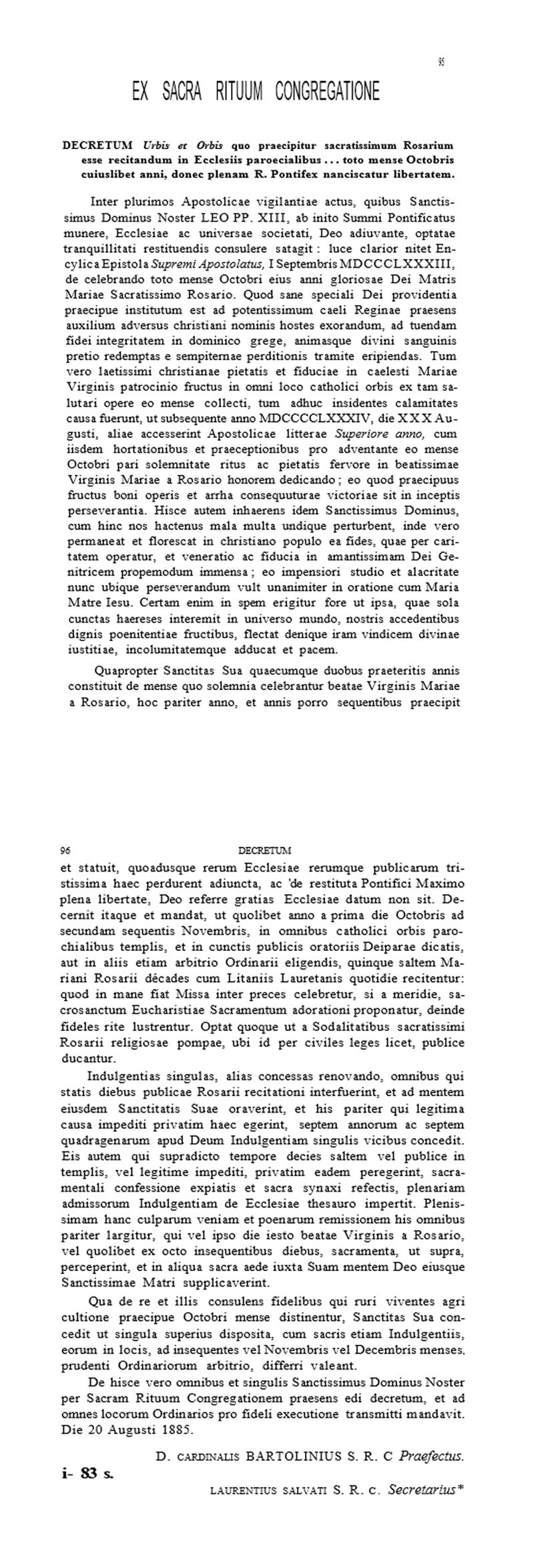
On August 20, 1885 the Prefect of the Congregation of the Rites under Leo XIII issued another document, an urbis et orbis decree [for the city and for the world] , dedicating the month of October to Our Lady of the Rosary. In that pronouncement he called for the Rosary to be recited during the rituals of the Mass. The Sacred Congregation of Rites reinforced this on January 16, 1886, when it answered a question on how specifically to apply the Pope’s recommendation.
The Christ Child offers the Rosary to three Teutonic knights
The question put to the Sacred Congregation of the Rites and the answer it gave read:
“Doubt V – The same Decree [of Leo XIII issued on August 20, 1885] rules that Rosary must be recited with the Litanies among the prayers carried out by the faithful. We ask whether these words should be understood as the Rosary to be said at the same time of the celebration of the Mass; or that the Mass should be celebrated before the recitation of the Rosary and Litanies as usually happens in the Palentina Diocese.
“Answer: Affirmative to the first part; negative to the second.” (Original in Latin here, pp. 47-48 )
As such, this decree unambiguously stated affirmative: the Rosary is to be prayed during the same time as the celebration of the Mass.
This endorsement by Leo XIII and its confirmation by the Congregation of Rites definitively established the Rosary as a legitimate accompaniment to the Mass. Several indulgences were granted to its recitation, and the Sacred Congregation of Rites confirmed this position again in 1887.
An objection
An objection could be raised that these pronouncements of Pope Leo XIII dealt specifically with the recitation of the Rosary during Masses in October.
To this we respond that while the aforementioned declaration established the recitation of the Mass-time Rosary for October, it made evident that the Rosary is essentially an acceptable form of worship to accompany the Mass in general.
The papal declaration granted special indulgences to doing so in October, and by extension showed that there is no conflict with praying the Rosary during Mass. Since this established that the Rosary is in harmony with the liturgy, not in opposition to it, it becomes clear that the Rosary is a perfectly acceptable devotion during Mass for anyone who is so inclined to pray it.
Pope Pius XII reinforced this position with Mediator Dei, including prayer of the Rosary in those devotions that are cooperative with the Mass.
Conclusion
The Mass-time Rosary is a devotion that assists the supplicant in raising his spirit to God. As a practice it provides a legitimate spiritual means for those who are so inclined to say it. Pius XII endorsed the Rosary as an appropriate means of assisting at Mass and Leo XIII also did so by allowing it to be said during Mass and by granting indulgences to do the same during the month of October.
Progressivist hierarchy and clergy today despise anything that detracts from their ideal of “active participation,” yet, despite their hatred, the practice of praying the Rosary during Mass is a firmly established tradition that has the approval of past Popes and the Sacred Congregation of Rites.
To unite oneself with the Mass by praying the Rosary and meditating on its mysteries thus continues to stand as a legitimate, praiseworthy and respectable custom of the Holy Catholic Church. Let those who so wish honor Our Lady and Our Lord in this way. “


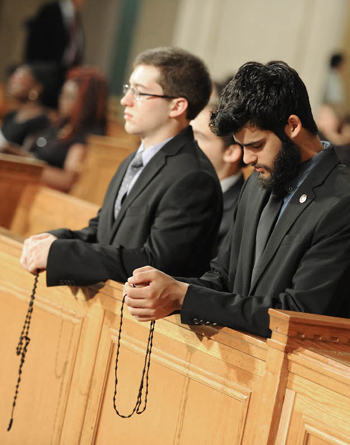 You can pray the Rosary not only before Mass but during Mass; it is an approved custom
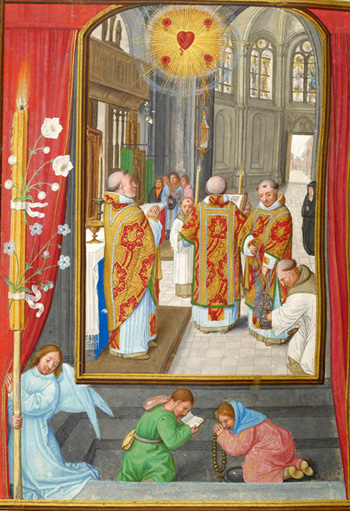 A 15th century prayer books shows the faithful at Mass – one with a prayerbook, the other with a Rosary
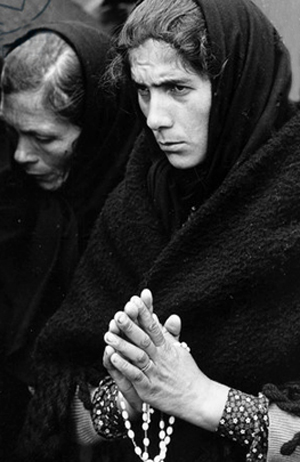 Pilgrims praying the Rosary at Fatima
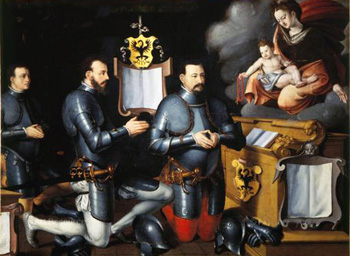 The Christ Child offers the Rosary to three Teutonic knights
 Christian Universal Truth