Luke 1

images

Douay-Rheims Bible
Dedication to Theophilus

(Acts 1:1-3)

1FORASMUCH as many have taken in hand to set forth in order a narration of the things that have been accomplished among us; 2According as they have delivered them unto us, who from the beginning were eyewitnesses and ministers of the word: 3It seemed good to me also, having diligently attained to all things from the beginning, to write to thee in order, most excellent Theophilus, 4That thou mayest know the verity of those words in which thou hast been instructed.

The Birth of John the Baptist Foretold

(Matthew 11:7-19; Luke 7:24-35; Luke 16:14-17)

5There was in the days of Herod, the king of Judea, a certain priest named Zachary, of the course of Abia; and his wife was of the daughters of Aaron, and her name Elizabeth. 6And they were both just before God, walking in all the commandments and justifications of the Lord without blame. 7And they had no son, for that Elizabeth was barren, and they both were well advanced in years.

8And it came to pass, when he executed the priestly function in the order of his course before God, 9According to the custom of the priestly office, it was his lot to offer incense, going into the temple of the Lord. 10And all the multitude of the people was praying without, at the hour of incense. 11And there appeared to him an angel of the Lord, standing on the right side of the alter of incense. 12And Zachary seeing him, was troubled, and fear fell upon him. 13But the angel said to him: Fear not, Zachary, for thy prayer is heard; and thy wife Elizabeth shall bear thee a son, and thou shalt call his name John: 14And thou shalt have joy and gladness, and many shall rejoice in his nativity. 15For he shall be great before the Lord; and shall drink no wine nor strong drink: and he shall be filled with the Holy Ghost, even from his mother’s womb. 16And he shall convert many of the children of Israel to the Lord their God. 17And he shall go before him in the spirit and power of Elias; that he may turn the hearts of the fathers unto the children, and the incredulous to the wisdom of the just, to prepare unto the Lord a perfect people.

18And Zachary said to the angel: Whereby shall I know this? for I am an old man, and my wife is advanced in years. 19And the angel answering, said to him: I am Gabriel, who stand before God: and am sent to speak to thee, and to bring thee these good tidings. 20And behold, thou shalt be dumb, and shalt not be able to speak until the day wherein these things shall come to pass, because thou hast not believed my words, which shall be fulfilled in their time.

21And the people were waiting for Zachary; and they wondered that he tarried so long in the temple. 22And when he came out, he could not speak to them: and they understood that he had seen a vision in the temple. And he made signs to them, and remained dumb. 23And it came to pass, after the days of his office were accomplished, he departed to his own house.

24And after those days, Elizabeth his wife conceived, and hid herself five months, saying: 25Thus hath the Lord dealt with me in the days wherein he hath had regard to take away my reproach among men.

The Birth of Jesus Foretold

26And in the sixth month, the angel Gabriel was sent from God into a city of Galilee, called Nazareth, 27To a virgin espoused to a man whose name was Joseph, of the house of David; and the virgin’s name was Mary. 28And the angel being come in, said unto her: Hail, full of grace, the Lord is with thee: blessed art thou among women. 29Who having heard, was troubled at his saying, and thought with herself what manner of salutation this should be. 30And the angel said to her: Fear not, Mary, for thou hast found grace with God. 31Behold thou shalt conceive in thy womb, and shalt bring forth a son; and thou shalt call his name Jesus. 32He shall be great, and shall be called the Son of the most High; and the Lord God shall give unto him the throne of David his father; and he shall reign in the house of Jacob for ever. 33And of his kingdom there shall be no end. 34And Mary said to the angel: How shall this be done, because I know not man? 35And the angel answering, said to her: The Holy Ghost shall come upon thee, and the power of the most High shall overshadow thee. And therefore also the Holy which shall be born of thee shall be called the Son of God. 36And behold thy cousin Elizabeth, she also hath conceived a son in her old age; and this is the sixth month with her that is called barren: 37Because no word shall be impossible with God. 38And Mary said: Behold the handmaid of the Lord; be it done to me according to thy word. And the angel departed from her.

Mary Visits Elizabeth

39And Mary rising up in those days, went into the hill country with haste into a city of Juda. 40And she entered into the house of Zachary, and saluted Elizabeth. 41And it came to pass, that when Elizabeth heard the salutation of Mary, the infant leaped in her womb. And Elizabeth was filled with the Holy Ghost: 42And she cried out with a loud voice, and said: Blessed art thou among women, and blessed is the fruit of thy womb. 43And whence is this to me, that the mother of my Lord should come to me? 44For behold as soon as the voice of thy salutation sounded in my ears, the infant in my womb leaped for joy. 45And blessed art thou that hast believed, because those things shall be accomplished that were spoken to thee by the Lord.

Mary’s Song of Praise

(1 Samuel 2:1-11)

46And Mary said: My soul doth magnify the Lord.

47And my spirit hath rejoiced in God my Saviour.

48Because he hath regarded the humility of his handmaid; for behold from henceforth all generations shall call me blessed.

49Because he that is mighty, hath done great things to me; and holy is his name.

50And his mercy is from generation unto generations, to them that fear him.

51He hath shewed might in his arm: he hath scattered the proud in the conceit of their heart.

52He hath put down the mighty from their seat, and hath exalted the humble.

53He hath filled the hungry with good things; and the rich he hath sent empty away.

54He hath received Israel his servant, being mindful of his mercy:

55As he spoke to our fathers, to Abraham and to his seed for ever.

56And Mary abode with her about three months; and she returned to her own house.

The Birth of John the Baptist

57Now Elizabeth’s full time of being delivered was come, and she brought forth a son. 58And her neighbours and kinsfolks heard that the Lord had shewed his great mercy towards her, and they congratulated with her.

59And it came to pass, that on the eighth day they came to circumcise the child, and they called him by his father’s name Zachary. 60And his mother answering, said: Not so; but he shall be called John. 61And they said to her: There is none of thy kindred that is called by this name. 62And they made signs to his father, how he would have him called. 63And demanding a writing table, he wrote, saying: John is his name. And they all wondered. 64And immediately his mouth was opened, and his tongue loosed, and he spoke, blessing God. 65And fear came upon all their neighbours; and all these things were noised abroad over all the hill country of Judea. 66And all they that had heard them laid them up in their heart, saying: What an one, think ye, shall this child be? For the hand of the Lord was with him.

Zechariah’s Song

67And Zachary his father was filled with the Holy Ghost; and he prophesied, saying:

68Blessed be the Lord God of Israel; because he hath visited and wrought the redemption of his people:

69And hath raised up an horn of salvation to us, in the house of David his servant:

70As he spoke by the mouth of his holy prophets, who are from the beginning:

71Salvation from our enemies, and from the hand of all that hate us:

72To perform mercy to our fathers, and to remember his holy testament,

73The oath, which he swore to Abraham our father, that he would grant to us,

74That being delivered from the hand of our enemies, we may serve him without fear,

75In holiness and justice before him, all our days.

76And thou, child, shalt be called the prophet of the Highest: for thou shalt go before the face of the Lord to prepare his ways:

77To give knowledge of salvation to his people, unto the remission of their sins:

78Through the bowels of the mercy of our God, in which the Orient from on high hath visited us:

79To enlighten them that sit in darkness, and in the shadow of death: to direct our feet into the way of peace.

80And the child grew, and was strengthened in spirit; and was in the deserts until the day of his manifestation to Israel.

Douay-Rheims Bible

Archbishop Viganò Responds to Questions Posed by CFN

 Brian McCallSeptember 1, 2020

Catholic Family News is happy to report that His Grace, Carlo Maria Viganò, has sent us a letter today replying to the important questions which CFN contributor Stephen Kokx respectfully posed in his recent article, “Questions for Viganò: His Excellency is Right about Vatican II, But What Does He Think Catholics Should Do Now?” In his detailed reply, Archbishop Viganò demonstrates that he is a true shepherd who cares for the confused and abandoned sheep of our time. He provides clear and practical answers for the increasing number of Catholics whose eyes are being opened to the Conciliar Revolution. In his prior interventions, Archbishop Viganò has accurately diagnosed the cause of the current crisis and identified the ultimate cure for it — the casting aside of the Conciliar texts. In today’s letter, His Excellency advises what practical treatment members of the Church Militant can utilize to inoculate themselves against the deadly errors of the Conciliar and post-Conciliar period so that their faith can survive until that ultimate cure is administered by a future holy pope.

Refuting Sedevacantists

The archbishop begins by clearly refuting those who have mischaracterized his prior interventions as advocating that Catholics break with the Church or refuse to acknowledge the occupants of hierarchical offices (as do the Sedevacantists). He delineates the need both to refuse any admixture with the Modernist errors and to remain firmly within the Church: “While it is clear that no admixture is possible with those who propose adulterated doctrines of the conciliar ideological manifesto, it should be noted that the simple fact of being baptized and of being living members of the Church of Christ does not imply adherence to the conciliar team; this is true above all for the simple faithful and also for secular and regular clerics who, for various reasons, sincerely consider themselves Catholics and recognize the Hierarchy. “

His Excellency turns the question back on the Modernists of today, who try to claim that the defenders of Tradition, such as His Grace, have broken “full” communion with the Church. With respect to churchmen who “embrace the heterodox doctrines that have spread over these decades, with the awareness that these represent a rupture with the preceding Magisterium,” he reassures the faithful that it is “licit to doubt their real adherence to the Catholic Church, in which however they hold official roles that confer authority on them. It is an illicitly exercised authority, if its purpose is to force the faithful to accept the revolution imposed since the Council.” In a clear refutation of Sedevacantist claims, he urges the faithful: “[L]et us not give in to the temptation to abandon – albeit with justified indignation – the Catholic Church, on the pretext that it has been invaded by heretics and fornicators: it is they who must be expelled from the sacred enclosure, in a work of purification and penance….”

In explaining how he understands that members of what he calls the “conciliar sect” can remain in hierarchical offices, His Excellency explains that he accepts the theory of Bishop Bernard Tissier de Mallerais that there are two entities coexisting in the Church. The Church of Christ coexists together with the “strange extravagant Church … like wheat with the tare, in the Roman Curia, in dioceses, in parishes.” We must acknowledge this sad state but we “cannot judge our pastors for their intentions, nor suppose that all of them are corrupt in faith and morals….”

He urges the same path as the one which Archbishop Marcel Lefebvre pointed out many decades ago, the path that is mockingly labeled by Sedevacantists as “Recognize and Resist”. Just as we must avoid the perverted “obeisance of the court” and blindly adhere to novelties, we must also avoid the rejection of authority advocated by the Sedevacantists. He explains: “We must not rebel, but oppose; we must not be pleased with the errors of our pastors, but pray for them and admonish them respectfully; we must not question their authority but the way in which they use it.”

Right and Duty to Avoid New Mass Parishes: It’s About More Than the Latin Mass

Yet, do Catholics have the right to separate themselves from their geographical parish if it does not offer the sacraments according to the traditional rites and sound Catholic education? He unambiguously affirms that “faithful laity have the right and the duty to find priests, communities and institutes that are faithful to the perennial Magisterium. And may they know how to accompany the laudable celebration of the liturgy in the Ancient Rite with adherence to sound doctrine and morals, without any subsidence on the front of the Council.” It is important that Archbishop Viganò declares this avoidance of New Mass parishes not only a right but also a duty. That means it is not just permissible to do so if one prefers a Latin Mass, but for those who understand what is at stake it constitutes an obligation, a duty. He also makes clear that what the faithful need to find is not simply a place in which they can attend the Traditional Mass. Their duty is to find a place that offers the Ancient Rite together with sound doctrine that does not sink into (“subsidence”) the Council.

His Grace underscores this inherent connection that must exist between the Mass and doctrine by the term he uses several times to refer to the Traditional Mass. He calls it simply the “Catholic Rite”. He eschews the ambiguous and inaccurate term “extraordinary form of the Roman Rite”. He makes clear that priests should offer the Catholic Rite not merely “to preserve the extraordinary form of the rite, but to testify to adherence to the depositum fidei that finds perfect correspondence only in the Ancient Rite.” The adverb “only” is extremely significant. The Old Mass is not merely an optional choice among two equal forms (new and old). It is the “only” one that perfectly corresponds to the Deposit of Faith (depositum fidei).

What Are Clerics To Do?

His Grace acknowledges the more complex situation of clerics. On one hand, clerics have less agility than the laity in seeking a place in the Church to remain Catholic because they must be subject to ecclesiastical superiors. Yet, they have greater freedom as they can at any time legitimately “celebrate the Mass and administer the Sacraments in the Tridentine Rite and … preach in conformity with sound doctrine.” (Again, note the connection between liturgy and doctrine.) His Grace makes clear that clerics must avoid both the mistake of abandoning the visible Church to set up their own church as well as the opposite error of simply conforming to the New Mass and novel doctrine to avoid persecution. Clerics must remain in the Church and remain faithful to the Catholic Rite and the true doctrine, even at the cost of persecution, which he acknowledges they will suffer as did the few faithful clerics in the time of the Arian heresy.

He makes clear that priests must celebrate only “the Tridentine Mass and preach sound doctrine,” but explains that truth cannot be preached if a priest never mentions the Council. He acknowledges that fulfilling these three duties (offering only the Catholic Rite, preaching the truth, and calling out the errors of the Council) may result in the priest being thrown out of his parish. But he reminds such persecuted priests: “No one can ever prevent you from renewing the Holy Sacrifice, even if it is on a makeshift altar in a cellar or an attic….” Priests must be willing to suffer such persecution for the Church. He urges faithful priests not to fear being called false names: “Let’s stop fearing that the fault of the schism lies with those who denounce it, and not, instead, with those who carry it out: the ones who are schismatics and heretics are those who wound and crucify the Mystical Body of Christ, not those who defend it by denouncing the executioners!”

What Are the Laity To Do?

As noted earlier, His Grace makes clear that the laity have a right and duty to receive the traditional sacraments and true doctrine. They must seek out ministers who will provide them and avoid ministers “contaminated by present errors.” Yet, he makes clear that the laity must do more than avail themselves of such good priests for their own spiritual benefit. They also have a “sacred task”. They must “comfort good priests and good bishops” and “[g]ive them hospitality, help them, console them in their trials.” Just as he put his finger so accurately on the Conciliar errors, His Grace also diagnoses a danger in Traditionalist communities that must be avoided, namely, the sowing of division. He calls on the laity to build communities “in which murmuring and division do not predominate, but rather fraternal charity in the bond of Faith.”

What About the Society of Saint Pius X?

Perhaps as a more concrete answer to the question about where are we to turn, Archbishop Viganò reveals for the first time his thoughts regarding the Society of Saint Pius X (SSPX) and its founder, Archbishop Marcel Lefebvre. He believes the SSPX “deserves recognition for not having allowed the flame of Tradition to be extinguished….” He reveals that he considers them to be “a healthy thorn in the side” of the Modernist hierarchy and credits them for shining a light on “the contradictions and errors of the conciliar sect.” He appears to condone the consecration of bishops without a written papal mandate in 1988 when he observes that these consecrations made it possible for the Society “to protect herself from the furious attack of the Innovators.” His Grace refers to the punishments inflicted upon the Archbishop and his Society (the alleged claim of his excommunication, for example) not as acts of justice but rather those of “persecution.” He believes that Archbishop Lefebvre’s critique of the Council is “more relevant than ever.” Rather than considering Lefebvre a “schismatic” or “excommunicate,” Archbishop Viganò calls him “an exemplary confessor of the Faith.”

Looking Forward with Hope to the Resurrection of the Church

Like Archbishop Lefebvre before him, Archbishop Viganò combines his clear-sighted diagnosis of the Conciliar disease with a true Catholic peace of soul that trusts firmly in God. After taking note that clerics and laity alike are beginning to see the Conciliar nightmare for what it is, he looks forward to a necessary “awakening” that is “almost a resurrection“. Just as “no son tolerates his mother being outraged by the servants, or his father being tyrannized by the administrators of his goods,” so to the Lord “offers us, in these painful situations, the possibility of being His allies in fighting this holy battle under His banner.” Rather than becoming discouraged by unjust persecution, His Grace reminds us of the consolation that “the King Who is victorious over error and death” will “permits us to share the honor of triumphal victory and the eternal reward that derives from it, after having endured and suffered with Him.” He exhorts us to practice the virtue of fortitude. We must not lose hope. His texts concludes with great confidence that God will rescue us from this crisis: “I am certain, with a certainty that comes to me from Faith, that the Lord will not fail to reward our fidelity … granting us holy priests, holy bishops, holy cardinals, and above all a holy Pope.”

Here follows the complete text of Archbishop Vigano’s letter which can also be downloaded as a PDF here.

*****

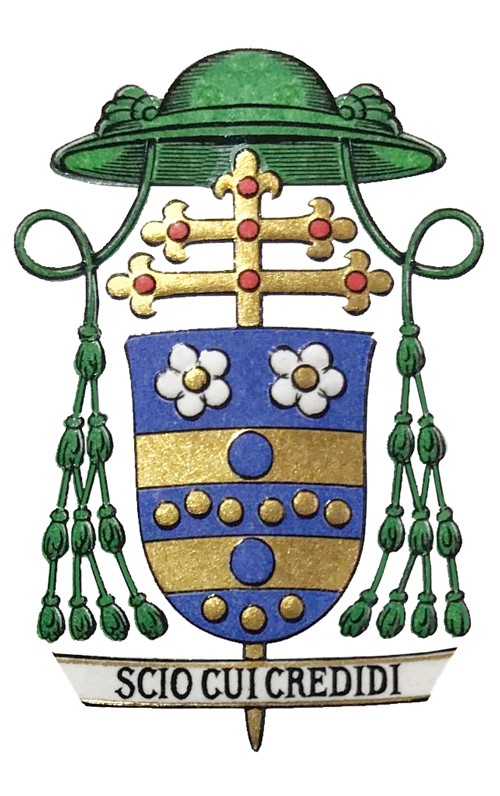
Archbishop Viganò’s Episcopal Coat of Arms

Dear Mr. Kokx,

I read with lively interest your article “Questions for Viganò: His Excellency is Right about Vatican II, But What Does He Think Catholic Should Do Now?” which was published by Catholic Family News on August 22 (here). I am happy to respond to your questions, which address matters that are very important for the faithful.

You ask: “What would ‘separating’ from the Conciliar Church look like in Archbishop Viganò’s opinion?” I respond to you with another question: “What does it mean to separate from the Catholic Church according to the supporters of the Council?” While it is clear that no admixture is possible with those who propose adulterated doctrines of the conciliar ideological manifesto, it should be noted that the simple fact of being baptized and of being living members of the Church of Christ does not imply adherence to the conciliar team; this is true above all for the simple faithful and also for secular and regular clerics who, for various reasons, sincerely consider themselves Catholics and recognize the Hierarchy.

Instead, what needs to be clarified is the position of those who, declaring themselves Catholic, embrace the heterodox doctrines that have spread over these decades, with the awareness that these represent a rupture with the preceding Magisterium. In this case it is licit to doubt their real adherence to the Catholic Church, in which however they hold official roles that confer authority on them. It is an illicitly exercised authority, if its purpose is to force the faithful to accept the revolution imposed since the Council.

Once this point has been clarified, it is evident that it is not the traditional faithful – that is, true Catholics, in the words of Saint Pius X – that must abandon the Church in which they have the full right to remain and from which it would be unfortunate to separate; but rather the Modernists who usurp the Catholic name, precisely because it is only the bureaucratic element that permits them not to be considered on a par with any heretical sect. This claim of theirs serves in fact to prevent them from ending up among the hundreds of heretical movements that over the course of the centuries have believed to be able to reform the Church at their own pleasure, placing their pride ahead of humbly guarding the teaching of Our Lord. But just as it is not possible to claim citizenship in a homeland in which one does not know its language, law, faith and tradition; so it is impossible that those who do not share the faith, morals, liturgy, and discipline of the Catholic Church can arrogate to themselves the right to remain within her and even to ascend the levels of the hierarchy.

Therefore let us not give in to the temptation to abandon – albeit with justified indignation – the Catholic Church, on the pretext that it has been invaded by heretics and fornicators: it is they who must be expelled from the sacred enclosure, in a work of purification and penance that must begin with each one of us.

It is also evident that there are widespread cases in which the faithful encounter serious problems in frequenting their parish church, just as there are ever fewer churches where the Holy Mass is celebrated in the Catholic Rite. The horrors that have been rampant for decades in many our parishes and shrines make it impossible even to assist at a “Eucharist” without being disturbed and putting one’s faith at risk, just as it is very difficult to ensure a Catholic education, Sacraments being worthily celebrated, and solid spiritual guidance for oneself and one’s children. In these cases faithful laity have the right and the duty to find priests, communities, and institutes that are faithful to the perennial Magisterium. And may they know how to accompany the laudable celebration of the liturgy in the Ancient Rite with adherence to sound doctrine and morals, without any subsidence on the front of the Council.

The situation is certainly more complex for clerics, who depend hierarchically on their bishop or religious superior, but who at the same time have the right to remain Catholic and be able to celebrate according to the Catholic Rite. On the one hand laity have more freedom of movement in choosing the community to which they turn for Mass, the Sacraments, and religious instruction, but less autonomy because of the fact that they still have to depend on a priest; on the other hand, clerics have less freedom of movement, since they are incardinated in a diocese or order and are subject to ecclesiastical authority, but they have more autonomy because of the fact that they can legitimately decide to celebrate the Mass and administer the Sacraments in the Tridentine Rite and to preach in conformity with sound doctrine. The Motu Proprio Summorum Pontificum reaffirmed that faithful and priests have the inalienable right – which cannot be denied – to avail themselves of the liturgy that more perfectly expresses their Catholic Faith. But this right must be used today not only and not so much to preserve the extraordinary form of the rite, but to testify to adherence to the depositum fidei that finds perfect correspondence only in the Ancient Rite.

I daily receive heartfelt letters from priests and religious who are marginalized or transferred or ostracized because of their fidelity to the Church: the temptation to find an ubi consistam [a place to stand] far from the clamor of the Innovators is strong, but we ought to take an example from the persecutions that many saints have undergone, including Saint Athanasius, who offers us a model of how to behave in the face of widespread heresy and persecuting fury. As my venerable brother Bishop Athanasius Schneider has many times recalled, the Arianism that afflicted the Church at the time of the Holy Doctor of Alexandria in Egypt was so widespread among the bishops that it leaves one almost to believe that Catholic orthodoxy had completely disappeared. But it was thanks to the fidelity and heroic testimony of the few bishops who remained faithful that the Church knew how to get back up again. Without this testimony, Arianism would not have been defeated; without our testimony today, Modernism and the globalist apostasy of this pontificate will not be defeated.

It is therefore not a question of working from within the Church or outside it: the winemakers are called to work in the Lord’s Vineyard, and it is there that they must remain even at the cost of their lives; the pastors are called to pastor the Lord’s Flock, to keep the ravenous wolves at bay and to drive away the mercenaries who are not concerned with the salvation of the sheep and lambs.

This hidden and often silent work has been carried out by the Society of Saint Pius X, which deserves recognition for not having allowed the flame of Tradition to be extinguished at a moment in which celebrating the ancient Mass was considered subversive and a reason for excommunication. Its priests have been a healthy thorn in the side for a hierarchy that has seen in them an unacceptable point of comparison for the faithful, a constant reproach for the betrayal committed against the people of God, an inadmissible alternative to the new conciliar path. And if their fidelity made disobedience to the pope inevitable with the episcopal consecrations, thanks to them the Society was able to protect herself from the furious attack of the Innovators and by its very existence it allowed the possibility of the liberalization of the Ancient Rite, which until then was prohibited. Its presence also allowed the contradictions and errors of the conciliar sect to emerge, always winking at heretics and idolaters but implacably rigid and intolerant towards Catholic Truth.

I consider Archbishop Lefebvre an exemplary confessor of the Faith, and I think that by now it is obvious that his denunciation of the Council and the modernist apostasy is more relevant than ever. It should not be forgotten that the persecution to which Archbishop Lefebvre was subjected by the Holy See and the world episcopate served above all as a deterrent for Catholics who were refractory toward the conciliar revolution.

I also agree with the observation of His Excellency Bishop Bernard Tissier de Mallerais about the co-presence of two entities in Rome: the Church of Christ has been occupied and eclipsed by the modernist conciliar structure, which has established itself in the same hierarchy and uses the authority of its ministers to prevail over the Spouse of Christ and our Mother.

The Church of Christ – which not only subsists in the Catholic Church, but is exclusively the Catholic Church – is only obscured and eclipsed by a strange extravagant Church established in Rome, according to the vision of Blessed Anne Catherine Emmerich. It coexists, like wheat with the tare, in the Roman Curia, in dioceses, in parishes. We cannot judge our pastors for their intentions, nor suppose that all of them are corrupt in faith and morals; on the contrary, we can hope that many of them, hitherto intimidated and silent, will understand, as confusion and apostasy continue to spread, the deception to which they have been subjected and will finally shake off their slumber. There are many laity who are raising their voice; others will necessarily follow, together with good priests, certainly present in every diocese. This awakening of the Church militant – I would dare to call it almost a resurrection – is necessary, urgent and inevitable: no son tolerates his mother being outraged by the servants, or his father being tyrannized by the administrators of his goods. The Lord offers us, in these painful situations, the possibility of being His allies in fighting this holy battle under His banner: the King Who is victorious over error and death permits us to share the honor of triumphal victory and the eternal reward that derives from it, after having endured and suffered with Him.

But in order to deserve the immortal glory of Heaven we are called to rediscover – in an emasculated age devoid of values such as honor, faithfulness to one’s word, and heroism – a fundamental aspect of the faith of every baptized person: the Christian life is a militia, and with the Sacrament of Confirmation we are called to be soldiers of Christ, under whose insignia we must fight. Of course, in most cases it is essentially a spiritual battle, but over the course of history we have seen how often, faced with the violation of the sovereign rights of God and the liberty of the Church, it was also necessary to take up arms: we are taught this by the strenuous resistance to repel the Islamic invasions in Lepanto and on the outskirts of Vienna, the persecution of the Cristeros in Mexico, of the Catholics in Spain, and even today by the cruel war against Christians throughout the world. Never as today can we understand the theological hatred coming from the enemies of God, inspired by Satan. The attack on everything that recalls the Cross of Christ – on Virtue, on the Good and the Beautiful, on purity – must spur us to get up, in a leap of pride, in order to claim our right not only not to be persecuted by our external enemies but also and above all to have strong and courageous pastors, holy and God-fearing, who will do exactly what their predecessors have done for centuries: preach the Gospel of Christ, convert individuals and nations, and expand the Kingdom of the living and true God throughout the world.

We are all called to make an act of Fortitude – a forgotten cardinal virtue, which not by chance in Greek recalls virile strength, ἀνδρεία – in knowing how to resist the Modernists: a resistance that is rooted in Charity and Truth, which are attributes of God.

If you only celebrate the Tridentine Mass and preach sound doctrine without ever mentioning the Council, what can they ever do to you? Throw you out of your churches, perhaps, and then what? No one can ever prevent you from renewing the Holy Sacrifice, even if it is on a makeshift altar in a cellar or an attic, as the refractory priests did during the French Revolution, or as happens still today in China. And if they try to distance you, resist: canon law serves to guarantee the government of the Church in the pursuit of its primary purposes, not to demolish it. Let’s stop fearing that the fault of the schism lies with those who denounce it, and not, instead, with those who carry it out: the ones who are schismatics and heretics are those who wound and crucify the Mystical Body of Christ, not those who defend it by denouncing the executioners!

The laity can expect their ministers to behave as such, preferring those who prove that they are not contaminated by present errors. If a Mass becomes an occasion of torture for the faithful, if they are forced to assist at sacrileges or to support heresies and ramblings unworthy of the House of the Lord, it is a thousand times preferable to go to a church where the priest celebrates the Holy Sacrifice worthily, in the rite given to us by Tradition, with preaching in conformity with sound doctrine. When parish priests and bishops realize that the Christian people demand the Bread of Faith, and not the stones and scorpions of the neo-church, they will lay aside their fears and comply with the legitimate requests of the faithful. The others, true mercenaries, will show themselves for what they are and will be able to gather around them only those who share their errors and perversions. They will be extinguished by themselves: the Lord dries up the swamp and makes the land on which brambles grow arid; he extinguishes vocations in corrupt seminaries and in convents rebellious to the Rule.

The lay faithful today have a sacred task: to comfort good priests and good bishops, gathering like sheep around their shepherds. Give them hospitality, help them, console them in their trials. Create community in which murmuring and division do not predominate, but rather fraternal charity in the bond of Faith. And since in the order established by God – κόσμος – subjects owe obedience to authority and cannot do otherwise than resist it when it abuses its power, no fault will be attributed to them for the infidelity of their leaders, on whom rests the very serious responsibility for the way in which they exercise the vicarious power which has been given to them. We must not rebel, but oppose; we must not be pleased with the errors of our pastors, but pray for them and admonish them respectfully; we must not question their authority but the way in which they use it.

I am certain, with a certainty that comes to me from Faith, that the Lord will not fail to reward our fidelity, after having punished us for the faults of the men of the Church, granting us holy priests, holy bishops, holy cardinals, and above all a holy Pope. But these saints will arise from our families, from our communities, from our churches: families, communities, and churches in which the grace of God must be cultivated with constant prayer, with the frequenting of Holy Mass and the Sacraments, with the offering of sacrifices and penances that the Communion of Saints permits us to offer to the Divine Majesty in order to expiate our sins and those of our brethren, including those who exercise authority. The laity have a fundamental role in this, guarding the Faith within their families, in such a way that our young people who are educated in love and in the fear of God may one day be responsible fathers and mothers, but also worthy ministers of the Lord, His heralds in the male and female religious orders, and His apostles in civil society.

The cure for rebellion is obedience. The cure for heresy is faithfulness to the teaching of Tradition. The cure for schism is filial devotion for the Sacred Pastors. The cure for apostasy is love for God and His Most Holy Mother. The cure for vice is the humble practice of virtue. The cure for the corruption of morals is to live constantly in the presence of God. But obedience cannot be perverted into stolid servility; respect for authority cannot be perverted into the obeisance of the court. And let’s not forget that if it is the duty of the laity to obey their Pastors, it is even a more grave duty of the Pastors to obey God, usque ad effusionem sanguinis.

+ Carlo Maria Viganò, Archbishop

September 1s, 2020

Translated by Giuseppe Pellegrino

source: https://catholicfamilynews.com/blog/2020/09/01/breaking-news-archbishop-vigano-responds-to-questions-posed-by-cfn/

Disappointment With Viganò

inveritateimagefinal2

AUGUST 19, 2020 BY BP. SANBORN
Disappointment With Viganò
Here and here, I spoke about the statements of Novus Ordo Archbishop Viganò. These were cerebral and succinct condemnations of the Second Vatican Council and of the effluent from that dreadful meeting.

In a recent statement to the Remnant, however, which is a recognize-and resist publication, the Archbishop took the position of what I would call recognize and ignore. He says, essentially, that Vatican II can just be ignored. Its false teachings do not matter since there were no definitions of dogma, and therefore are fallible statements.

This idea, that the only things which we are bound to believe are solemnly defined doctrines, defined either by the pope alone (ex cathedra) or by a general council in union with the pope, is a very serious error. For it neglects the much more common way of teaching, which is by universal ordinary magisterium (UOM). Doctrines which are taught by UOM are just as much the object of divine faith as solemnly defined dogmas, and therefore just as infallible. To doubt or deny them would be heresy.

A review of universal ordinary magisterium. The Vatican Council of 1870 taught this: “By divine and Catholic faith, all those things must be believed which are contained in the word of God, either written or handed down, and which are proposed by the Church either in a solemn pronouncement or in her ordinary and universal magisterium, to be believed as divinely revealed.”

Let us examine the statement. The Church gives various conditions for the requirement that something be believed by divine and Catholic faith. (1) The first is that what is taught be found either in Sacred Scripture or Tradition, at least implicitly; (2) the second is that the doctrine be proposed either by a solemn pronouncement or by the universal and ordinary magisterium; (3) the third is that the Church propose it as something to be believed as divinely revealed.

What is divine and Catholic faith? Divine faith is a supernatural assent to whatever God reveals, whether it is contained in Sacred Scripture or Tradition. Therefore everything in Sacred Scripture is the object of divine faith. For example, Saint Paul, in II Timothy IV: 13 says: “The cloak that I left at Troas, with Carpus, when thou comest, bring with thee, and the books, especially the parchments.” Because Sacred Scripture is the inspired word of God, we believe with divine faith that St. Paul did indeed leave his cloak at Troas with Carpus.

The Church, however, does not explicitly propose for belief, in her magisterium, everything that is in divine revelation, but only certain things. Those things which she proposes for belief, taken from revelation, are the object of divine and Catholic faith. This means that the universal Church (i.e., “Catholic” meaning universal) must make public profession of the proposed doctrines, under pain of the crime of heresy.

The Church may do this proposition of doctrine in two ways: (1) by solemn pronouncement; (2) by the universal ordinary magisterium.

By far the more common way in which the Church teaches is by the UOM. Indeed, it is the ordinary way.

What is the UOM? It is the doctrine which is taught by the pope and at least the majority of bishops, dispersed throughout the world, which is contained in revelation, at least implicitly, and which is proposed for belief as being divinely revealed.
Pope Pius XI
Notice I say doctrine. People commonly make the mistake of asking, “Is the encyclical infallible?” A document is not infallible, but a doctrine is infallible. The pope and the bishops may choose any kind of organ of communication, even verbal, such as sermons or allocutions. In these forms of communication there is usually a whole array of doctrines, ranging from the lowest level, what is merely the pope’s opinions [1], to the highest level, which is solemn magisterium. In the encyclical Casti Connubii Pius XI spoke mostly about exhortations to virtue in married life. But when it came to artificial birth control, he made a solemn statement, condemning the practice. So it is necessary to look at the doctrine, and how it is proposed, to determine whether or not it is the object of divine and Catholic faith. The document, or the organ of presentation in general, has no bearing.

How is the universal ordinary magisterium exercised? It happens in various ways: in the creeds in common use in the Catholic Church, as well as other professions of Faith, in sermons given by the pope and diocesan bishops; by doctrines contained in approved catechisms; by the common teaching of approved theologians; by approved liturgical feasts and practices; by devotions approved by local bishops.

There could be other ways. The important elements are that (1) the pope teaches it; (2) the majority of bishops teach it. For example, there is no solemn pronouncement that Guardian Angels exist. Yet, by the universal celebration of the feast, it is part of the universal ordinary magisterium. The same was true of the Assumption of the Blessed Virgin Mary before its solemn definition in 1950. Nearly all of the Church’s moral teaching is by means of the UOM.

A sign of UOM is that the faithful throughout the world believe it, and have always believed it. The reason why they believe it is that it has been taught to them universally by the hierarchy of the Catholic Church. The reason why they have always believed it is that the Church never contradicts herself, but always teaches the same thing.

Does Vatican II contain UOM? Absolutely it does. While most of it is just nonsensical gobbledygook, endless and boring verbiage, and juxtaposed antithetical statements, there are certain things in it which fulfill the conditions.

Most glaring is religious liberty. It fulfills, first of all, the condition that it is about morals, for a right concerns morals. Secondly, the text says: “This Vatican Council declares that the human person has a right to religious freedom. This freedom means that all men are to be immune from coercion on the part of individuals or of social groups and of any human power, in such wise that no one is to be forced to act in a manner contrary to his own beliefs, whether privately or publicly, whether alone or in association with others, within due limits.” [emphasis added] The word declares is indicative of an authoritative statement. Third, it cites divine revelation: “The council further declares that the right to religious freedom has its foundation in the very dignity of the human person as this dignity is known through the revealed word of God and by reason itself.” [emphasis added] The document is terminated by these words: “Each and every thing which in this Declaration has been declared has pleased the Fathers of the Sacred Council, and We, by the apostolic power given to Us by Christ, approve, decree, and establish those things in the Holy Ghost, together with the venerable Fathers, and We decree and order that those things which have been established in a synodal way be promulgated for God’s glory.” It is signed by Paul VI.

All of the bishops of the world promulgated this decree. It fulfills all of the conditions of UOM. It is therefore of divine and Catholic faith and is infallible — according to the rules. In fact it is a blasphemous heresy.

To understand what I just said, merely substitute the word “abortion” for “religious liberty,” and you will grasp it right away.

The SSPX attempts to whitewash the doctrine of religious liberty, however. Although Archbishop Lefebvre considered it heretical, the SSPX interprets it to mean that the Church should not force conversions. Of course the Church teaches this, but this is clearly not the sense of the document.

Proof is that in a few paragraphs down, the Council gives the right to false religions to propagate themselves and found their own communities: “Provided the just demands of public order are observed, religious communities rightfully claim freedom in order that they may govern themselves according to their own norms, honor the Supreme Being in public worship, assist their members in the practice of the religious life, strengthen them by instruction, and promote institutions in which they may join together for the purpose of ordering their own lives in accordance with their religious principles.”
The worship of the Golden Calf
The Council grants people, in other words, the right to blaspheme God by a false religion. This is utterly contrary to Sacred Scripture, as we see God’s anger at the Hebrews’ adoration of the Golden Calf. At God’s command, 23,000 were put to the sword for their idolatry. (Exodus 32) According to Vatican II, they should have had the right to honor the Supreme Being — the Calf — in public worship, instruct their people in the worship of the Calf, train clergy for Golden Calf worship, and establish religious orders and institutions for the cult of the Golden Calf .

There are many other cases in the Old Testament of God’s anger with false religions. In the New Testament, Our Lord predicted that Jerusalem would be destroyed because it knew not the time of its visitation, that is, the visitation of the Son of God. Approximately one million perished in 70 A.D. for infidelity to the true God and the true Son of God. The punishment for infidelity to the true religion was far more severe in the New Testament than in the Old.

Vatican II cannot be ignored. I have given only one example of why Vatican II is universal ordinary magisterium, and why it cannot be “ignored.” To recognize Vatican II as a true Council promulgated by a true pope is to destroy the Catholic Church’s seamless garment of consistency in teaching infallible truth throughout the ages.

Ignoring Vatican II demolishes the Roman Catholic Church altogether, and makes all of the arguments in defense of her divine origin and her perpetual divine assistance and protection completely worthless, false, null, and void.

The only way out of Vatican II is the painful declaration that it was the work of Modernist infiltrators in the hierarchy, starting with John XXIII and continuing up to and including Francis, and that all of the acts of these so-called pontiffs are null.

[1] Pius XII in his Christmas message of 1956, for example, expressed the desire that the U.N. be given more authority and strengthened [!] Obviously this is only his opinion, and not UOM.


via Disappointment With Viganò

The Gates of Hell

Purgatorynovena (2)

“The Gates of the netherworld shall not prevail against it: the netherworld (Greek Hades, the abode of the dead) is conceived of as a walled city who’s gates will not close in upon the church of Jesus, ie., it will not be overcome by the power of death.”

This version has been misquoted and misapplied by more Catholics than I care to think. What does it really mean, and how can we better understand its meaning?

Above is a direct quote from the New American Bible study notes.  Why then do most Catholics try to make this verse apply to the invincibility of the Roman Catholic Church?  As if God could not bring extreme judgment on us if we deserve it.

This verse is more readily applicable to the doctrine of the communion of the saints.  Which Catholic teaching supports as the saints in heaven, purgatory, and here on earth. Also the Gospels tell how because Christ was the first to conquer death, it has no power over us as Christians.

Baptist of Blood and Desire

2019-cmri-masthead-revised
“From the teachings of the Popes, the Council of Trent, the 1917 Code of Canon Law, the Roman Martyrology, the Fathers, Doctors and Theologians of the Church
1. COUNCIL OF TRENT (1545-1563)

Canons on the Sacraments in General (Canon 4):
“If anyone shall say that the sacraments of the New Law are not necessary for salvation, but are superfluous, and that although all are not necessary for every individual, without them or without the desire of them (sine eis aut eorum voto), through faith alone men obtain from God the grace of justiflcation; let him be anathema.”

Decree on Justification (Session 6, Chapter 4):
“In these words a description of the justification of a sinner is given as being a translation from that state in which man is born a child of the first Adam to the state of grace and of the ‘adoption of the Sons’ (Rom. 8:15) of God through the second Adam, Jesus Christ, our Savior and this translation after the promulgation of the Gospel cannot be effected except through the layer of regeneration or a desire for it, (sine lavacro regenerationis aut eius voto) as it is written: ‘Unless a man be born again of water and the Holy Spirit, he cannot enter in the kingdom of God’ (John 3:5).”

2. ST. ALPHONSUS LIGUORI (1691-1787)

Moral Theology (Bk. 6):
“But baptism of desire is perfect conversion to God by contrition or love of God above all things accompanied by an explicit or implicit desire for true Baptism of water, the place of which it takes as to the remission of guilt, but not as to the impression of the [baptismal] character or as to the removal of all debt of punishment. It is called “of wind␅ [flaminis] because it takes place by the impulse of the Holy Ghost Who is called a wind [flamen]. Now it is de fide that men are also saved by Baptism of desire, by virtue of the Canon Apostolicam De Presbytero Non Baptizato and the Council of Trent, Session 6, Chapter 4, where it is said that no one can be saved “without the laver of regeneration or the desire for it.”

3. 1917 CODE OF CANON LAW On Ecclesiastical Burial (Canon 1239. 2)

“Catechumens who, through no fault of their own, die without Baptism, are to be treated as baptized.” — The Sacred Canons
by Rev. John A. Abbo. St.T.L., J.C.D., and Rev. Jerome D. Hannan, A.M., LL.B., S.T.D., J.C.D.

Commentary on the Code:
“The reason for this rule is that they are justly supposed to have met death united to Christ through Baptism of desire.”

4. POPE INNOCENT III

Apostolicam:
To your inquiry we respond thus: We assert without hesitation (on the authority of the holy Fathers Augustine and Ambrose) that the priest whom you indicated (in your letter) had died without the water of baptism, because he persevered in the faith of Holy Mother the Church and in the confession of the name of Christ, was freed from original sin and attained the joy of the heavenly fatherland. Read (brother) in the eighth book of Augustine’s City of God where among other things it is written, “Baptism is ministered invisibly to one whom not contempt of religion but death excludes.” Read again the book also of the blessed Ambrose concerning the death of Valentinian where he says the same thing. Therefore, to questions concerning the dead, you should hold the opinions of the learned Fathers, and in your church you should join in prayers and you should have sacrifices offered to God for the priest mentioned (Denzinger 388).

Debitum pastoralis officii, August 28, 1206:
You have, to be sure, intimated that a certain Jew, when at the point of death, since he lived only among Jews, immersed himself in water while saying: “I baptize myself in the name of the Father, and of the Son, and of the Holy Spirit. Amen.”

We respond that, since there should be a distinction between the one baptizing and the one baptized, as is clearly gathered from the words of the Lord, when He says to the Apostles: “Go baptize all nations in the name etc.” (cf. Matt. 28:19), the Jew mentioned must be baptized again by another, that it may be shown that he who is baptized is one person, and he who baptizes another… If, however, such a one had died immediately, he would have rushed off to his heavenly home without delay because of the faith of the sacrament, although not because of the sacrament of faith (Denzinger 413).

5. POPE ST. PIUS V (1566-1572)

Ex omnibus afflictionibus, October 1, 1567
Condemned the following erroneous propositions of Michael du Bay:

Perfect and sincere charity, which is from a “pure heart and good conscience and a faith not feigned” (1 Tim. 1:5) can be in catechumens as well as in penitents without the remission of sins.
That charity which is the fullness of the law is not always connected with the remission of sins.
A catechumen lives justly and rightly and holily, and observes the commandments of God, and fulfills the law through charity, which is only received in the laver of Baptism, before the remission of sins has been obtained.
6. ST. AMBROSE

“I hear you express grief because he [Valentinian] did not receive the Sacrament of Baptism. Tell me, what else is there in us except the will and petition? But he had long desired to be initiated… and expressed his intention to be baptized… Surely, he received [it] because he asked [for it].”

7. ST. AUGUSTINE, City of God

“I do not hesitate to place the Catholic catechumen, who is burning with the love of God, before the baptized heretic… The centurion Cornelius, before Baptism, was better than Simon [Magus], who had been baptized. For Cornelius, even before Baptism, was filled with the Holy Ghost, while Simon, after Baptism, was puffed up with an unclean spirit” (De Bapt. C. Donat., IV 21).

8. ST. THOMAS AQUINAS

Summa, Article 1, Part III, Q. 68:
“I answer that, the sacrament of Baptism may be wanting to someone in two ways. First, both in reality and in desire; as is the case with those who neither are baptized, nor wished to be baptized: which clearly indicates contempt of the sacrament, in regard to those who have the use of the free will. Consequently those to whom Baptism is wanting thus, cannot obtain salvation: since neither sacramentally nor mentally are they incorporated in Christ, through Whom alone can salvation be obtained.

“Secondly, the sacrament of Baptism may be wanting to anyone in reality but not in desire: for instance, when a man wishes to be baptized, but by some ill-chance he is forestalled by death before receiving Baptism. And such a man can obtain salvation without being actually baptized, on account of his desire for Baptism, which desire is the outcome of faith that worketh by charity, whereby God, Whose power is not yet tied to visible sacraments, sanctifies man inwardly. Hence Ambrose says of Valentinian, who died while yet a catechumen: ‘I lost him whom I was to regenerate: but he did not lose the graces he prayed for.’”

9. ST. ROBERT BELLARMINE, Doctor of the Church (1542-1621)

Liber II, Caput XXX:
“Boni Catehecumeni sunt de Ecclesia, interna unione tantum, non autem externa”(Good catechumens are of the Church, by internal union only, not however, by external union).

10. Roman Martyrology

January 23: At Rome, St. Emerentiana, Virgin and Martyr, who was stoned by the heathen while still a catechumen, when she was praying at the tomb of St. Agnes, whose foster-sister she was.

April 12: At Braga, in Portugal, St. Victor, Martyr, who, while still yet a catechumen, refused to worship an idol, and confessed Christ Jesus with great constancy, and so after many torments, he merited to be baptized in his own blood, his head being cut off.

11. POPE PIUS IX (1846-1878) — Singulari Quadam, 1854:

174. “It must, of course, be held as a matter of faith that outside the apostolic Roman Church no one can be saved, that the Church is the only ark of salvation, and that whoever does not enter it will perish in the flood. On the other hand, it must likewise be held as certain that those who are affected by ignorance of the true religion, if it is invincible ignorance, are not subject to any guilt in this matter before the eyes of the Lord. Now, then, who could presume in himself an ability to set the boundaries of such ignorance, taking into consideration the natural differences of peoples, lands, native talents, and so many other factors? Only when we have been released from the bonds of this body and see God just as He is (see John 3:2) all we really understand how close and beautiful a bond joins divine mercy with divine justice.”

Quanto Conficiamur Moerore (1863):
“…We all know that those who are afflicted with invincible ignorance with regard to our holy religion, if they carefully keep the precepts of the natural law that have been written by God in the hearts of men, if they are prepare to obey God, and if they lead a virtuous and dutiful life, can attain eternal life by the power of divine light and grace.”

12. POPE PIUS XII (1939-1958) — Mystical Body of Christ (June 29, 1943):

“As you know, Venerable Brethren, from the very beginning of Our Pontificate We have committed to the protection and guidance of heaven those who do not belong to the visible organization of the Catholic Church, solemnly declaring that after the example of the Good Shepherd We desire nothing more ardently than that they may have life and have it more abundantly… For even though unsuspectingly they are related to the Mystical Body of the Redeemer in desire and resolution, they still remain deprived of so many precious gifts and helps from heaven, which one can only enjoy in the Catholic Church.”

13. FR. A. TANQUERY, Dogmatic Brevior; ART. IV, Section I, II – 1945 (1024-1)

The Baptism of Desire. Contrition, or perfect charity, with at least an implicit desire for Baptism, supplies in adults the place of the baptism of water as respects the forgiveness of sins.

This is certain.

Explanation: a) An implicit desire for Baptism, that is, one that is included in a general purpose of keeping all the commandments of God is, as all agree, sufficient in one who is invincibly ignorant of the law of Baptism; likewise, according to the more common opinion, in one who knows the necessity of Baptism.

b) Perfect charity, with a desire for Baptism, forgives original sin and actual sins, and therefore infuses sanctifying grace; but it does not imprint the Baptismal character and does not of itself remit the whole temporal punishment due for sin; whence, when the Unity offers, the obligation remains on
one who was sanctified in this manner of receiving the Baptism of water.

14. FR. DOMINIC PRUMMER, O.P., Moral Theology, 1949:

“Baptism of Desire which is a perfect act of charity that includes at least implicitly the desire for Baptism by water”;
“Baptism of Blood which signifies martyrdom endured for Christ prior to the reception of Baptism by Water”;
“Regarding the effects of Baptism of Blood and Baptism of Desire… both cause sanctifying grace. …Baptism of Blood usually remits all venial sin and temporal punishment…”
15. FR. FRANCIS O’CONNELL, Outlines of Moral Theology, 1953:

“Baptism of Desire… is an act of divine charity or perfect contrition…”
“These means (i.e. Baptism of Blood and Desire) presuppose in the recipient at least the implicit will to receive the sacrament.”
“…Even if an infant can gain the benefit of the Baptism of Blood if he is put to death by a person actuated by hatred for the Christian faith….”
16. MGR. J. H. HERVE, Manuale Theologiae Dogmaticae (Vol. III: chap. IV), 1931

II. On those for whom Baptism of water can be supplied:

The various baptisms: from the Tridentinum itself and from the things stated, it stands firm that Baptism is necessary, yet in fact or in desire; therefore in an extraordinary case it can be supplied. Further, according to the Catholic doctrine, there are two things by which the sacrament of Baptism can be supplied: namely, an act of perfect charity with the desire of Baptism, and the death as martyr. Since these two are a compensation for Baptism of water, they themselves are called Baptism, too, in order that they may be comprehended with it under one, as it were, generic name, so the act of love with desire for Baptism is called Baptismus flaminis (Baptism of the Spirit) and the martyrium (Baptism of Blood).

17. FR. H. NOLDEN, S.J., FR. A. SCHMIT, S.J. — Summa theologiae moralis (Vol. III de Sacramentis), Book 2 Quaestio prima, 1921

Baptism of spirit (flaminis) is perfect charity or contrition, in which the desire in fact to receive the sacrament of Baptism is included; perfect charity and perfect contrition, however, have the power to confer sanctifying grace.

18. FR. ARTHUR VERMEERSCH, S.J., Theologiae Moralis (Vol. III), Tractatus II,1948:

The Baptism of spirit (flaminis) is an act of perfect charity or contrition, in so far as it contains at least a tacit desire of the Sacrament. Therefore it can be had only in adults. It does not imprint a character; …but it takes away all mortal sin together with the sentence of eternal penalty, according to: “He who loves me, is loved by my Father” (John 14:21).

19. FR. LUDOVICO BILLOT, S.J., De Ecclesiae Sacmmentis (Vol. I); Quaestio LXVI; Thesis XXIV – 1931:

Baptism of spirit (flaminis), which is also called of repentance or of desire, is nothing else than an act of charity or perfect contrition including a desire of the Sacrament, according to what has been said above, namely that the heart of everyone is moved by the Holy Ghost to believe, and to love God, and to be sorry for his sins.

20. FR. ALOYSIA SABETTI, S.J., FR. TIMOTHEO BARRETT, S.J., Compendium Theologiae Moralis, Tractatus XII [De Baptismo, Chapter I, 1926:

Baptism, the gate and foundation of the Sacraments, in fact or at least in desire, is necessary for all unto salvation…

From the Baptism of water, which is called of river (Baptismus fluminis), is from Baptism of the Spirit (Baptismus flaminis) and Baptism of Blood, by which Baptism properly speaking can be supplied, if this be impossible. The first one is a full conversion to God through perfect contrition or charity, in so far as it contains an either explicit or at least implicit will to receive Baptism of water… Baptism of Spirit (flaminis) and Baptism of Blood are called Baptism of desire (in voto).

21. FR. EDUARDUS GENICOT, S.]., Theologiae Moralis Institutiones (Vol. II),Tractatus XII, 1902

Baptism of the Spirit (flaminis) consists in an act of perfect charity or contrition, with which there is always an infusion of sanctifying grace connected…

Both are called “of desire” (in voto)…; perfect charity, because it has always connected the desire, at least the implicit one, of receiving this sacrament, absolutely necessary for salvation.”(https://cmri.org/articles-on-the-traditional-catholic-faith/baptism-of-blood-and-of-desire/)

The Mystery of Iniquity

By: Rodney Ford

73404024_1368280293339711_8312791180001673216_n

2 Thessalonians 2:7-9
Douay-Rheims 1899 American Edition
“7 For the mystery of iniquity already worketh; only that he who now holdeth, do hold, until he be taken out of the way.

8 And then that wicked one shall be revealed whom the Lord Jesus shall kill with the spirit of his mouth; and shall destroy with the brightness of his coming, him,

9 Whose coming is according to the working of Satan, in all power, and signs, and lying wonders,”

The Mystery of Iniquity is already at work, says St. Paul.  How are we to understand this?  I have found some guidance from the Catechism:

The Church’s ultimate trial

“675 Before Christ’s second coming the Church must pass through a final trial that will shake the faith of many believers.574 The persecution that accompanies her pilgrimage on earth575 will unveil the “mystery of iniquity” in the form of a religious deception offering men an apparent solution to their problems at the price of apostasy from the truth. The supreme religious deception is that of the Antichrist, a pseudo-messianism by which man glorifies himself in place of God and of his Messiah come in the flesh.576

676 The Antichrist’s deception already begins to take shape in the world every time the claim is made to realize within history that messianic hope which can only be realized beyond history through the eschatological judgment. The Church has rejected even modified forms of this falsification of the kingdom to come under the name of millenarianism,577 especially the “intrinsically perverse” political form of a secular messianism.578

677 The Church will enter the glory of the kingdom only through this final Passover, when she will follow her Lord in his death and Resurrection.579 The kingdom will be fulfilled, then, not by a historic triumph of the Church through a progressive ascendancy, but only by God’s victory over the final unleashing of evil, which will cause his Bride to come down from heaven.580 God’s triumph over the revolt of evil will take the form of the Last Judgment after the final cosmic upheaval of this passing world.”(C.C.C)

So this ultimate trial may only happen when “that he who now holdeth, do hold, until he be taken out of the way.“And who is this one who now holdeth?  None other than the Pope himself.

If the Pope could be taken out of the way, evil would prevail over the earth in a way unimaginable to our forefathers.  And it seems as though that is what has happened to our glorious Church.  Since 1958 ,after the death of Pius XII, the world has been in the grip of a diabolical disorientation never seen before by mere man.

The person occupying the Apostolic See is no longer formally the pope: He no longer has any divinely assisted Pontifical authority; he however remains materially a pope insofar as he has not been juridically deposed.(known as Sedeprivationism)

Let us suppose that the New Order popes held only materially the Papal office, while not holding formally the chair of Peter. This is the conclusion of Fr. Bernard Lucien in his “Thesis Cassiciacum.” That the occupant of the chair of Peter is not formally Pope.

“It would appear, then, that the Chair is not totally vacant, nor is it completely full. The new order popes possess some legal aspect as popes but lack the authority to teach and rule on matters of faith and morals. In the face of this situation, the proper response of all faithful Catholics is to believe what Catholics have always believed and to do what Catholics have always done. We cannot go wrong doing that!” (Fr. Ronald Ringrose, St. Athanasius Church Bulletins of Jan. 14, Jan. 21, Jan. 28, 2018; bold print and italics given.)

“As universal pastor, he cannot err when he teaches on matters of faith and morals. How then, are faithful Catholics to explain the appearance that the pope has erred since Vatican II? Here are some of the attempts that have been made over the years. Some of you old timers will no doubt remember them.

– It is the liberal bishops and not the pope who are responsible.

– The council was ambiguous and the wrong interpretation has been given.

– The real pope is being held captive and a look-alike imposter has taken over.

– The pope didn’t speak ex cathedra.

– The council was only a pastoral council.

– Nowadays it seems that it can sometimes happen that the pope teaches error. When he does, we must continue to recognize his authority, but hold fast and resist whatever erroneous teaching or evil commands he may give.

– The pope and bishops have embraced the apostasy of the new religion and have thereby lost their offices. All the seats are empty, including that of the pope and we are today without any hierarchy whatsoever.

We understand that as glaring as some of these errors may seem today, they were the best answers that were available at the time. Only in time and with further reflection, did the error of these answers become apparent. Let us consider this last error, which many now call sedevacantism (Latin for “the see being vacant”). The popular name for this error is borrowed from the term that is used between the death of one pope and the election of a new one. Good Catholics, who believed the idea that all the seats are vacant, did so only to be faithful to the promise of Christ that the religion any pope would teach the Universal Church would be guaranteed by His own word and the power of the Holy Ghost. However, while defending this one truth of Christ, they unwittingly fell into an error contrary to another teaching of the Church, that the Hierarchy is perpetual, that it will last to the end of time, and that Peter will have perpetual successors. The pope and the Hierarchy cannot simply be gone! Therefore, this explanation must be rejected by Catholics.” (Fr. Ronald Ringrose, St. Athanasius Church Bulletins )

[Sedevacantism has never formally been rejected by the Magisterium of the Church, therefore Catholics are free to debate these issues which are not decided dogma.]

Catholic teaching that Christ has given to Peter and his successors a unique role in the Church as Universal Pastor. In this role as teacher Our Lord has promised that he who hears Peter hears Him. Recognizing this promise, the Church has infallibly taught that Peter and his successors cannot teach error to the Universal Church any more than Christ can. So Christ guarantees that Peter will never teach error and Peter has the special assistance of the Holy Ghost to carry this out.

In light of all the errors propagated by the Novus Ordo sect, it is clear to him who has eyes to see that this church is no longer the Catholic Church, but some anti-church headed by an anti-pope.[Some of these modernist ‘Popes’ may have been only material heretics, I will leave that for God’s ultimate judgment]

A Church Without Dogma

The architects of Vatican II, by their modernist philosophy, created a church without dogma. Reckless use of ambiguity and subtly destroyed the Vatican documents and it was to intentionally destroy the faith in the minds of the faithful. “For, by his Incarnation, he, the son of God, in a certain way united himself with each man.”(John Paul II, Redemptor Hominid) This quote from John Paul II is a definite sign of his

humanistic and modernist views. He also said,”The sin of the killing of Christ on the cross has redeemed us.” Or how about, “Christ is in every man.” On January 11, 1989 he said,”…that the part of the creed talking about Christ descending into hell can be interpreted metaphorically.”

“How does a Catholic sin against faith? A Catholic sins against the faith by apostasy, heresy, indifferentism, and by taking part in non-Catholic worship.”(Catechism of Trent, Catechism of Pope St. Pius X, Baltimore Catechism) Canon Law states: It is not permitted at all for faithful to assist in any active manner or have any part in the worship of non-Catholics.( Canon 1258)

False Ecumenism

All of these ,so called, Popes expressed views that showed their religious indifference. As if all roads lead to heaven. This shows also the influence of Masonic false ecumenism. True Catholic dogma does not teach this.

“It firmly believes, professes and preaches that all those who are outside the catholic church, not only pagans but also Jews or heretics and schismatics, cannot share in eternal life and will go into the everlasting fire which was prepared for the devil and his angels, unless they are joined to the catholic church before the end of their lives;”{Pope Eugene IV, Council of Florence, Cantate Domino, 1441, ex cathedra}

So why do these Popes continue to contradict this clear teaching of the extraordinary magisterium? Let’s look at some examples:

The kissing of the Qur-an (the “holy” books of the false religion of Islam) by Pope John Paul the Second scandalized thousands in the Catholic Church. Add the public dethroning of Christ: the Assisi blasphemy, where the devotees of every false god known to man were invited to stand alongside Peter. Surely we are witnessing the“Diabolical disorientation of the Church, starting at the top,” of which Our Lady forewarned us at Fatima?[Essay by Don McGovern with acknowledgement to by the Remnant]

This is the contradiction I was talking about, Ecumenism and interfaith dialogue always implies or at least encourages the heresy of Indifferentism, according to which it does not matter what religion one professes, as long as one has good will or shares certain beliefs or“values” in common. Until the death of Pope Pius XII in 1958, the Catholic Church always opposed the ecumenical movement and offered as her own alternative the conversion of all non-Catholics to the only true Church, which has been instituted by God as the sole means of salvation.

“One must resist the Pope who openly destroys the Church.”(St. Cajetan) These post-councilor Popes are all modernist who, by their own public manifest heresy, have put themselves outside the Catholic Church.

Defection of the faith is accomplished by public heresy “Ipso facto” without any declaration. From any ecclesiastical office.(Council of Constance) So, even though Vatican I says,”a Pope cannot be judged by anyone.” The Pope is judged by his own actions. Once heresy is public, then that person ceases to be a member of the Church. [Pope Innocent III] Therefore he ceases to be Pope. This is a “de fide” Catholic teaching of the Church according to St. Robert Bellarmine, all the early Church Fathers taught this through the ordinary Magisterium.

St. Robert Bellarmine,( De Romano Pontifice, II, 30:) “For, in the first place, it is proven with arguments from authority and from reason that the manifest heretic is ‘ipso facto’ deposed. The argument from authority is based on St. Paul (Titus 3:10), who orders that the heretic be avoided after two warnings, that is, after showing himself to be manifestly obstinate – which means before any excommunication or judicial sentence. And this is what St. Jerome writes, adding that the other sinners are excluded from the Church by sentence of excommunication, but the heretics exile themselves and separate themselves by their own act from the body of Christ.”

St. Robert Bellarmine, (De Romano Pontifice, II, 30:) “This principle is most certain. The non-Christian cannot in any way be Pope, as Cajetan himself admits (ib. c. 26). The reason for this is that he cannot be head of what he is not a member; now he who is not a Christian is not a member of the Church, and a manifest heretic is not a Christian, as is clearly taught by St. Cyprian (lib. 4, epist. 2), St. Athanasius (Scr. 2 cont. Arian.), St. Augustine (lib. De great. Christ. Cap. 20), St. Jerome (contra Lucifer.) and others; therefore the manifest heretic cannot be Pope.

“When foulness invades the whole Church we must return to the Church of the past.”(St. Vincent of Lerins) Pope St. Pius X also wrote the famed Oath Against Modernism which was required to be sworn to by clergy and others in the Church,and sought to warn the faithful before it was too late. Much work was done to extinguish modernist trends of thought within the Church thanks to this most venerable and saintly Pope, and to this day, he remains the most important saint to have ever fought against the poisonous infections of the movement.(https://www.catholicgentlem…

While many devout Catholic people reside in the so called Roman Catholic Church, the Novus Ordo rite is a new religion. Not Catholic! I am not relying on my own personal interpretation, but that of the Church. This does not include the blasphemous teachings of the post-councilor Popes. I apologize, but “to be silent before error is to be repulsive to God.”

So this is why today dogma is frowned upon in the Church. Christ is just one among many gods! What a shame. The most painful part is the unwillingness for the laity to see the truth that they have been deceived.

Conclusion

After looking at the evidence of 50 years of modernist anti-Christ Pope’s, can we truely say the Pope, the vicar of Christ, has been taken out of the way?  In the Apocalypse we get a glimpse of what may be happening with the Councillor ‘popes’.

Douay-Rheims Bible(Apocalypse 17:1-13)
The Woman on the Beast

1And there came one of the seven angels, who had the seven vials, and spoke with me, saying: Come, I will shew thee the condemnation of the great harlot, who sitteth upon many waters, 2With whom the kings of the earth have committed fornication; and they who inhabit the earth, have been made drunk with the whine of her whoredom. 3And he took me away in spirit into the desert. And I saw a woman sitting upon a scarlet coloured beast, full of names of blasphemy, having seven heads and ten horns. 4And the woman was clothed round about with purple and scarlet, and gilt with gold, and precious stones and pearls, having a golden cup in her hand, full of the abomination and filthiness of her fornication. 5And on her forehead a name was written: A mystery; Babylon the great, the mother of the fornications, and the abominations of the earth. 6And I saw the woman drunk with the blood of the saints, and with the blood of the martyrs of Jesus. And I wondered, when I had seen her, with great admiration.

The Mystery Explained

7And the angel said to me: Why dost thou wonder? I will tell thee the mystery of the woman, and of the beast which carrieth her, which hath the seven heads and ten horns.

8The beast, which thou sawest, was, and is not, and shall come up out of the bottomless pit, and go into destruction: and the inhabitants on the earth (whose names are not written in the book of life from the foundation of the world) shall wonder, seeing the beast that was, and is not. 9And here is the understanding that hath wisdom. The seven heads are seven mountains, upon which the woman sitteth, and they are seven kings: 10Five are fallen, one is, and the other is not yet come: and when he is come, he must remain a short time. 11And the beast which was, and is not: the same also is the eighth, and is of the seven, and goeth into destruction. 12And the ten horns which thou sawest, are ten kings, who have not yet received a kingdom, but shall receive power as kings one hour after the beast. 13These have one design: and their strength and power they shall deliver to the beast.

The seven kings can be viewed as the anti-Christ ‘Popes’ staring with: John XXIII, Paul VI, John Paul I, John Paul II, Benedict XVI, Francis I, and ending with the man of sin; Anti-Christ.  But that only makes seven.  However, we know that:

“Five are fallen, one is, and the other is not yet come: and when he is come, he must remain a short time. And the beast which was, and is not: the same also is the eighth, and is of the seven, and goeth into destruction.”

When Benedict XVI dies, the five will have fallen.  The one that is, Francis I, and the other not yet come.(This would be the last ‘pope’, and may well be one of the seven reincarnated, which makes eight.  The eighth(the beast) is one of the seven.  Knowing that the anti-Christ will have to parallel the resurrection of Christ, he will be one of these seven reincarnated.  For elsewhere in Revelation 13:3 we find:

“And I saw one of his heads as it were slain to death: and his death’s wound was healed. And all the earth was in admiration after the beast.”

We must also remember the words of Our Lady of La Salette:

“Rome will lose the faith and become the seat of the Antichrist.”

Eschatological View of Catholicism

site_logo

HTML> The Holy SeeCatechism of the Catholic Church
PART ONE
THE PROFESSION OF FAITH

SECTION TWO
THE PROFESSION OF THE CHRISTIAN FAITH

CHAPTER TWO
I BELIEVE IN JESUS CHRIST, THE ONLY SON OF GOD

ARTICLE 7
“FROM THENCE HE WILL COME AGAIN TO JUDGE THE LIVING AND THE DEAD”

I. HE WILL COME AGAIN IN GLORY

Christ already reigns through the Church. . .

668 “Christ died and lived again, that he might be Lord both of the dead and of the living.”549 Christ’s Ascension into heaven signifies his participation, in his humanity, in God’s power and authority. Jesus Christ is Lord: he possesses all power in heaven and on earth. He is “far above all rule and authority and power and dominion”, for the Father “has put all things under his feet.”550 Christ is Lord of the cosmos and of history. In him human history and indeed all creation are “set forth” and transcendently fulfilled.551

669 As Lord, Christ is also head of the Church, which is his Body.552 Taken up to heaven and glorified after he had thus fully accomplished his mission, Christ dwells on earth in his Church. The redemption is the source of the authority that Christ, by virtue of the Holy Spirit, exercises over the Church. “The kingdom of Christ [is] already present in mystery”, “on earth, the seed and the beginning of the kingdom”.553

670 Since the Ascension God’s plan has entered into its fulfillment. We are already at “the last hour”.554 “Already the final age of the world is with us, and the renewal of the world is irrevocably under way; it is even now anticipated in a certain real way, for the Church on earth is endowed already with a sanctity that is real but imperfect.”555 Christ’s kingdom already manifests its presence through the miraculous signs that attend its proclamation by the Church.556

. . .until all things are subjected to him

671 Though already present in his Church, Christ’s reign is nevertheless yet to be fulfilled “with power and great glory” by the King’s return to earth.557 This reign is still under attack by the evil powers, even though they have been defeated definitively by Christ’s Passover.557 Until everything is subject to him, “until there be realized new heavens and a new earth in which justice dwells, the pilgrim Church, in her sacraments and institutions, which belong to this present age, carries the mark of this world which will pass, and she herself takes her place among the creatures which groan and travail yet and await the revelation of the sons of God.”559 That is why Christians pray, above all in the Eucharist, to hasten Christ’s return by saying to him:560 Marana tha! “Our Lord, come!”561

672 Before his Ascension Christ affirmed that the hour had not yet come for the glorious establishment of the messianic kingdom awaited by Israel562 which, according to the prophets, was to bring all men the definitive order of justice, love and peace.563 According to the Lord, the present time is the time of the Spirit and of witness, but also a time still marked by “distress” and the trial of evil which does not spare the Church564 and ushers in the struggles of the last days. It is a time of waiting and watching.565

The glorious advent of Christ, the hope of Israel

673 Since the Ascension Christ’s coming in glory has been imminent,566 even though “it is not for you to know times or seasons which the Father has fixed by his own authority.”567. This eschatological coming could be accomplished at any moment, even if both it and the final trial that will precede it are “delayed”.568

674 The glorious Messiah’s coming is suspended at every moment of history until his recognition by “all Israel”, for “a hardening has come upon part of Israel” in their “unbelief” toward Jesus.569 St. Peter says to the Jews of Jerusalem after Pentecost: “Repent therefore, and turn again, that your sins may be blotted out, that times of refreshing may come from the presence of the Lord, and that he may send the Christ appointed for you, Jesus, whom heaven must receive until the time for establishing all that God spoke by the mouth of his holy prophets from of old.”570 St. Paul echoes him: “For if their rejection means the reconciliation of the world, what will their acceptance mean but life from the dead?”571 The “full inclusion” of the Jews in the Messiah’s salvation, in the wake of “the full number of the Gentiles”,572 will enable the People of God to achieve “the measure of the stature of the fullness of Christ”, in which “God may be all in all”.573

The Church’s ultimate trial

675 Before Christ’s second coming the Church must pass through a final trial that will shake the faith of many believers.574 The persecution that accompanies her pilgrimage on earth575 will unveil the “mystery of iniquity” in the form of a religious deception offering men an apparent solution to their problems at the price of apostasy from the truth. The supreme religious deception is that of the Antichrist, a pseudo-messianism by which man glorifies himself in place of God and of his Messiah come in the flesh.576

676 The Antichrist’s deception already begins to take shape in the world every time the claim is made to realize within history that messianic hope which can only be realized beyond history through the eschatological judgment. The Church has rejected even modified forms of this falsification of the kingdom to come under the name of millenarianism,577 especially the “intrinsically perverse” political form of a secular messianism.578

677 The Church will enter the glory of the kingdom only through this final Passover, when she will follow her Lord in his death and Resurrection.579 The kingdom will be fulfilled, then, not by a historic triumph of the Church through a progressive ascendancy, but only by God’s victory over the final unleashing of evil, which will cause his Bride to come down from heaven.580 God’s triumph over the revolt of evil will take the form of the Last Judgment after the final cosmic upheaval of this passing world.581

* II. TO JUDGE THE LIVING AND THE DEAD

678 Following in the steps of the prophets and John the Baptist, Jesus announced the judgment of the Last Day in his preaching.582 Then will the conduct of each one and the secrets of hearts be brought to light.583 Then will the culpable unbelief that counted the offer of God’s grace as nothing be condemned.584 Our attitude to our neighbor will disclose acceptance or refusal of grace and divine love.585 On the Last Day Jesus will say: “Truly I say to you, as you did it to one of the least of these my brethren, you did it to me.”586

679 Christ is Lord of eternal life. Full right to pass definitive judgment on the works and hearts of men belongs to him as redeemer of the world. He “acquired” this right by his cross. The Father has given “all judgment to the Son”.587 Yet the Son did not come to judge, but to save and to give the life he has in himself.588 By rejecting grace in this life, one already judges oneself, receives according to one’s works, and can even condemn oneself for all eternity by rejecting the Spirit of love.589

IN BRIEF

680 Christ the Lord already reigns through the Church, but all the things of this world are not yet subjected to him. The triumph of Christ’s kingdom will not come about without one last assault by the powers of evil.

681 On Judgment Day at the end of the world, Christ will come in glory to achieve the definitive triumph of good over evil which, like the wheat and the tares, have grown up together in the course of history.

682 When he comes at the end of time to judge the living and the dead, the glorious Christ will reveal the secret disposition of hearts and will render to each man according to his works, and according to his acceptance or refusal of grace.

549 Rom 14:9.
550 Eph 1:20-22.
551 Eph 1:10; cf. 4:10; 1 Cor 15:24,27-28.
552 Cf. Eph 1:22.
553 LG 3; 5; cf. Eph 4:11-13.
554 1 Jn 2:18; cf. 1 Pet 4:7.
555 LG 48 § 3; cf. 1 Cor 10:11.
556 Cf. Mk 16:17-18,20.
557 Lk 21:27; cf. Mt 25:31.
558 Cf. 2 Thess 2:7.
559 LG 48 § 3; cf. 2 Pet 3:13; Rom 8:19-22; 1 Cor 15:28.
560 Cf. 1 Cor 11:26; 2 Pet 3:11-12.
561 1 Cor 16:22; Rev 22:17,20.
562 Cf. Acts 1:6-7.
563 Cf. Isa 11:1-9.
564 Cf. Acts 1:8; 1 Cor 7:26; Eph 5:16; 1 Pet 4:17.
565 Cf. Mt 25:1, 13; Mk 13:33-37; 1 Jn 2:18; 4:3; 1 Tim 4:1.
566 Cf. Rev 22:20.
567 Acts 1:7; Cf. Mk 13:32.
568 Cf. Mt 24:44; 1 Thess 5:2; 2 Thess 2:3-12.
569 Rom 11:20-26; cf. Mt 23:39.
570 Acts 3:19-21.
571 Rom 11:15.
572 Rom 11:12, 25; cf. Lk 21:24.
573 Eph 4:13; 1 Cor 15:28.
574 Cf. Lk 18:8; Mt 24:12.
575 Cf. Lk 21:12; Jn 15:19-20.
576 Cf. 2 Thess 2:4-12; 1 Thess 5:2-3; 2 Jn 7; 1 Jn 2:18,22.
577 Cf. DS 3839.
578 Pius XI, Divini Redemptoris, condemning the “false mysticism” of this “counterfeit of the redemption of the lowly”; cf. GS 20-21.
579 Cf. Rev 19:1-9.
580 Cf Rev 13:8; 20:7-10; 21:2-4.
581 Cf. Rev 20:12 2 Pet 3:12-13.
582 Cf. Dan 7:10; Joel 3-4; Mal 3:19; Mt 3:7-12.
583 Cf Mk 12:38-40; Lk 12:1-3; Jn 3:20-21; Rom 2:16; 1 Cor 4:5.
584 Cf. Mt 11:20-24; 12:41-42.
585 Cf. Mt 5:22; 7:1-5.
586 Mt 25:40.
587 Jn 5:22; cf. 5:27; Mt 25:31; Acts 10:42; 17:31; 2 Tim 4:1.
588 Cf. Lk 21:12; Jn 15:19-20.
589 Cf. Jn 3:18; 12:48; Mt 12:32; 1 Cor 3:12-15; Heb 6:4-6; 10:26-31.

previous page table of contents next page